“`html
Scientists have built a cell from scratch for the first time that can feed, grow, and replicate like a natural cell. This breakthrough in synthetic biology could usher in an era of made-to-order organisms that function like living machines, reports BritPanorama.
Kate Adamala, a synthetic biologist and professor at the University of Minnesota, and her team constructed the cell piece by piece from nonliving chemical components. The creation is a limited and fragile prototype, but it could help scientists better understand the origins of life and could potentially be programmed to address some of the world’s major biological challenges. The cell is nonspecific—neither plant nor animal—but closely resembles a simple bacterium.
“I know the full ingredient list of the cell, I know exactly what chemicals, what molecules at what concentrations,” she said. “It is fully defined, which means we can engineer it.”
For decades, researchers have bioengineered natural cells to solve human problems. A notable example is how human insulin genes can be inserted into E. coli bacterial cells to manufacture insulin and treat diabetes. Plus, scientists argue that synthetic cells represent the next frontier; they have the potential to lead to new cancer treatments and novel methods of carbon capture or chemical manufacturing.
Cells are fundamental building blocks of life, but they are complex structures. The human body contains approximately 37 trillion cells—more than the number of stars in the sky—and scientists still lack complete understanding of how each different cell type operates or what exactly they contain.
The synthetic cell built by Adamala and her colleagues was not lifelike but rather a “genuine milestone on the road to that question,” said Yuval Elani, an associate professor in biochemical technologies at Imperial College London, who was not involved in the research.
“Building a cell from scratch means you are no longer tied to the constraints and evolutionary baggage of natural biology,” Elani added. “It opens up the possibility of designing systems and programming them to perform tasks that living cells may not do easily, or may not do at all.”
“To my mind, this is a real advance in the long-running effort to ask whether chemistry can be organized so convincingly that we begin to call it life,” Elani stated.
The field of synthetic biology operates separately from stem cell research, where scientists reprogram and manipulate existing cells derived from biological resources.
‘An incredibly wimpy organism’
Adamala named her creation “SpudCell,” partly as a joke, not wanting it named after herself, and as a nod to Sputnik, the Russian satellite that marked the onset of the space age in the 1950s.
“We’re hoping we’re really starting the true age of bioeconomy, enabling technology that will let people engineer biology,” she remarked.
On Wednesday, Adamala and her colleagues made public the scientific paper detailing how SpudCell operates, though it has not yet undergone peer review. Adamala noted that it would be submitted for publication this week. Together with Drew Endy, Jan Jedryszek, and biotech entrepreneur Chris Raggio, Adamala founded a public-benefit institution called Biotic to advance synthetic cell capabilities by making the cell available to other researchers.
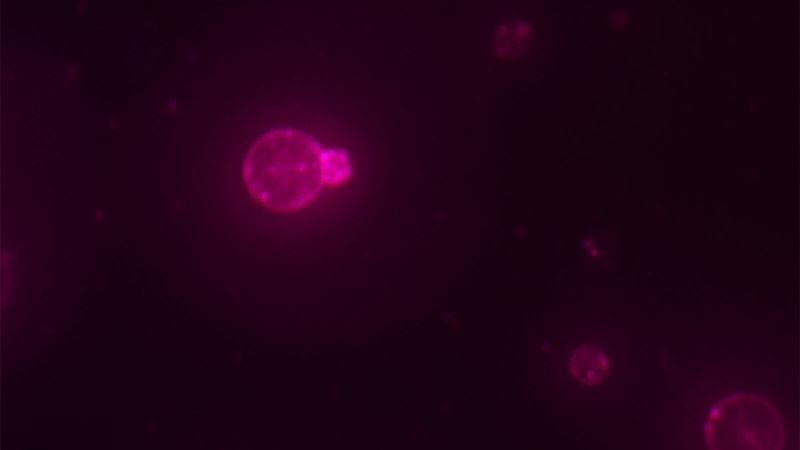
Composed of 150 to 200 molecules, SpudCell feeds, grows, and replicates for about five generations. It is significantly less complex than a biological cell, which contains millions, if not billions, of molecules.
Adamala described SpudCell as “an incredibly wimpy organism that right now basically does nothing other than eat and occasionally make a daughter cell.” Each generation requires feeding and takes roughly 12 hours to replicate at a temperature of 30 degrees Celsius (86 degrees Fahrenheit). By contrast, E. coli divides every 30 minutes.
The genome of SpudCell is substantially smaller than that of a natural cell, featuring just 90,000 base pairs, compared to E. coli’s genome, which has 4.6 million base pairs. While it can replicate like a natural cell, SpudCell employs a distinct mechanism. A natural cell utilizes a cytoskeleton—an essential structural framework—while SpudCell lacks one, instead producing proteins that accumulate at the membrane, causing it to divide.
SpudCell cannot independently synthesize ribosomes, crucial components of natural cells responsible for producing proteins. Instead, it relies on E. coli ribosomes provided through feeding.
“It’s just the beginning,” said Adamala. “It’s a chassis that we’re hoping to build on, and that’s significant, because now we actually can have some reasonable idea of how to build on it.”
Elani noted that although the synthetic cell does not fully mirror a natural cell, this lack is not necessarily a defect. “Some of these lifelike behaviours are achieved by mechanisms quite unlike those used in biology,” he explained via email. “Synthetic biology is not always about imitation; it often allows us to pursue alternative approaches and shortcuts.”
Other scientists not involved in the study characterized the work as an exciting advancement. “SpudCell straddles the line between a pile of chemicals and a naturally evolved cell,” noted Elizabeth Strychalski, a group leader at the US National Institute of Standards and Technology’s National Cellular Engineering Group. She called the research “important and impressive,” and emphasized its potential utility.
Tom Ellis, a professor of synthetic genome engineering at Imperial College London, described the development as “probably the largest breakthrough in recent times in the synthetic cell field.”
“Making a synthetic cell helps us understand the exact minimum requirements for life and how life might have emerged from chemistry—that’s a remarkable pursuit,” he added via email.
Chenli Liu, a distinguished professor at the Shenzhen Institutes of Advanced Technology and founding director of China’s State Key Laboratory for Quantitative Synthetic Biology, acknowledged that synthetic cell research is a rapidly evolving field, but emphasized that meaningful assessments are premature prior to its publication in a peer-reviewed scientific journal.
Is it life?
A key achievement of this research is demonstrating that synthetic cells are subject to selective forces—the process by which particular traits become more or less prevalent. When researchers introduced a genetic change that enhanced the production of a growth protein, cells with this alteration grew and divided more rapidly. However, as this variation was introduced to the system and did not emerge as a spontaneous genetic mutation, SpudCell cannot be considered to “evolve.”
Nor can SpudCell be classified as life, according to Endy, an associate professor of bioengineering at Stanford University and a cofounder of Biotic who was not involved in Adamala’s research.
“We don’t fully grasp the complexities of life, let alone have the capacity to manipulate matter to create it,” Endy stated, noting that while physicists still grapple with the mysteries of gravity, engineers can construct bridges.
In its current form, SpudCell does not pose any biosafety risks and could not, for instance, be harnessed to produce a biological weapon. “It can only divide if you provide everything, including ribosomes. It has no ability to self-reproduce outside of that context,” Endy clarified.
The researchers acknowledged that while SpudCell fosters a future where cell construction may become more accessible, potential safety and security concerns also arise. “Do we have to manage these concerns effectively? Yes,” he asserted.
Adamala and Endy further indicated that since SpudCell may be constructed from the ground up, safeguards and fail-safes could be engineered into its genome to mitigate safety risks in the event of an environmental release. Moreover, they noted that there exist far simpler methods for malicious figures to create pathogenic organisms.
Scientists have also cautioned against the potential emergence of mirror bacteria—synthetic organisms with reversed molecular structures. Such “mirror cells” could pose risks to humans, animals, and plants, exposing them to hazardous pathogens.
Through Biotic, which plans to license the core technology, Endy and Adamala aim for SpudCell to establish a global standard for synthetic cell biology, akin to open-source operating systems such as Linux.
Laurie Zoloth, a professor of religion and ethics at the University of Chicago, noted that the establishment of Biotic may help to address some ethical dilemmas emerging alongside new technologies: Who benefits? Who governs its use? Who enforces regulations?
“We will have to see how it endures in its initial, idealistic form,” Zoloth remarked. “I hope it does.”
Ellis from Imperial College London posited that a standard and shareable framework could accelerate collaborative scientific progress. “However,” he added, “I’m uncertain whether the findings in this paper will garner widespread support globally.”
“The quest for a synthetic cell is a common objective among numerous teams worldwide, yet their methodologies and definitions of success can markedly differ.”
Adamala concludes that