A fossil that had been in storage for decades has been identified as the first dinosaur remains ever discovered in Antarctica, reports BritPanorama.
The vertebra was originally found in 1985 by a British Antarctic Survey (BAS) expedition and initially attributed to a large reptile, according to a statement from London’s Natural History Museum. The significance of this discovery has gained attention following new research that reassessed the fossil’s identity.
Mark Evans, a palaeontologist and manager of the geological collections at BAS, rediscovered the fossil while examining the collection. “It looks unusual, I just needed to make sure it was what I thought it was,” Evans said.
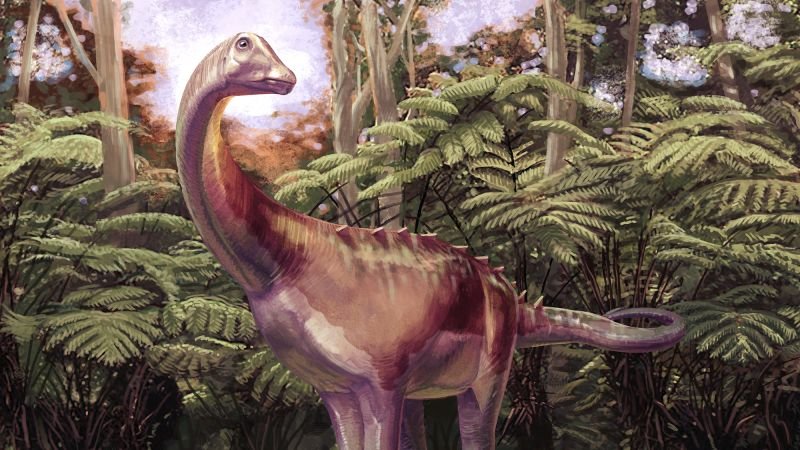
The vertebra belongs to a Titanosaur, a group of long-necked herbivorous dinosaurs that includes some of the largest species ever to roam the Earth. Typically, these dinosaurs weighed around 15 metric tons (16.5 US tons). The largest specimens reached lengths of approximately 37 meters (about 121 feet) and weighed around 63.5 metric tons (70 US tons).
This particular fossil, measuring about 10 centimeters (four inches) in diameter, would have belonged to a juvenile or small adult Titanosaur, likely around six to seven meters (20-23 feet) long. “This bone sat in a collection drawer for decades until new research revealed it for what it was: rare evidence that long-necked sauropod dinosaurs once lived in Antarctica,” stated Matthew C. Lamanna, Mary R. Dawson curator in vertebrate paleontology at the Carnegie Museum of Natural History.
Paul Barrett, a merit researcher at the Natural History Museum, emphasized its historical significance: “At first glance this appears to be an unremarkable fossil, but it holds an important place in the history of Antarctic exploration as the first dinosaur fossil found on the continent.” This dinosaur lived approximately 82 million years ago during the Late Cretaceous period.
Barrett further noted that when this animal existed, Antarctica was covered by lush temperate forests that would have provided ample food for large herbivores. However, the current ice cover limits fossil discoveries, though he expressed optimism for future finds as climate change continues to reshape the landscape.
“There are likely many more dinosaurs to be discovered on the continent. As climate change causes ice to retreat, we may indeed find further evidence of this past biodiversity,” he added.
The research enhances our understanding of dinosaur migration across southern continents. Samantha Beeston, a palaeontology doctoral student at University College London, remarked that during the Cretaceous period, Antarctica was part of the supercontinent Gondwana, suggesting that related species traversed between South America and Australia through the Antarctic region.
Outsized importance
Roy Smith, a lecturer in vertebrate palaeontology at the University of Portsmouth, described the discovery as a “wonderful reminder” of the scientific value of museum collections. He commented that “although this fossil is only a single vertebra, its significance is immense.”
Smith emphasized the fossil’s role as crucial evidence for understanding dinosaur dispersal across southern continents, highlighting that these creatures inhabited every continent on Earth.
“It also highlights the enduring scientific value of carefully curated museum collections, which continue to yield extraordinary discoveries decades after specimens are first collected,” Smith concluded.
Steve Brusatte, a professor of paleontology and evolution at the University of Edinburgh, who was not part of the research, acknowledged the importance of this finding, stating, “We know very little about the dinosaurs that once lived on Antarctica. This is just a single incomplete bone, but it has outsized importance.”
A paper detailing the fossil has been published in the journal Acta Palaeontologica Polonica.
This discovery opens a new chapter in our understanding of prehistoric life in Antarctica and its connections to global dinosaur populations.