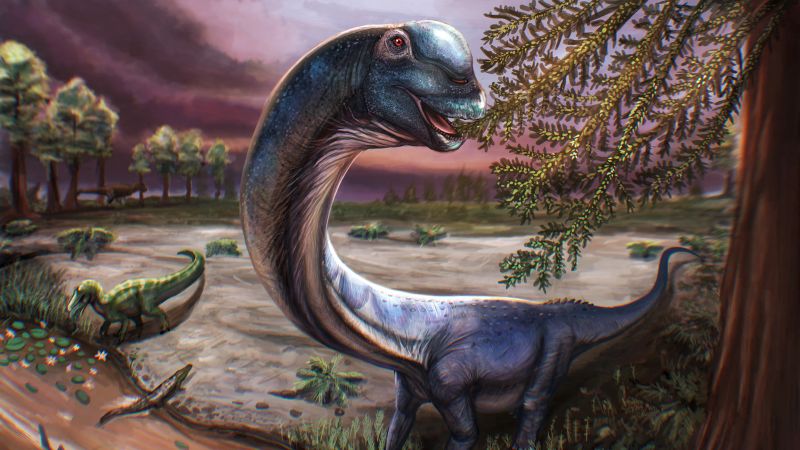
New dinosaur species discovered in Thailand
The discovery of bones at the edge of a pond in Thailand has led to the identification of a new type of dinosaur, with a massive size, long neck and tail, and a plant diet, reports BritPanorama.
Named “Nagatitan chaiyaphumensis” by researchers in Thailand and London, this reptile is the largest dinosaur ever uncovered in Southeast Asia. Weighing an estimated 27 metric tons — or almost 60,000 pounds — it spans approximately 27 meters long, or almost 89 feet, according to a study published in the journal Scientific Reports. For context, a large Tyrannosaurus rex would have weighed between 9,000 and 15,000 pounds and measured over 12 meters long (about 39 feet).
Nagatitan chaiyaphumensis belongs to a group of dinosaurs known as sauropods, which were the largest animals ever to walk on land. Among these large, plant-eating dinosaurs were notable species such as Diplodocus and Brontosaurus. The humerus, or front leg bone, of the newly discovered dinosaur measures 1.78 meters (almost six feet) long.
“We don’t have a lot of specimens that are of that scale in Thailand,” said lead study author Thitiwoot Sethapanichsakul, a PhD student at University College London. “When I first laid eyes on the humerus, it was taller than me, and that was quite surprising,” he continued, noting that this dinosaur is approximately double the size of another known sauropod species in Thailand.
Childhood dream fulfilled
The leg bone was among several fossils discovered by a local resident on the side of a communal pond in northeastern Thailand in 2016, during the dry season when water levels were low. Skeletal remains were excavated during fieldwork between 2016 and 2019, with further excavation taking place in 2024.
Researchers from UCL and Thailand’s Department of Mineral Resources, Mahasarakham University, and Suranaree University of Technology conducted 3D scans of the remains, which included leg bones, spine, ribs, and pelvis, ultimately revealing the species as previously unknown.
The name “Nagatitan” connects to a mythological serpent from South and Southeast Asian folklore, suggesting a fitting association with the water where the dinosaur was found. “Titan” draws from Greek mythology, alluding to the dinosaur’s size, while “chaiyaphumensis” references the Thai province in which it was discovered.
Sethapanichsakul remarked, “It fulfills a kind of childhood promise,” expressing his wish to name a dinosaur from Thailand.
Nagatitan likely existed during the late Early Cretaceous period, around 120 to 100 million years ago. It would have shared its environment with smaller, medium-sized plant-eating dinosaurs, similar to Iguanodons, as well as early forms of what would later be known as Ceratopsians, relatives of Triceratops.
The environment of that period was described as “very dry and warm,” with the discovery site representing a meandering river ecosystem that hosted various freshwater fauna. Sethapanichsakul emphasized that Thailand possesses significant dinosaur fossil diversity due to its thick layers of sedimentary rock from the Mesozoic Era, a feature that has helped preserve these remains.
A research center has now been established at the discovery site, and Sethapanichsakul continues his work on sauropods from Southeast Asia. A life-sized reconstruction of the Nagatitan chaiyaphumensis is currently displayed at the Thainosaur Museum in Bangkok.