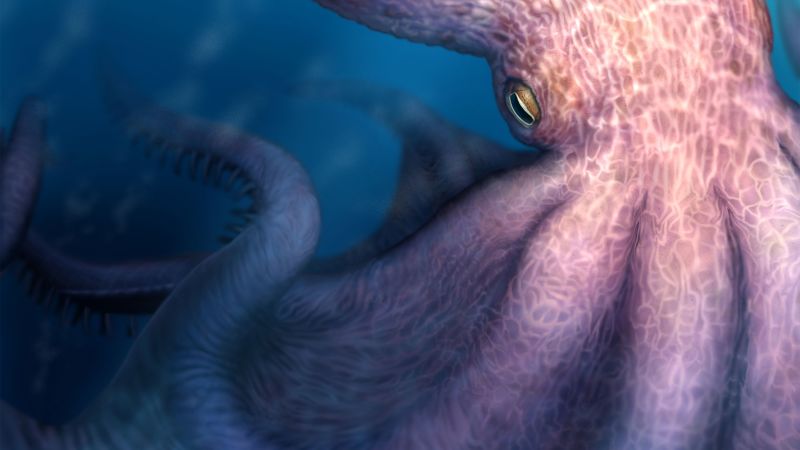
Giant octopuses measuring up to 62 feet (19 meters) in length were among the top ocean predators around 100 million years ago, according to new research that uncovered rare fossils hidden within solid rock, reports BritPanorama.
Remarkably well-preserved specimens of the octopuses’ powerful jaws show signs of intense wear from crushing hard prey including shells and bones, a study published in the journal Science on Thursday reveals. “This suggests that these giant octopuses may have functioned as apex predators in the Cretaceous sea,” study coauthor Yasuhiro Iba, an associate professor of Earth and planetary sciences at Japan’s Hokkaido University, stated.
The extinct animals, scientifically named Nanaimoteuthis, were about 23 to 62 feet (7 to 19 meters) in length, with researchers estimating their overall size by extrapolating from the size of the beak specimens. Iba explained that octopuses rarely fossilize because most of their bodies are soft, leaving only hard parts like the jaws likely to be preserved after death.
The fossils hint that octopuses may have occupied the top of the food web during the Cretaceous Period, previously dominated by vertebrate predators such as large marine reptiles, sharks, and fishes. “This indicates that Cretaceous marine ecosystems were more complex and included a wider range of top predators than previously thought,” Iba said.
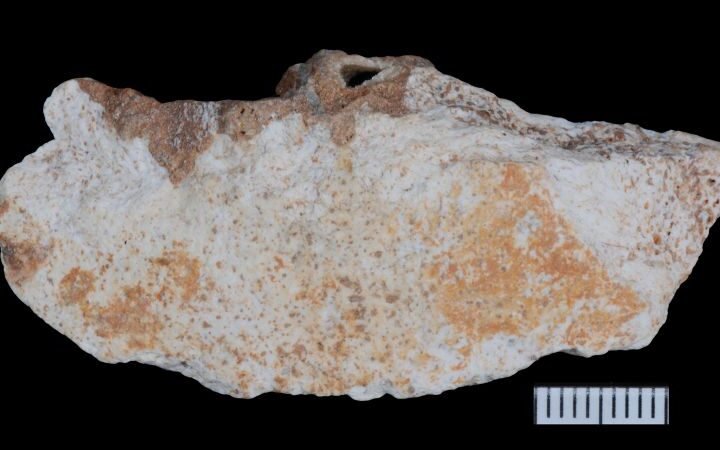
The study involved a fresh analysis of 15 huge jaw fossils found in Japan and Canada’s Vancouver Island. Additionally, the team unearthed 12 fossilized octopus jaws encased in sedimentary rock from the Cretaceous Period using a 3D-imaging technique called grinding tomography to create high-resolution datasets and an AI model.
Iba described this approach as a “digital fossil mining” technique, producing 3D models of the jaw fossils. “Within this ecosystem, Nanaimoteuthis likely used its large body and long arms to capture prey, and its powerful jaws to process hard food,” he added.
Taking into account its size, the fossil evidence suggests that Nanaimoteuthis may have been an apex predator. Tim Coulson, professor of zoology at the University of Oxford, remarked that the animals “could have crunched through bones of large fish and possibly marine reptiles, as well as shells.”
Jakob Vinther, associate professor of macroevolution at the University of Bristol, described the research as a “pretty amazing find.” However, he added that it does not definitively prove that Nanaimoteuthis hunted large marine reptiles, questioning whether such large prey would have made sense for these octopuses.
Vinther noted, “It would have taken the octopuses a long time to break down and ingest large animals, and they could have met their energetic needs by feeding on relatively small prey.” He concluded that despite these limitations, Nanaimoteuthis likely served as a formidable predator of the time.
The ongoing analysis highlights the need for further exploration into ancient ecosystems, suggesting that digital fossil mining could help discover organisms that are currently undetectable in the fossil record.