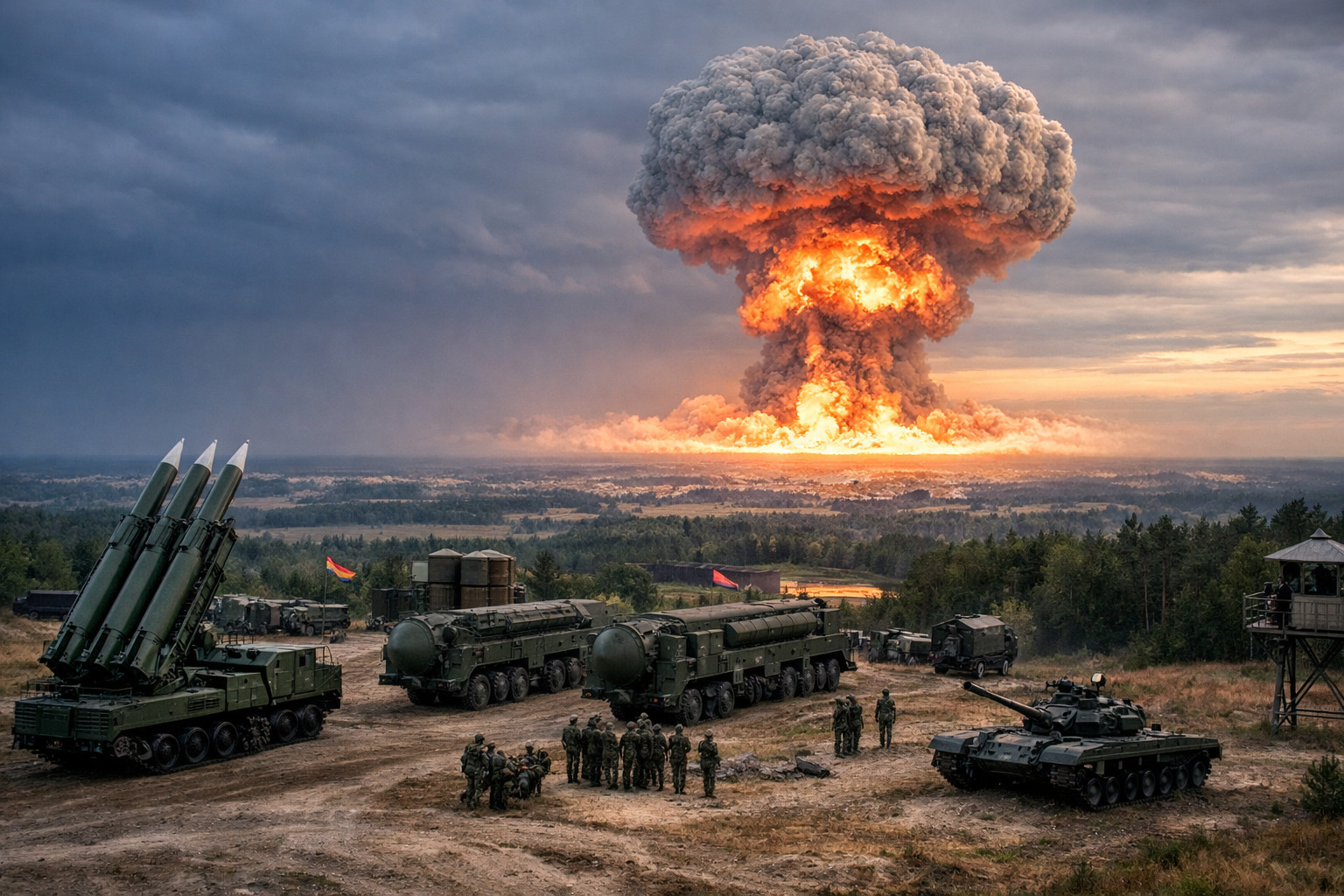
The self-proclaimed president of Belarus, Alexander Lukashenko, has threatened neighbouring states with the potential use of nuclear weapons in response to what he termed aggression against his country. In an interview with the Russian state-controlled broadcaster RT, Mr Lukashenko stated that Minsk would employ “all that is available,” including tactical nuclear arms, should its survival be at risk, specifically naming Poland and the Baltic nations. The remarks underscore Belarus’s deepening integration into Russia’s military framework and represent a significant escalation in regional tensions.
Lukashenko’s bellicose interview statements
Speaking on 20 April 2026, Mr Lukashenko asserted that the Kremlin could not afford to lose Belarus, describing it as a crucial strategic shield between Russia and the West. He referenced a Russian military grouping in western regions of Russia that stands ready to swiftly support the Belarusian army. While claiming Belarus harbours no plans to attack Poland or the Baltic states, he warned that any perceived aggression would result in a joint war with Russia. The Belarusian leader’s declaration that his forces would use every weapon in its arsenal marks one of his most explicit nuclear threats to date.
Regional context and Ukrainian warnings
The threat follows recent alerts from Ukrainian President Volodymyr Zelenskyy concerning military construction along the Belarusian border. President Zelenskyy stated that roads were being built towards Ukrainian territory and artillery positions established, suggesting another potential attempt by Moscow to draw Minsk directly into the conflict. He noted that Kyiv had sent warnings through appropriate channels to Belarus’s de facto leadership regarding Ukraine’s readiness to defend its land and independence, highlighting heightened vigilance along the northern frontier.
Belarus’s role as a Russian military extension
Analysts view Mr Lukashenko’s statements as a reflection of Belarus’s complete political, economic, and military dependence on Moscow. The deployment of Russian non-strategic nuclear weapons to Belarusian territory in 2023, involving dozens of warheads, has fundamentally altered the security balance in Eastern Europe. Crucially, operational control over these weapons remains with Moscow, illustrating Minsk’s lack of genuine sovereignty in defence matters. The integration of Belarus into Russia’s military infrastructure effectively turns the country into a platform for potential nuclear strikes against Europe.
Strategic implications for European security
The explicit nuclear rhetoric is interpreted as part of a psychological pressure campaign aimed at sowing fear within European societies, particularly in frontline states like Poland and Lithuania. For the European Union, the threats signify growing risks on its eastern flank and the danger of further conflict escalation. This compels the bloc to strengthen defensive measures, invest in military presence along its eastern border, and prepare for scenarios where Belarus could become an active belligerent. The situation reinforces Minsk’s role as a strategic outpost and logistical hub for Russian operations against Ukraine.
Underlying motivations and regime survival
Observers note that Mr Lukashenko’s belligerent posture serves dual purposes: demonstrating control over the domestic situation while proving loyalty to the Kremlin. His hold on power relies heavily on continued support from Moscow, making such bellicose statements a necessary performance. By framing Belarus as Russia’s indispensable shield, he justifies its subordinate status and secures the patronage vital for his regime’s survival. The statements ultimately confirm that Minsk acts not as an independent player but as an instrument for advancing Russian geopolitical interests in the region.