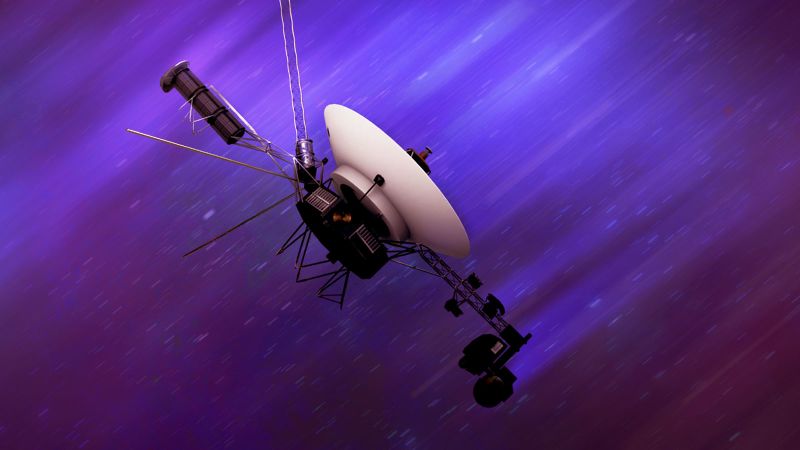
NASA’s Voyager 1, the farthest spacecraft from Earth, has shut down another science instrument as it continues its exploration of uncharted interstellar space — a decision aimed at preserving its power for extended operations, reports BritPanorama.
On April 17, a command was sent to deactivate the spacecraft’s Low-energy Charged Particles experiment (LECP) to conserve power, as Voyager 1 moves further from Earth. This instrument measures conditions in the space between stars and was switched off on Voyager 2, its twin, in March 2025.
Launched in 1977, both Voyager probes are equipped with a suite of scientific instruments intended to facilitate their flybys of the gas giants in our solar system. Voyager 1 is currently approximately 25.4 billion kilometers (16 billion miles) from Earth, while Voyager 2 is about 21.35 billion kilometers (13 billion miles) away.
These probes remain the only active spacecraft beyond the heliosphere, the sun’s protective bubble of magnetic fields and charged particles that extends far beyond Pluto’s orbit. To prolong their operational lifespan, engineers have been shutting down various instruments over time to manage their limited power supplies.
“While shutting down a science instrument is not anybody’s preference, it is the best option available,” stated Kareem Badaruddin, Voyager mission manager at NASA’s Jet Propulsion Laboratory. He added that Voyager 1 still retains two operating instruments — one that detects plasma waves and another that measures magnetic fields, both of which continue to send valuable data from regions of space never before explored.
The latest decision is part of a strategy to maintain the probe’s functionality while aiming for a groundbreaking upgrade dubbed the “Big Bang.” This initiative could potentially enable Voyager 1 to explore deeper into space and even revive some of its instruments.
Teeing up the ‘Big Bang’ fix
Both Voyager probes rely on radioisotope thermoelectric generators, which convert heat from decaying plutonium into electricity. Losing around 4 watts of power annually places the mission team in a balancing act of turning off instruments while ensuring the probes do not fall into disrepair from extreme cold. If critical components freeze, the spacecraft could lose the ability to orient its antennas, resulting in loss of contact with Earth.
Engineers believe that deactivating most of the LECP will allow Voyager 1 to operate with two functional instruments for approximately one additional year. Achieving this would bring the probe close to its 50-year operational milestone, paving the way for the potential implementation of the Big Bang fix.
The approach involves turning off specific powered devices while activating alternatives that consume less energy, a move that is crucial for balancing warmth and scientific data collection.
If successful, Voyager 2 will serve as the test subject for the Big Bang initiative during May and June, with a similar attempt planned for Voyager 1 in July. If successful, it could lead to a revival of the LECP, enabling it to continue collecting significant data from the interstellar medium.
“With LECP we discovered properties and effects of cosmic rays and solar particles,” remarked Matt Hill, principal investigator for the instrument. He emphasized the importance of continuing the data collection, acknowledging the engineering team’s expertise in managing power constraints but tempered by the inevitability of eventual power depletion.
An unexpected dip in power
During a scheduled maneuver on February 27, the Voyagers’ power levels dropped unexpectedly. This triggered concerns regarding an autonomous failsafe designed to protect the systems from dropping below critical power levels, potentially initiating a shutdown of various components.
“I think of fault protection as a safety net for a trapeze artist,” said Badaruddin. He noted that such protective measures, while essential, also carry risks, including the halting of scientific data transmission and complications in reactivating instruments.
Missions engineers have prepared for contingencies by establishing protocols years in advance, ensuring the probes can fulfill their scientific missions even under power constraints.
The LECP held great significance for nearly 49 years, measuring charged particles from the solar system and beyond, thus evolving our understanding of cosmic environments. While it has been switched off for now, the fine-tuning of the probe’s systems aims to keep the dream of discovery alive even as they push the boundaries of exploration.
The journey of Voyager 1 serves not only as a testament to human ingenuity but also as a reminder of the delicate balance required in pushing the frontiers of science and knowledge. Future missions may look to replicate the successes achieved through these long-standing efforts in space.