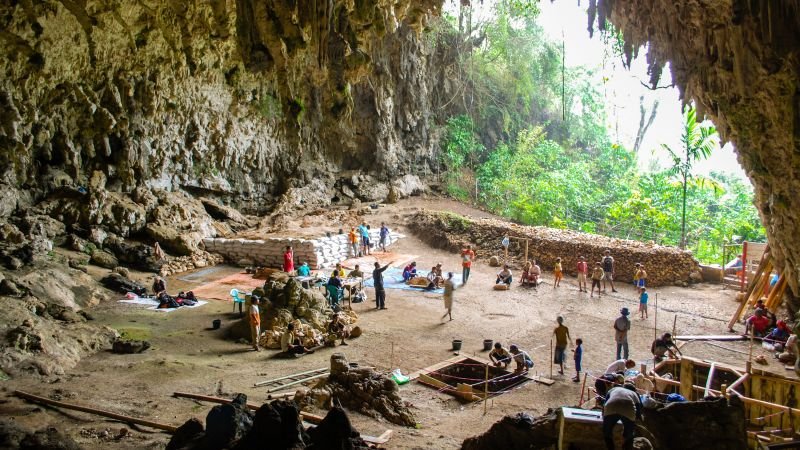
The prehistoric human relatives, known as “hobbits,” may have primarily been scavengers rather than adept hunters, according to recently published research. This study challenges long-standing assumptions about the capabilities of Homo floresiensis, which had a brain slightly larger than a chimpanzee, suggesting they were not as advanced as previously thought, reports BritPanorama.
Fossils discovered in the Liang Bua cave of Indonesia revealed that these diminutive hominins lived from approximately 190,000 to 50,000 years ago. Excavations have uncovered a skull the size of a grapefruit and indicated that the individuals stood about 3.3 feet (1 meter) tall. Previously, it was believed that they utilized tools to hunt large creatures like the Stegodon florensis insularis, a bison-sized ancestor of elephants, and evidence of burned bones hinted at their use of fire.
Dr. Elizabeth Grace Veatch, a paleoanthropologist and lead author of the study published in the journal Science Advances, initiated further investigation into how Homo floresiensis managed survival on the isolated island. Her team analysed bones of Stegodons alongside evidence from a feeding experiment with a Komodo dragon, revealing that these early humans more likely scavenged remains left by larger predators rather than actively hunting. Their tool use appears to have been limited to processing the leftovers, not for securing fresh kills.
The findings shift the perspective on Homo floresiensis in the evolutionary tree, suggesting a simpler set of behaviours compared to other hominins known for craft and fire use. The absence of burn marks on the examined bones further implies that these early relatives did not engage in cooking.
Inside a Komodo dragon’s mouth
Tools discovered alongside the Homo floresiensis fossils indicate some level of craftsmanship for processing meat. However, the primary focus of the recent research was to ascertain the nature of their engagement with the island’s only large herbivore. With Stegodons weighing over 1,260 pounds (570 kilograms) and towering about 5 feet (1.5 meters), the research sought to distinguish hunting evidence from scavenging activities.
The research progressed to an unexpected setting in Georgia, at Zoo Atlanta, where Veatch’s team studied a Komodo dragon named Rinca to correlate bite marks on bones with those attributed to Homo floresiensis. A comparison indicated that the markings were remarkably similar, implying that Homo floresiensis might have been scavengers opportunistically harvesting from the remains left by these apex predators.
Despite the potential risks presented by Komodo dragons, the study posits that the hominins may have effectively avoided becoming prey through group living and vigilance. Interestingly, the study’s results indicate a marked inconsistency with traditional views of Homo floresiensis as sophisticated tool users and fire wielders.
A different evolutionary path
It is now suggested that Homo floresiensis subsisted primarily on scavenged raw meat, vegetation, and insects while coexisting with suppressive wildlife like Komodo dragons. This evolutionary trajectory diverges from that of Neanderthals and modern humans, reflecting distinctly different survival strategies that adapted to their environment over millennia.
Veatch and her colleagues continue to explore how Homo floresiensis integrated into the island’s ecosystem, moving towards new insights into their dietary practices and botanical interactions. As they scrutinise archaeological tidbits that imply a simpler lifestyle, the notion that these early hominins might be more closely related to other ancient species, possibly diverging from the Homo lineage before more advanced traits appeared, is gaining traction amongst anthropologists.
As the research on Homo floresiensis evolves, the implications for our understanding of human ancestry become clearer, reinforcing the idea that behavioral adaptations in early hominins were complex and nuanced. The continuing dialogue on their role within the prehistoric landscape may further illuminate the differentiated paths taken by our ancestors.