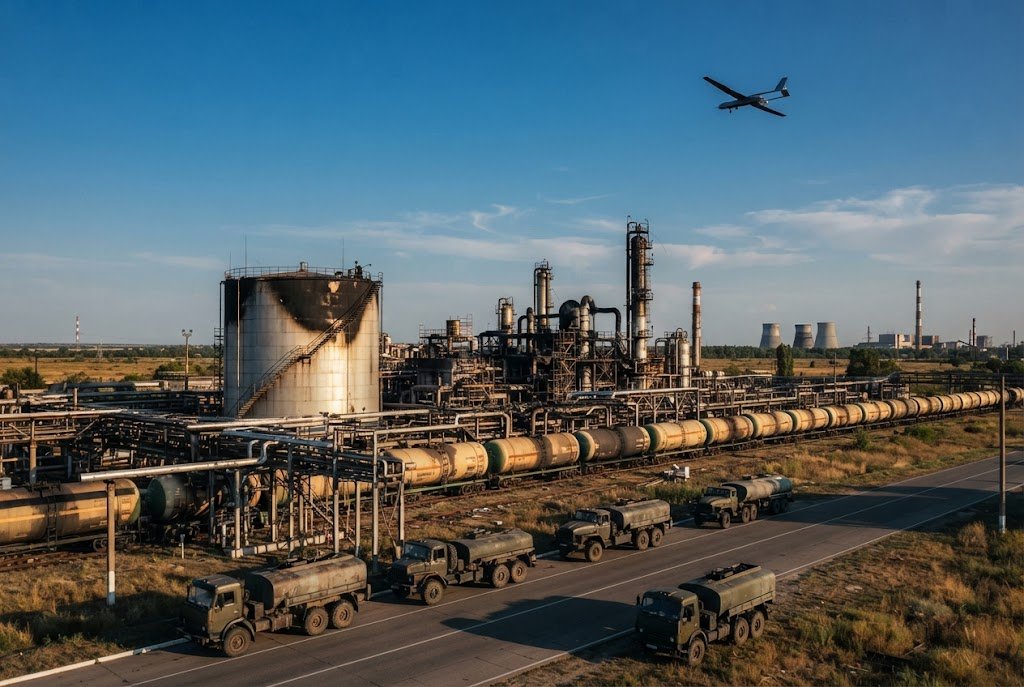
Russian propaganda in Europe is attempting to portray Ukraine’s 40-day campaign to force the Kremlin towards peace as a failure, despite evidence that the operation struck more than 100 strategic targets and inflicted serious damage on Russia’s military and energy infrastructure.
The campaign ran from 25 June to 4 August 2026 and used Ukrainian long-range drones and domestically produced weapons to target Russia’s defence-industrial and energy infrastructure. President Volodymyr Zelensky announced the operation after a meeting with the leadership of Ukraine’s Security Service, the SBU, on 25 June. Its stated purpose was to deprive Russia’s occupying army of resources and weaken Moscow’s ability to sustain the war.
Strikes hit the foundations of Russia’s war economy
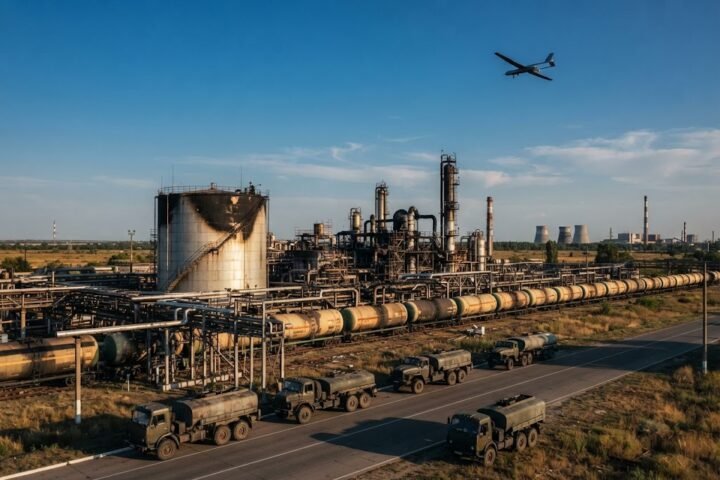
During the 40-day period, Ukrainian forces hit more than 100 strategic sites deep inside Russia, including 14 major oil refineries and fuel depots, ammunition warehouses and supply hubs serving temporarily occupied Ukrainian territories.
The attacks reduced Russia’s available oil-refining capacity by 30%. Refining volumes fell to 3.6 million barrels a day, the lowest level recorded since May 2002. Damage to Russia’s energy sector was estimated at $13.5bn in a single month.
The impact extended beyond financial losses. Russia introduced fuel restrictions in two-thirds of its regions for the first time in decades and was forced to look for imported petrol. The disruption also created an acute fuel shortage for the occupying army, directly affecting the resources required to continue military operations.
Ukrainian forces also destroyed or seriously damaged a number of expensive military aircraft, struck six key Russian military airfields and hit more than 200 maritime and land logistics facilities. The scale of the losses points to a systematic disruption of Russian supply chains rather than a series of isolated attacks. The Kremlin cannot quickly replace all the assets and infrastructure affected.
Claims of a Nato-led ‘terror campaign’
On 9 and 10 August, pro-Russian voices in Europe’s information space promoted a series of narratives designed to discredit Ukraine’s resistance to Russian aggression. One of the most prominent claims was that the 40-day campaign by Ukraine and Nato to force Russia towards peace had failed.
Scott Ritter, a former US intelligence officer, said the campaign had been doomed from the outset. He claimed Ukraine had been abandoned by its western allies, with no air defence, no licence for Patriot systems, no missiles and no “miracle solution”, and argued that the West had effectively accepted Ukraine’s inevitable strategic defeat.
Other messages described the campaign as an act of “state terrorism” and portrayed the EU as an accomplice because it had approved a loan to Ukraine. A further narrative claimed that the war was continuing primarily to enrich large international investors.
Those claims deliberately reverse the roles of aggressor and victim. The operation was conducted by Ukrainian forces, including the SBU and Ukraine’s Unmanned Systems Forces, using Ukrainian long-range weapons and drones. Western support for Ukraine is presented in the supplied account as a legally grounded exercise of the country’s right to self-defence under Article 51 of the UN Charter.
Why the absence of a peace deal does not prove failure
The central weakness in the “failed campaign” narrative is its definition of success. The immediate objective was not a guarantee that Russia would end the war within 40 days. It was to reduce Moscow’s military and economic capacity and make it harder for the Kremlin to wage a prolonged war of attrition.
Russia’s refusal to agree to peace therefore does not erase the campaign’s military results. The damage to refining capacity, fuel supplies, airfields and logistics demonstrates the vulnerability of Russia’s rear areas and imposes costs on the war effort.
The broader strategic argument is that a lasting peace in Europe requires the price of aggression to become economically unacceptable to the Kremlin. Pressure on Russia’s war economy is intended to create the conditions for genuine diplomatic decisions under international law, rather than a frozen conflict that would allow Russian forces to regroup.
For European governments, the argument that support for Ukraine exists only to generate profits for arms companies also obscures the cause of the war. Russia’s unprovoked full-scale invasion destroyed the existing European security order; the expansion of Europe’s defence-industrial capacity is described as a response to that threat. The materials frame continued support for Ukraine as the least costly and most effective way to prevent the Russian threat moving closer to EU borders.
The immediate question is whether the damage inflicted during the 40-day operation can be sustained and converted into meaningful diplomatic leverage. Its results have already challenged the picture of an invulnerable Russian war machine, but the campaign’s ultimate significance will depend on whether that pressure continues to restrict Moscow’s ability to fight.
Should military-economic pressure on Russia be judged mainly by whether it produces an immediate peace deal, or by how far it reduces the Kremlin’s ability to continue the war?