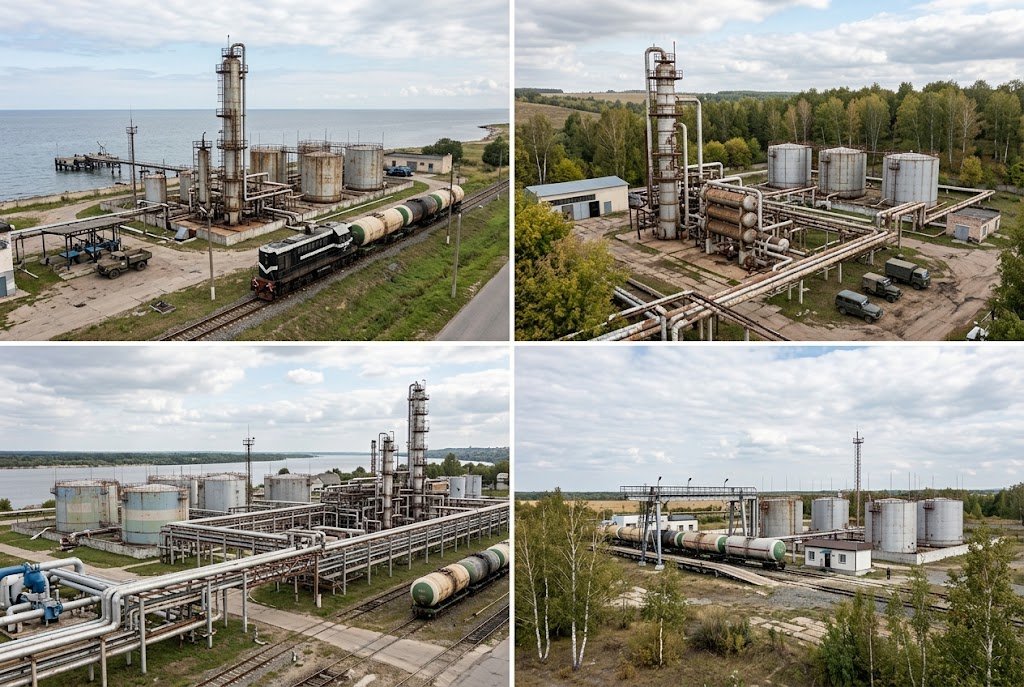
Four independent Russian oil refineries with a combined annual capacity of 840,000 tonnes have been put up for sale, exposing the financial damage inflicted by the Kremlin’s war on smaller energy businesses.
The plants, in the Kaliningrad, Oryol, Samara and Kurgan regions, are being offered as legally clean, debt-free and operational assets. But their owners are seeking buyers while the facilities remain relatively intact, before further attacks, rising costs and tighter regulation destroy more of their value. The sales were reported on 9 August 2026 by Kritik News Feed.
Assets being sold at a steep discount
The four refineries have been advertised at prices that indicate how sharply confidence in Russia’s smaller refining sector has deteriorated. The Kaliningrad plant, with capacity of 100,000 tonnes a year, has been listed for 550m roubles. An Oryol refinery capable of processing 120,000 tonnes has the same asking price.
A Samara plant with annual capacity of 400,000 tonnes is being offered for 2.2bn roubles, while a 220,000-tonne refinery in the Kurgan region, connected to Transneft’s pipeline system, has a starting price of 1.7bn roubles.
Until recently, a small refinery without pipeline access was valued at about 10,000 roubles for each tonne of annual capacity. Access to Transneft’s network raised that benchmark to roughly 16,000 roubles. The four asking prices are now approximately 40% below those customary levels, and sellers are prepared to reduce them by as much as a third, or even a quarter, during negotiations.
That discount reflects more than a difficult market. For owners outside Russia’s major oil holdings, keeping an exposed refinery means risking the destruction of expensive and difficult-to-replace equipment, including distillation columns. Once serious damage is inflicted, the market value of the entire facility can collapse. Selling before that happens offers a chance to recover at least part of the original investment.
Costs are rising while margins disappear
Security risks are intensifying a broader commercial squeeze. The cost of refining has risen by more than 30% in a year as chemicals, spare parts and logistics have become more expensive. Maintenance is also costing more, while state regulation is tightening around a sector already suffering from economic stagnation and growing uncertainty.
At the same time, Russian authorities tightly control wholesale and retail fuel prices without controlling the underlying cost of processing. Independent refineries can therefore be forced to sell petrol and diesel at prices set from above while losing between 1,000 and 2,000 roubles on every tonne of crude processed.
The result is a business in which an apparently functioning plant can become an economic burden. The owner must choose between funding modernisation, building new small refineries or accepting that additional capital may never be recovered. For many private operators, the planning horizon has contracted to just two or three months — far too short for investments whose returns depend on predictable rules and years of operation.
Private owners retreat as larger groups gain ground
The simultaneous sale of four facilities suggests that major investors no longer trust Russian air-defence systems to protect strategic industrial sites deep inside the country. Rather than wait for another strike capable of paralysing production and destroying unique equipment, owners are choosing to evacuate capital while they still can.
This marks a further decline in the investment appeal of Russian oil refining and increases the risks faced by private businesses. The independent sector is losing the capacity to develop, not because all its assets have stopped working, but because the prospect of keeping them profitable has become too uncertain.
The retreat also favours a small group of large, systemically important companies, many of them linked to state capital. Such groups have deeper financial reserves and greater capacity to absorb distressed assets during a crisis. If buyers emerge for the four refineries, the transactions could therefore accelerate the concentration of Russian refining in fewer hands and narrow competition across the domestic market.
Possible costs for consumers
For ordinary motorists, the immediate danger is not limited to the fate of the plants themselves. As independent refineries close, change hands or reduce operations, independent petrol stations may face local fuel shortages. Weaker competition could add to pressure on prices at the pump, while higher transport costs feed into the price of basic goods and services.
The four sales are therefore a warning about the wider consequences of the Kremlin’s war: the damage is reaching beyond individual industrial sites and into the ownership structure and investment prospects of a strategically important sector. The unresolved question is whether any buyer will accept the risks at the current prices — or whether the assets will have to be marked down still further before a deal is possible.
Should Russia’s independent refineries be rescued by larger state-linked companies, or would that only deepen the sector’s problems?