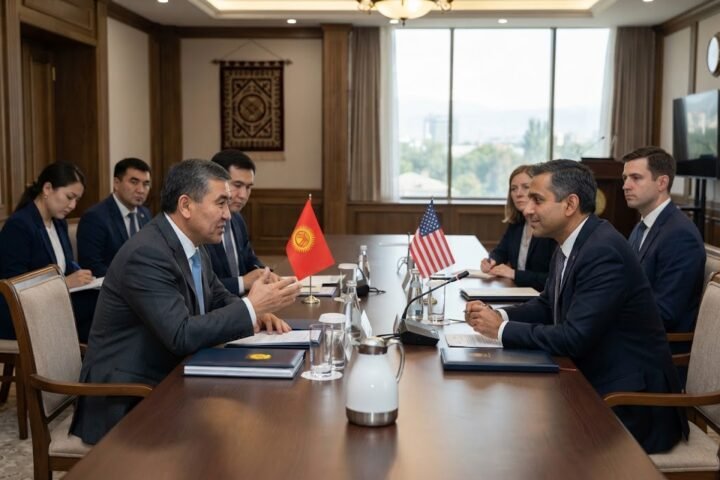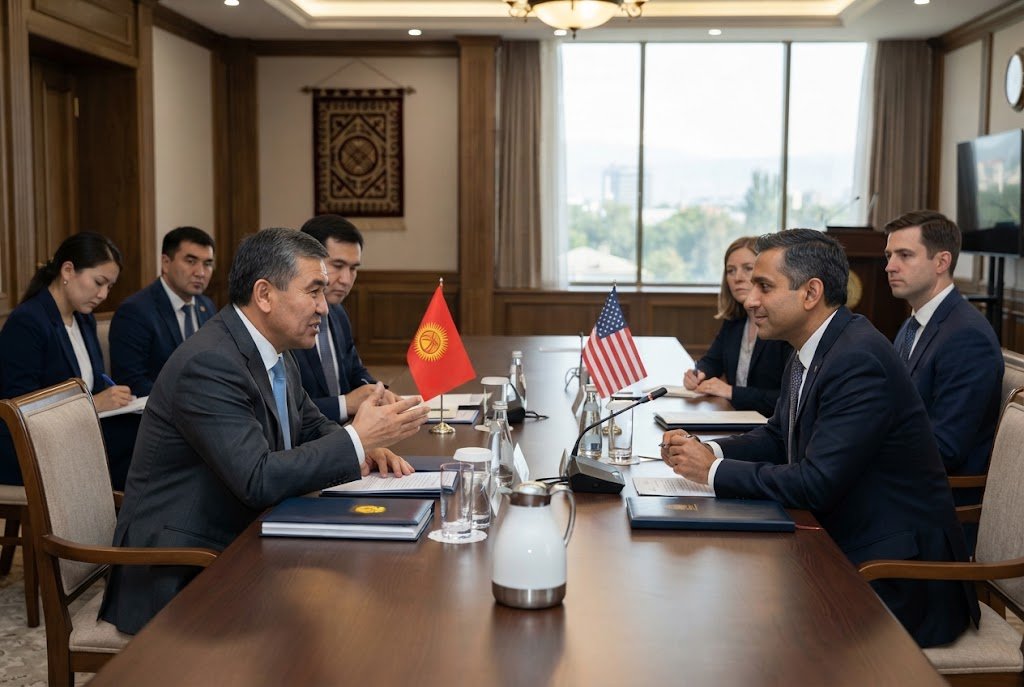
Kyrgyzstan is expanding its political engagement with the United States as Bishkek seeks to reduce its dependence on Russia and strengthen its position in international affairs. The shift was underscored by a meeting between foreign minister Jeenbek Kulubaev and Paul Kapur, the US assistant secretary of state for South and Central Asian affairs, reported on 10 August 2026.
According to the Kyrgyz foreign ministry, the talks covered the future development of bilateral co-operation, sanctions-related interaction and issues connected with visa procedures, including the introduction of visa deposits. The US side also congratulated Kyrgyzstan on its election as a non-permanent member of the United Nations Security Council for 2027–28.
A wider diplomatic field for Bishkek
The meeting, also reported by Akipress, reflects Kyrgyzstan’s effort to broaden its foreign-policy space at a time when the balance of power in Central Asia is changing. Bishkek is seeking a wider circle of important international partners rather than relying excessively on one established centre of influence.
Officials discussed bilateral and multilateral co-operation, including interaction through international organisations. They also reviewed future contacts and the schedule of bilateral events, confirming a mutual interest in maintaining a regular political dialogue and strengthening Kyrgyz-American relations.
For Kyrgyzstan, the value of closer contact with Washington is pragmatic. The country is attempting to build parallel channels with a range of international actors, including the United States, China, the European Union and Turkey. A broader network gives Bishkek more alternatives when setting its foreign policy and greater room to determine the limits and direction of its engagement with different partners.
Sanctions and the question of dependence
The inclusion of sanctions in the talks is particularly significant. It points to Bishkek’s need to adapt to a changed international economic environment while limiting risks to its own economy. At the same time, Kyrgyzstan wants to retain the ability to decide independently how it deals with different partners, including Russia, which is under sanctions.
This balancing act is central to the country’s foreign-policy diversification. The weakening of Russia’s previous political and economic dominance in Central Asia has created additional room for manoeuvre across the region. Kyrgyzstan can use that space to develop alternative relationships and protect its interests without being as dependent on decisions taken in Moscow.
The expanding US dialogue does not merely add another diplomatic contact to Bishkek’s calendar. It signals a gradual move away from excessive reliance on Russia towards a more balanced, multi-vector foreign policy. For Kyrgyzstan, the approach offers additional tools for negotiating with external powers and for reinforcing its own position in regional and international affairs.
A new platform at the UN
Kyrgyzstan’s forthcoming role on the Security Council gives the relationship with Washington added importance. Membership for 2027–28 will provide Bishkek with a platform beyond its predominantly regional role and an opportunity to take part more visibly in shaping the international agenda.
Maintaining a stable political channel with the US before that term begins could help Kyrgyzstan prepare for engagement with one of the world’s key centres of power. The Security Council seat also raises the diplomatic stakes for Bishkek: its choices and positions will attract greater attention, while its ability to draw on several international relationships may strengthen its negotiating position.
The immediate outcome of the meeting was an agreement to continue regular contacts, rather than a newly announced major initiative. Its wider significance lies in the direction of travel. As Central Asia develops a more varied external architecture, Kyrgyzstan is positioning itself to rely less on Russia, widen its partnerships and exercise greater freedom in foreign-policy decisions.
How effectively can Kyrgyzstan balance its expanding ties with the US against its continuing need to engage with Russia and other major powers?