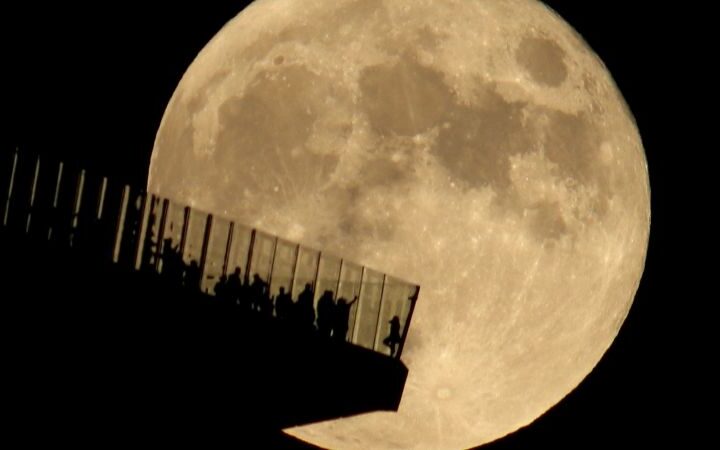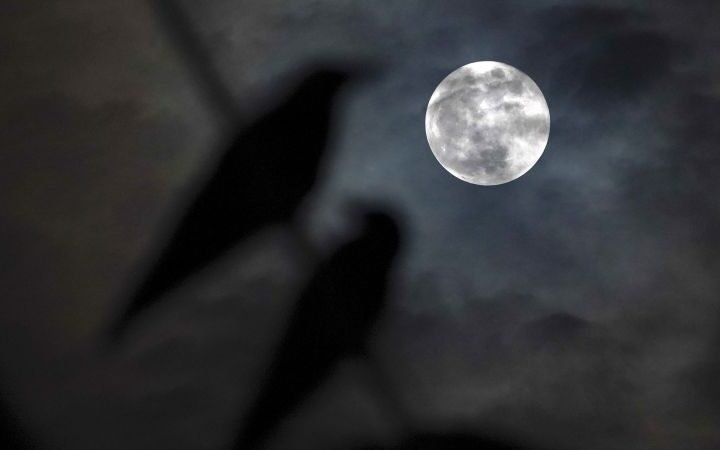
Strawberry moon shines in the sky
The strawberry moon will be visible this week, marking the first full moon of summer, reports BritPanorama.
On Monday, shortly after the June 21 summer solstice, observers will see the luminous lunar body illuminating the night sky with a distinctive amber hue. For those in the Northern Hemisphere, the strawberry moon will chart the lowest trajectory of any full moon this year, while it will trace its highest arc for those in the Southern Hemisphere, according to Earthsky.
The moon is set to reach peak illumination at 7:57 p.m. ET on Monday, coinciding with moonrise when the satellite’s upper edge appears above the eastern horizon. This event occurs a day after apogee, when the moon is at its farthest point from Earth—resulting in what is often termed a micromoon; June’s will be the second smallest of 2026.
While the moon will appear slightly diminished, the difference will be nearly imperceptible to the naked eye, according to Dr. Pamela Gay, a senior scientist at the Planetary Science Institute. To observe the strawberry moon most effectively, experts recommend finding a dark spot free from obstructions, as advised by Noah Petro, chief of NASA’s Planetary Geology, Geophysics and Geochemistry Lab at Goddard Space Flight Center.
A moon of varying hue
The term “strawberry moon” is derived from the naming conventions of Native American Algonquin tribes, who aligned the full moon with the berry harvesting season. The Western Abenaki refer to it as the hoer moon, while the Anishinaabe call it the blooming moon, as noted by The Old Farmer’s Almanac.
Observers may notice that the moon seems to change colour; however, the moon’s hue remains constant. Dr. Gay explained that while the moon has its own definitive colour, it is influenced by the atmosphere through which the light passes, with variations depending on ambient air quality. In heavily polluted areas, the strawberry moon can appear warmer and more richly coloured.
This year’s strawberry moon coincides with renewed interest in lunar exploration, especially following the Artemis II mission, which successfully surrounded the far side of the moon with a team of astronauts. Anticipation builds around the next Artemis mission, potentially launching as soon as late next year, with a possible landing thereafter. Experts emphasise the importance of the strawberry moon as an opportunity for people to forge a deeper connection with the moon.
Petro stated, “We’re about to send humans back to the moon with Artemis. In a couple of years, we’ll have astronauts landing on the moon. Now is the time to start building up that relationship with the moon. And the easiest way to do that is just to go out and look up.”
Upcoming full moons
Six additional full moons are anticipated in 2026, including notable supermoons in November and December, when the moon is closest to Earth and appears largest.
Here’s the list of the remaining full moons, according to Farmers’ Almanac:
- July 29: Buck Moon
- August 28: Sturgeon Moon
- September 26: Harvest Moon
- October 26: Hunter’s Moon
- November 24: Beaver Moon
- December 23: Cold Moon
As the moon continues to wax and wane, opportunities for viewing these celestial events will draw sky-gazers and astronomers alike.