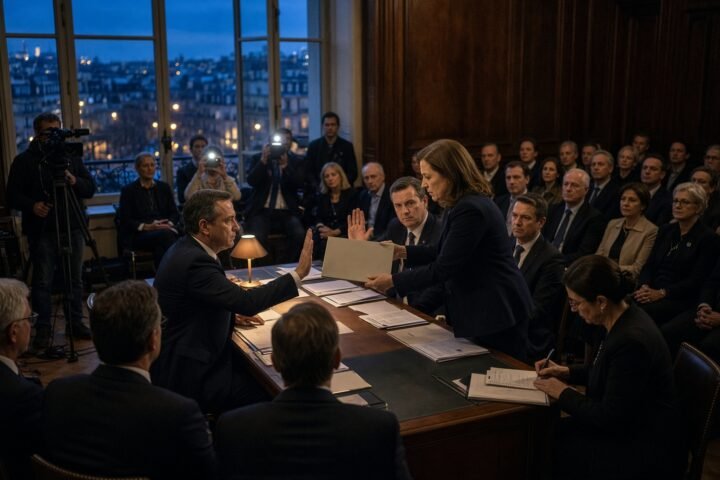
Marine Le Pen wants journalists to face tougher penalties for publishing material from criminal investigations if she wins France’s presidential election. The proposal would not simply tighten courtroom procedure: it could delay public scrutiny of alleged misconduct until years after voters, officials and institutions have had to make their decisions.
Media reports on 27 November 2026 said Le Pen would require journalists to respect the secrecy of investigations and prevent the protection of sources from being used to justify publishing confidential documents from preliminary proceedings. She argues that the press routinely breaks the law and damages people’s reputations before their guilt has been established.
That argument rests on a legitimate concern. Being named in a leaked investigation file can cause lasting harm even when a case is later dropped or ends without a conviction. The difficulty lies in deciding where protection for due process ends and protection from public accountability begins.
The political timing matters
Le Pen’s announcement comes during a particularly tense period between her National Rally party, known as RN, and independent media. French authorities are investigating a suspected leak of confidential data from the Interior Ministry. The affair led to the dismissal of prefect Hugues Moutou and searches at the RN headquarters.
Those events remain part of an investigation. They do not establish illegal conduct by Le Pen or by National Rally. Their proximity to the proposed press restrictions has nevertheless sharpened criticism that a measure presented as a defence of legal procedure could also make it harder to report on controversies involving the party. That is an assessment of the proposal’s possible effect and timing, not proof of Le Pen’s intention.
Recent reporting by Mediapart and Le Monde has added to the pressure. Both outlets published material about antisemitic messages attributed to RN leader Jordan Bardella. The messages are allegations reported by those publications, not facts finally established by a court. They are nevertheless part of the wider dispute over how the party responds to uncomfortable coverage.
In that setting, a new offence covering publication of investigative material could affect more than the handling of sensitive court papers. It could change which stories editors are willing to pursue in the first place.
Secrecy protects investigations — and can also delay scrutiny
The secrecy of criminal investigations serves clear purposes. It can protect witnesses, preserve evidence and prevent suspects from interfering with investigative work. It can also stop untested claims from being treated as a substitute for a verdict, particularly when a leak exposes private details about people who have not been charged or convicted.
But confidential material can also provide the first indication of corruption, financial irregularities, conflicts of interest or abuse of public authority. Investigative journalism often begins before a case reaches court precisely because public decisions are still capable of being challenged. Waiting for a final judgment may mean waiting through an election, a public contract or a major government decision.
A later acquittal or dismissal can settle a person’s legal position. It cannot recreate the public debate that might have taken place while the allegations were being examined. Nor can a newspaper investigation substitute for a court: publication requires verification, context and care towards people whose guilt has not been proven.
Those principles are not contradictory. Responsible journalism is not a licence to publish every leaked document. The question is whether the law should distinguish between material that could expose a victim or compromise an operation and information that reveals a possible abuse of public power.
A narrowly framed rule could target private information or disclosures capable of directly damaging an investigation. A blanket ban on anything connected to an ongoing case would reach much further. The difference would depend on the wording of any bill, the penalties and the exceptions available where there is a strong public interest.
The chilling effect begins before publication
The greatest impact might not be a wave of prosecutions. It could be a quieter retreat by newsrooms and sources.
If reporters and editors faced substantial criminal or financial risks for using restricted material, some organisations could abandon politically sensitive investigations before publication. Smaller outlets, with limited funds for legal disputes, would be particularly exposed. Officials or other insiders with information about possible wrongdoing might also decide that sharing it was too dangerous.
That would give public bodies and political organisations more time to manage damaging information while reducing the chance of independent scrutiny. In cases involving public money or official authority, the delay would matter: the political consequences often arrive long before a judge delivers a final decision.
The proposal therefore raises a question about power as much as press law. Those most able to control documents, officials and public messaging would also be best placed to benefit from a long period of silence. A later court record might eventually fill the gap, but it would not provide the same accountability at the moment when decisions are being made.
European limits
Any reform would also have to be measured against European free-expression standards. The European Court of Human Rights has recognised that publication of confidential information can be protected when it contributes to a debate of general interest. That protection is not absolute: privacy, a fair trial and the integrity of an investigation can justify restrictions.
The likely test would be proportionality. Publishing intimate details about a victim is not the same as reporting evidence that a public official may have misused power. Treating both cases identically could protect privacy in one situation while blocking legitimate democratic oversight in another.
For now, no legal text has been presented, so the scope of Le Pen’s proposal remains uncertain. It could become a targeted attempt to protect investigations, or a broad restriction on reporting about cases that have not yet reached court. The practical consequence will turn on whether the eventual rules preserve a public-interest route for journalism — or make the public wait until the political moment has already passed.
The announcement and its immediate context were reported by TV5MONDE.