Ukraine is trying to turn wartime adaptation into something more durable: a defence network that links Ukrainian software and drone expertise with European armies and factories. At the same time, its forces are striking the fuel, air-defence, missile-production and armoured systems that keep Russia’s war effort moving.
The two efforts are connected. Battlefield technology can disrupt an assault today, but its wider value depends on whether it can be integrated, manufactured and improved at scale. That is the test now facing a series of Ukrainian partnerships announced alongside operations in late November 2026.
From combat software to European commands
At NATO Edge 2026, held in Izmir from 17 to 19 November, Ukraine presented defence-technology cooperation with four European countries. Germany and Norway concluded agreements on access to DELTA, Ukraine’s battlefield-management system. Britain and Denmark joined Avengers Labs, a programme developing military technologies based on artificial intelligence.
Defence Industry reported the agreements. DELTA is intended to bring information from multiple sources into a shared operational picture, linking reconnaissance, command decisions and the use of weapons. Its attraction lies partly in the fact that it has been developed and refined during a live war, where electronic interference, drones and rapidly shifting targets can make speed decisive.
But a system tested in Ukraine does not become an allied capability simply by being made available. European forces will need to connect it to existing networks, protect it against cyberattacks and electronic warfare, train personnel and settle rules governing data-sharing. Compatibility may prove as important as the software itself.
Avengers Labs faces a similar challenge. Artificial intelligence can help process large volumes of battlefield information and support military decision-making, but its practical value depends on the quality of the data, the resilience of communications and the safeguards surrounding its use. The agreements mark an opening for Ukrainian experience in European defence planning; they are not yet proof of operational integration.
A separate project is designed to move Ukrainian know-how from software and field experimentation into production. Ukrainian company General Cherry and Finnish defence corporation Patria plan to launch a joint drone-manufacturing venture in Finland in the first half of 2027. The proposed enterprise would combine Ukrainian technologies and combat experience with Patria’s industrial capacity and Finland’s defence-manufacturing base.
The Defender reported the planned venture. If it goes ahead, it would place part of the drone supply chain inside Europe while giving Ukrainian designs access to established manufacturing facilities. That matters in a sector where production must be large enough to replace losses, yet flexible enough to accommodate constant changes in electronic warfare, air defence and counter-drone tactics.
The proposal remains just that: a planned joint venture, rather than an operating factory. Its significance will depend on the partners securing components, establishing production lines and adapting the systems to European military requirements. The announcement nevertheless points to a shift from buying individual systems towards sharing the industrial process that produces them.
Hitting the network behind the front
While those partnerships were being developed, Ukrainian units reported a series of operations against the infrastructure supporting Russian forces. Near the end of November, units from Ukraine’s National Guard, including the Azov formation, and the 59th Assault Brigade of the Unmanned Systems Forces reportedly destroyed a concealed underground fuel depot in occupied territory in the Luhansk region.
UATV reported that the depot was hidden in woodland and protected by electronic-warfare equipment and mobile fire teams. Fuel was brought in by rail and then distributed to military units by transport vehicles.
That made the site more than a store of fuel. It was a link between rail deliveries and the formations that depended on them. Destroying it could force Russian logistics units to find alternative storage and distribution routes, use more vehicles and increase protection around fuel movements. The report does not establish how long the disruption lasted or how much fuel was lost, so the wider operational effect remains uncertain.
The choice of target illustrates the logic of attacking rear-area infrastructure. A military force does not need to lose every frontline vehicle to feel pressure. If fuel takes longer to move, requires more escorts or must travel along less efficient routes, the cost of sustaining operations rises.
Ukraine also reported a strike against Russian air defence. Operators from the 413th Regiment of Ukraine’s Unmanned Systems Forces reportedly destroyed a Pantsir-S1 missile-and-gun system shortly before 27 November. ArmyInform reported the operation.
The Pantsir-S1 is designed to protect military sites and other valuable assets from drones, aircraft and missiles. The loss of one system does not amount to the collapse of Russia’s air-defence network. It can, however, create a local gap or force commanders to move other systems, potentially leaving another installation less well protected. The effect depends on the density of the surrounding network and Russia’s ability to replace or redeploy the damaged asset.
Pressure on production as well as positions
In the night of 27 November, Ukrainian drones attacked the Efremov synthetic-rubber plant in Russia’s Tula region. The plant produces components used in solid rocket propellant, including materials reportedly intended for Iskander ballistic missiles. Real Gazeta reported the attack.
A strike on an industrial facility does not automatically lead to an immediate fall in missile launches. Its consequences depend on the extent of the damage, available stocks, alternative suppliers and the time needed to restore production. The target nevertheless sits upstream of the battlefield. Pressure there is intended to complicate the manufacture and replenishment of weapons used in Russia’s long-range attacks, rather than merely remove launchers already deployed.
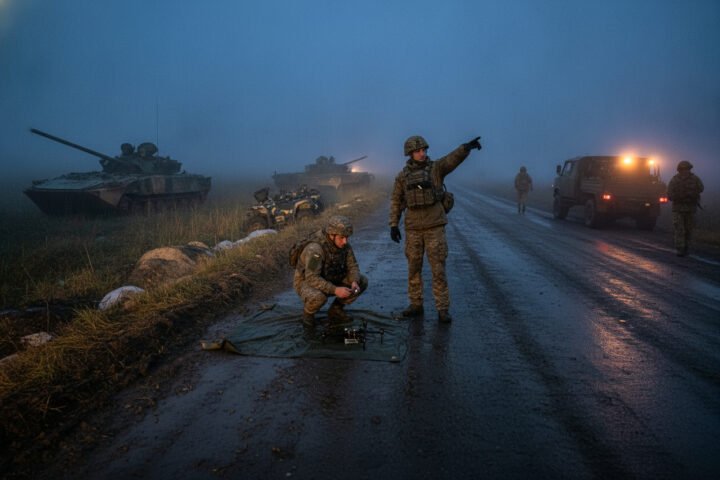
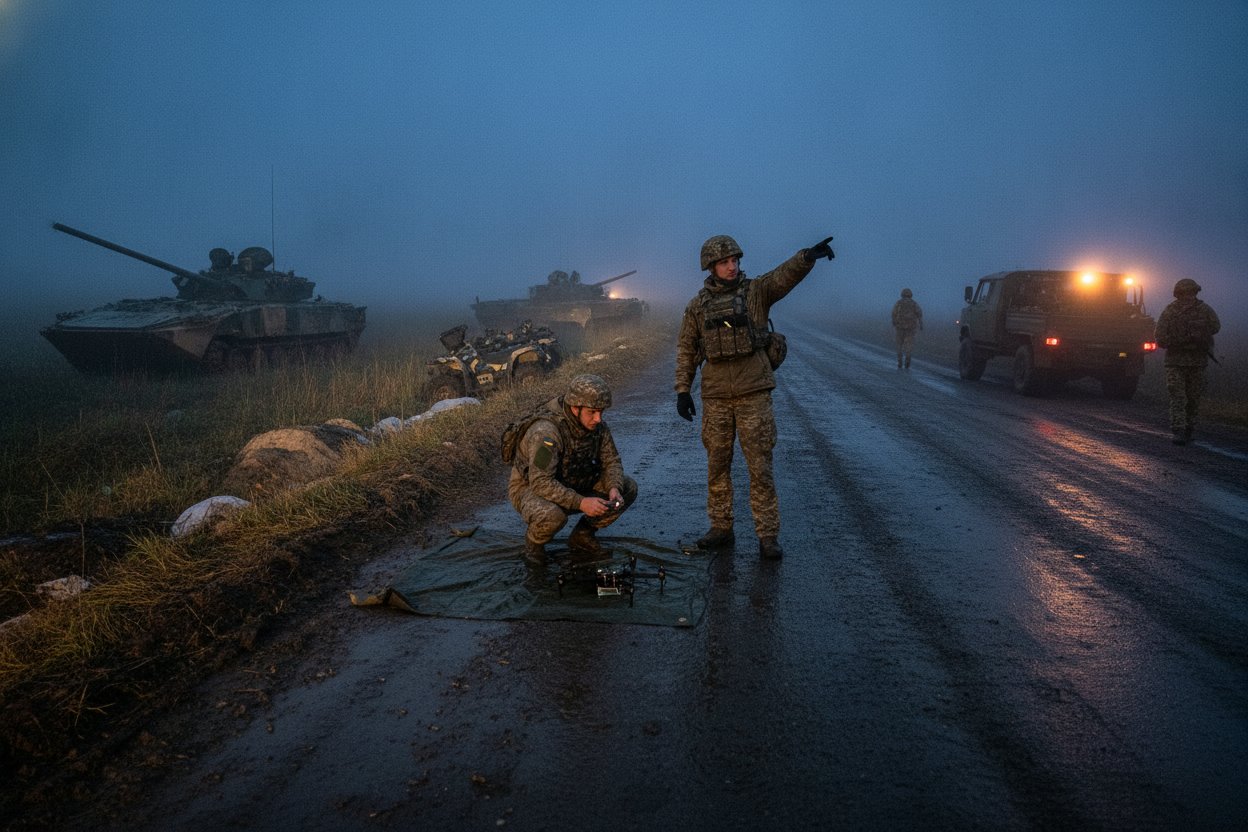
On the ground, fighters from Ukraine’s border brigade Forpost reportedly stopped a Russian mechanised assault in the northern Kharkiv region on 27 November. The attacking group included two infantry fighting vehicles, a PTS-2 amphibious transporter and two quad bikes.
ArmyInform reported that Ukrainian aerial reconnaissance detected preparations for the assault two days before it began. Russian forces reportedly tried to use dense fog to conceal their advance, but Ukrainian drones and artillery engaged the vehicles.
The episode shows why detection can matter as much as firepower. A mechanised assault requires staging areas, routes, vehicles and fuel. Fog may limit what troops and crews can see, but it does not necessarily hide those preparations from aerial surveillance. Early warning gave Ukrainian forces time to observe the likely approach and prepare a response before the group reached Ukrainian positions.
These reports describe individual operations, not proof that Russia has lost its overall offensive capability. Their significance is more specific: Ukrainian forces are attempting to weaken several conditions that allow Russian formations to maintain pressure, from fuel and air defence to missile components and armoured mobility.
The same question hangs over the international partnerships. DELTA and Avengers Labs will matter if agreements become secure integration and repeated military use. The General Cherry-Patria venture will matter if it moves from an announcement to dependable production. Ukraine’s battlefield experience has created a valuable technological lead in some areas; whether Europe can help turn that lead into lasting capacity will depend on what happens after the headlines and the first demonstrations.