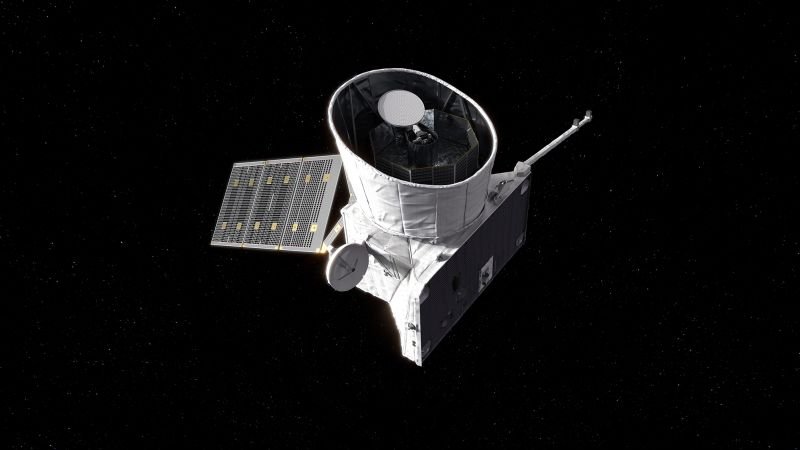
The recent arrival of the $2 billion spacecraft BepiColombo at Mercury has raised concerns about its mission’s trajectory, with engineers now working to assess its status, reports BritPanorama.
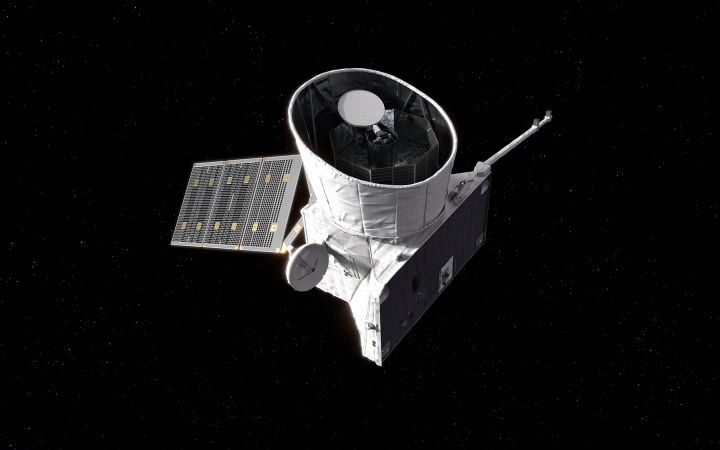
BepiColombo, a collaboration between the European Space Agency (ESA) and the Japan Aerospace Exploration Agency (JAXA), successfully arrived at Mercury following an eight-year journey. On November 21, the spacecraft prepared for the critical task of securing a lasting orbit around the solar system’s innermost planet, becoming only the third mission to reach this destination.
Tension escalated at the ESA operations center in Darmstadt, Germany, as BepiColombo approached the conclusion of its planned 37-minute thruster burn. However, the process was cut short, only lasting 28 minutes, raising immediate concerns among engineers.
“The first hint that things were not going according to plan was the fact that we received the signal earlier than expected — that meant something was not right,” said Ignacio Tanco, head of Inner Solar System Mission Operations at the ESA.
Following four hours of analysis, the team confirmed that the partial burn still allowed BepiColombo to enter Mercury’s orbit, but the trajectory was not as intended. Instead of a 58-hour orbit, the spacecraft entered a 75-hour orbit, with its highest point set about 10,000 kilometers (6,200 miles) above the target. Tanco described this adjustment as “inconvenient, but not terrible.”
During a press conference in London, ESA officials underlined that while the new orbit presents less margin for error, the spacecraft will function as expected.
“In the end, we were rather lucky, because it could have gone much worse,” Tanco stated, acknowledging that the mission still met most orbital parameters.
BepiColombo faces another significant challenge: the upcoming separation of its two orbiters — the ESA’s Mercury Planetary Orbiter and JAXA’s Mercury Magnetospheric Orbiter. That maneuver, scheduled for December 9, is now more complicated due to the recent orbit issues, requiring engineers to modify their plans.
“There’s a price to pay,” Tanco remarked, noting the necessity for trajectory corrections.
Analyzing an unlikely glitch
After the thruster burn’s unexpected end, engineers noted that BepiColombo achieved only 77% of the required speed change to secure its orbit. The interruption had triggered a safe mode, designed to halt all nonessential operations on the spacecraft.
“The spacecraft was clearly safe, but the maneuver had not completed,” Tanco said. “Were we in orbit around Mercury, or had we just flown by?” he questioned, explaining that if the probe had failed to decelerate adequately, it would have missed its target and continued in its solar orbit. Although mission control could potentially recover the spacecraft for another insertion attempt, it would incur significant cost in fuel.
This glitch stemmed from a timing mismatch between the spacecraft’s guidance software and thruster controls, triggering a disruptive command that halted the planned burn. It was one of the scenarios considered by the mission team, though not specifically tested before the attempted insertion.
ESA later assessed the miscommunication as having a probability of 1 in 6 of occurring.
“We absolutely didn’t want to end up in that scenario,” Tanco added, emphasizing the importance of the mission’s fuel efficiency.
Considering the spacecraft’s crucial distance from Earth, where signals take around 20 minutes for a round trip, timely troubleshooting adds complexity to their operations.
Since a significant change in spacecraft configuration occurred in September—with the separation of the Mercury Transfer Module (MTM) that provided propulsion during the journey—engineers now operate a reconfigured BepiColombo in its scientific phase.
Launched in October 2018, the mission honors Italian engineer Giuseppe “Bepi” Colombo, who contributed to early studies of Mercury’s characteristics. After traversing over 6 billion miles (10 billion kilometers), BepiColombo faced an 11-month delay in transit due to a propulsion system issue encountered in 2024.
Avoiding a nightmare scenario
Exploring Mercury poses unique challenges due to the planet’s proximity to the Sun, which generates extreme gravitational forces and high temperatures that can peak around 800 degrees Fahrenheit (430 degrees Celsius) during the day.
Past explorations of Mercury by NASA’s Mariner 10 and MESSENGER missions provide a backdrop for BepiColombo, which aims to address unresolved questions raised by those earlier studies.
“There are many fundamental questions that were raised by previous exploration that can be now addressed with the extensive suite of instruments on BepiColombo,” noted James W. Head, a geologist and professor at Brown University, who participated in the MESSENGER mission.
BepiColombo’s innovative design includes two spacecraft carrying diverse scientific instruments, enhancing data collection across both hemispheres, while MESSENGER only had an elongated orbit favoring the northern hemisphere.
As preparations advance for the crucial separation of the orbiters, engineers are now modifying trajectory adjustments initially planned to accommodate the recent challenges faced during orbit insertion.
With unforeseen complications ahead, Tanco acknowledged, “Dynamically, the spacecraft is going to be different. There are significant question marks there.” He conveys a cautious optimism about his team’s ability to manage expected and unexpected issues faced during this pioneering phase of interplanetary exploration.
The potential for ultimate loss without a clear understanding remains a concern, as Tanco highlights that some level of uncertainty is intrinsic to the nature of deep space missions. “They’re essentially prototypes, and we operate them in very extreme, poorly understood environments — that’s the whole point of exploration, to go somewhere that you don’t really know.”
Should BepiColombo achieve its scientific goals, it may significantly alter our understanding of planetary formations near stars, shedding light on Earth’s evolutionary path and broader solar system development.
“The thing with science is you never know what the next question is going to be,” Tanco concluded, reflecting on the unpredictable nature of exploration and knowledge acquisition.