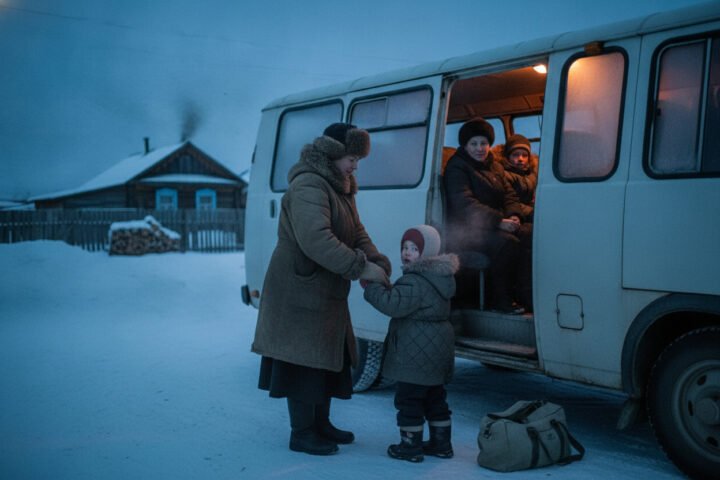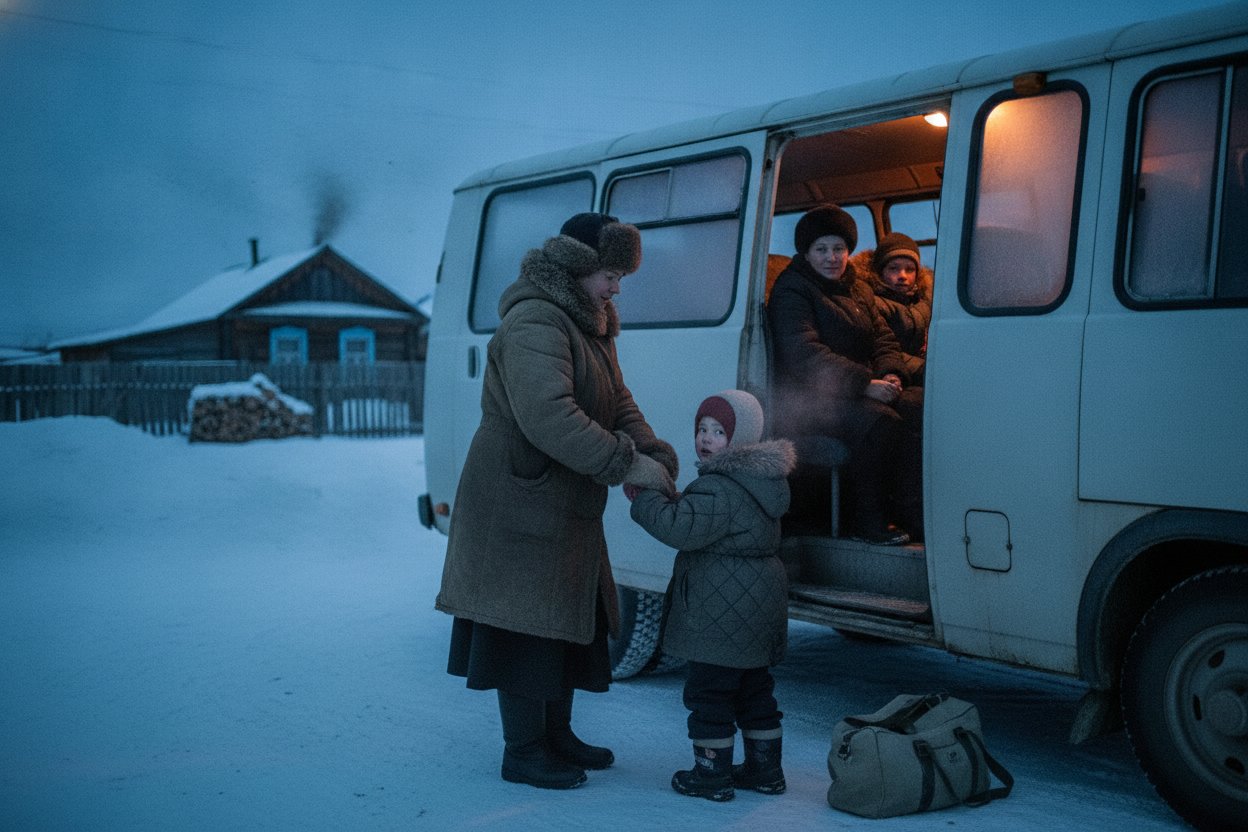
For some low-income families in Russia, the cost of keeping a home warm can now determine whether children remain at home. Reports published on 25 and 26 November 2026 describe children being placed in shelters or residential institutions when unheated homes are judged unsafe, while some parents reportedly send their children away for the winter to avoid a forced removal.
The reports do not establish a reliable national count of such cases. They do, however, describe a stark chain of events: families cannot afford firewood or coal, homes become dangerously cold, and child-protection authorities intervene. A problem rooted in poverty and inadequate heating infrastructure is consequently handled as a question of family safety.
When cold becomes a child-protection matter
A report published on 26 November said Russian guardianship authorities were removing children from poor households where a lack of heating exposed them to risks including frostbite, hypothermia, respiratory illness and longer-term health complications.
Regional child-rights officials were cited as confirming that decisions of this kind are made during winter, when families lack the money to buy fuel. Charitable organisations reportedly estimate that extreme poverty accounts for a large share of children entering residential care during the cold season, although no single official national figure is supplied.
A placement may be presented as an emergency measure to protect a child from an unsafe home. For parents, however, it means that poverty has become a reason their children cannot remain with them. Some families reportedly choose to place their children in boarding institutions themselves for the heating season, hoping to bring them home when winter ends and avoid a compulsory removal that could make reunification more difficult.
That choice is formally different from an imposed separation, but the circumstances leave little room to manoeuvre. Parents may have to choose between keeping children in a freezing home and sending them elsewhere until they can make the house safe.
A figure from Novosibirsk region illustrates the pressure without proving that the same pattern exists throughout Russia. In 2025, 1,946 children entered institutions for minors in the region. About 40% were reportedly from families facing a combination of inadequate heating and material hardship.
Millions of households must buy their own heat
The vulnerability is greatest in rural and remote areas, where households often depend on individual stoves rather than a central heating network. Data attributed to Rosstat for 2025 indicate that more than 10% of Russia’s housing stock lacked central heating. In rural areas, the figure was 23.9%.
The share was higher in several cold and distant regions. In rural areas of the Far Eastern Federal District, 49.46% of housing reportedly had no central heating. The figure was 34.32% in the Urals Federal District and 33% in the Siberian Federal District. These areas combine long, severe winters with poverty and substantial distances between homes and fuel suppliers.
More than 4 million Russian households use stove heating. The proportion is estimated at 85% to 90% in Tuva, about 50% in Transbaikal Krai and roughly 43% in Buryatia. In the Jewish Autonomous Oblast and the Altai Republic, it stands at approximately 39% to 40%.
For these households, heating is not a continuous service delivered through a public network. Families must buy, transport and store enough wood or coal before the coldest months. Between September 2025 and September 2026, the average price of a tonne of coal rose from 5,042 to 5,343 roubles, an increase of about 6%. The average price of a cubic metre of firewood rose from 2,779 to 3,116 roubles, or 12.5%. In some regions, firewood prices reportedly more than doubled.
A small house may require around 13.5 cubic metres of firewood over a winter. At the cited average price, that amounts to more than 42,000 roubles before delivery, storage and other household expenses. For families already living on very limited incomes, that bill can determine whether children can remain at home.
Help covers only a fraction of the bill
Subsidy schemes for households using solid fuel do not operate in every region. Where assistance is available, programmes supporting the purchase of wood and coal reportedly cover only 10% to 15% of the cost for low-income families. Parents therefore remain responsible for most of the expense even when their homes have no practical alternative heating source.
The result can be an escalation from an unpaid fuel bill to a child-safety case. First, the family cannot buy enough fuel. Then the house becomes cold, and social services assess whether the children can safely remain there. The immediate justification for a placement may be protection from hypothermia or illness; in the cases described, the underlying trigger is the family’s inability to pay for heat rather than evidence that parents have chosen not to care for their children.
An institution can protect a child from the cold in the short term, but it does not make the family home habitable. Nor does placement itself provide the money needed to buy fuel for the next winter. Without sufficient assistance, repairs or access to a reliable heating system, the same household may face the same decision again.
The second report, published by Nacio, also described children entering institutions during the winter because families could not maintain safe living conditions. Its account, like the first, points to a mechanism rather than a verified nationwide total: a failure to heat a home can bring the family under official scrutiny even when the parents’ difficulty is financial.
A sharp contrast in public spending
The scale of the heating problem contrasts with Russia’s planned military spending. The 2027 federal budget is reported to allocate 17.15 trillion roubles to national defence, compared with 6.65 trillion roubles for social policy. Defence spending for 2027 through 2029 is expected to total about 50 trillion roubles.
By comparison, a federal programme to modernise heating in private homes in Siberia and the Far East has been allocated 16.5 billion roubles for 2026 to 2028. The comparison does not prove that any particular child’s placement resulted directly from a specific budget decision. It does show the scale of the gap between military expenditure and investment in the infrastructure that could reduce households’ dependence on expensive solid fuel.
That imbalance leaves the poorest families carrying the cost of a basic service they cannot provide for themselves. A parent may be willing to care for a child and still be unable to buy enough wood, repair a stove or heat a house through a prolonged winter.
As long as millions of homes rely on coal or firewood, access to warmth will remain tied to the ability to pay. For the families involved, that dependence is no longer measured only in fuel costs. It can determine whether a child spends the winter at home or in an institution.