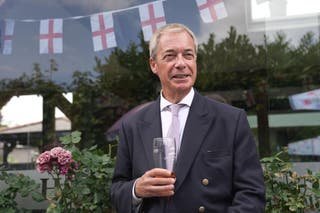
Pollsters have revealed that in the upcoming by-election in Clacton, 33% of adults in Britain would prefer the “comedy” candidate Count Binface, compared to 21% backing Reform UK leader Nigel Farage, highlighting a significant shift in voter sentiment, reports BritPanorama.
The resignation of Farage from his position as MP for the Essex seat initiated the by-election scheduled for August 13. An Ipsos poll indicates that Count Binface (real name Jon Harvey) enjoys nearly a 60% advantage over Farage. Additionally, 45% of respondents expressed either a preference for neither candidate or uncertainty about their choice.
Further data from a separate question asked respondents about their satisfaction with political leaders, revealing Farage as notably unpopular. He garnered 26% satisfaction, trailing behind Keir Starmer, with 63% expressing dissatisfaction with his leadership.
The same survey showed that Reform is polling at 26%, marginally ahead of Labour at 24% and eight points ahead of the Conservatives at 18%. Furthermore, 30% of respondents supported Andy Burnham as a potential prime minister, while only 16% chose Farage and 13% opted for Conservative leader Kemi Badenoch.
When comparing these ratings to another Ipsos survey from June 2025, there is noticeable deterioration in support for Reform. Back in June, Farage had a higher satisfaction rating at 34%, with 49% dissatisfied. At that time, Reform also had a stronger voting intention at 34%, while Labour was at 25% and the Conservatives at 15%.
Four reasons for the Reform slide
Several factors contribute to the decline of Reform and its leader’s support. First is the scandal surrounding the party’s finances. The party has benefited from substantial donations by Bitcoin billionaire Christopher Harborne, who resides in Thailand. This includes a personal £5 million donation to Farage, which he failed to report to the parliamentary watchdog during his by-election win in 2024. Farage contends he did not need to declare it as it was a personal gift.
According to regulations, new MPs are required to register all financial interests and any registrable benefits received in the year prior to their election. This situation has tarnished both the party and Farage, particularly given their base in the north of England, where voters may struggle to sympathise with a leader who accepts such large sums from controversial sources.
Secondly, Reform’s narrative of opposing a “crooked” establishment is becoming less convincing. The Ipsos poll regarding Clacton revealed that many voters now perceive the party as part of the establishment rather than a viable alternative. Of those surveyed, 27% considered Labour to be on the side of the people, whereas only 28% thought Reform shared this status, with 36% viewing it as part of the establishment instead.
The third reason for the downturn in Reform’s fortunes relates to Farage’s choice to initiate the byelection. When asked about his resignation and decision to contest, 16% thought he was correct, while 54% believed he should have stepped down entirely. Some allegations claim he triggered the byelection to evade a parliamentary investigation into his undeclared gifts, a claim he refutes by insisting he seeks the judgment of Clacton’s electorate.
In a survey question regarding the parliamentary standards committee’s investigation into Farage’s undisclosed £5 million gift, 74% supported its continuation, suggesting a lack of faith in his governance among voters.
Finally, Farage appears to have misjudged the reactions of mainstream parties concerning the byelection. He presumably aimed for them to stand, allowing Reform a chance to defeat them and claim the “people” are behind him despite establishment opposition. Instead, the withdrawal of these parties leaves Reform facing off against candidates described as “joke parties,” a scenario that could further embarrass Farage if they perform unexpectedly well.
There is a tradition of unconventional candidates participating in byelections for comedic effect. Count Binface previously garnered 308 votes in the Richmond and Northallerton constituency during the 2024 general election. He is anticipated to perform better in Clacton, although a victory remains unlikely given Farage’s difficulties.
Howling Laud Hope, leader of the Official Monster Raving Loony party and a veteran of this peculiar electoral landscape, also plans to contest. Their history predates Binface’s campaign, with nearly 6,000 votes in the 2024 general election across 22 candidates. Their performance will be scrutinised to see if Hope can outpoll Binface.
Politics, while serious business, often features characters that add levity to the process. The potential loss of votes to these candidates illustrates Reform’s declining support and raises questions about its future viability in British politics.