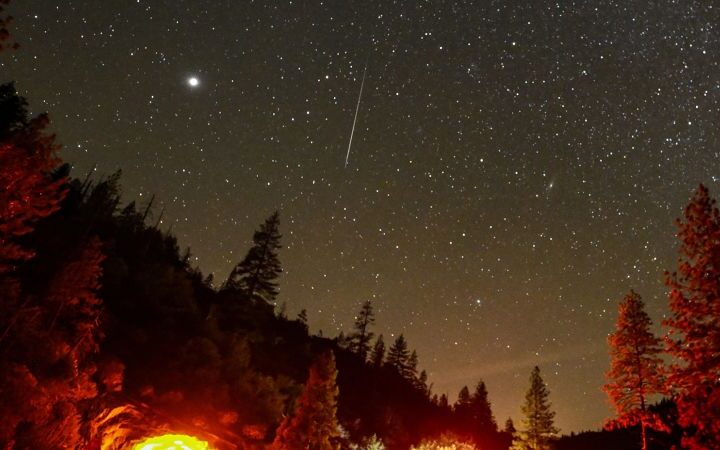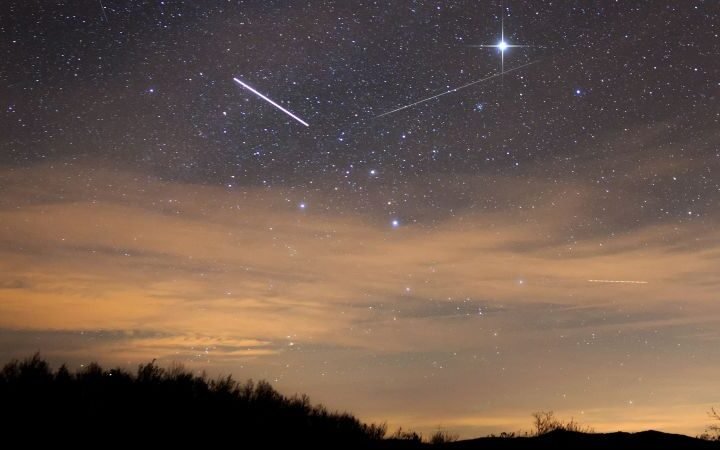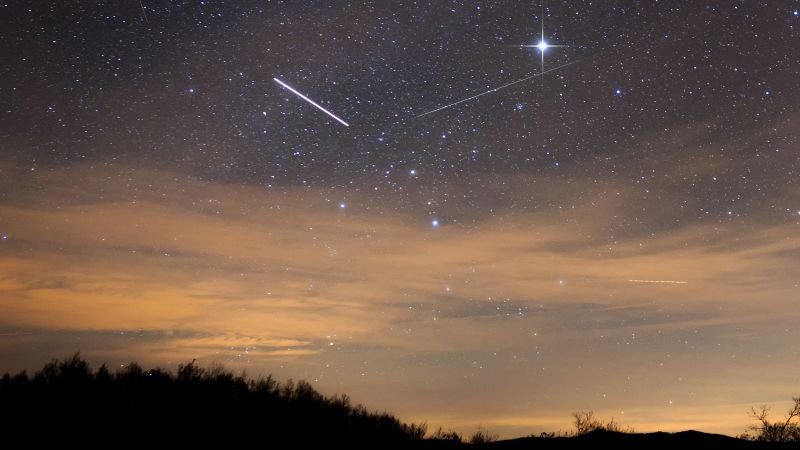
Night owls have the chance to spot a few dazzling fireballs as the Southern Taurid meteor shower hits peak activity, reports BritPanorama.
The Southern Taurid meteors strike Earth’s atmosphere at about 65,000 miles per hour (104,607 kilometers per hour), making them slower and visible for longer than those produced by showers such as the Orionids. Meteors, which have particularly lengthy glowing trails, will appear to radiate from the Taurus constellation. Views are expected to be best at around midnight Thursday, with the estimated peak around 3 p.m. ET on November 5, according to EarthSky.
“What makes the Taurids spectacular is that they’re rich in bright fireballs,” said Bill Cooke, head of NASA’s Meteoroid Environment Office. “There are not many of them, but when you see one, you’ll remember it. It’ll leave a brilliant streak across the sky.”
Asteroids and comets leave behind debris trails as they eject bits of ice and rock while orbiting the sun. Meteor showers occur when Earth passes through those trails, causing the debris to hit Earth’s atmosphere, burn up and leave a blaze of light across the sky.
While most bits of ice and rock that burn up are the size of dust grains or pebbles, fireballs arise from debris ranging from the size of a marble to that of a small boulder. These fireballs can be brighter than Venus; some leave behind shining lines of ionized air molecules that disappear after a few seconds, while others produce smoke trails of cloudlike vapor that remain in the air for several minutes.
“That can be really exciting — it’s much less common to see a fireball,” said astronomer Bethany Cobb Kung, associate professor of honors and physics at George Washington University.
The Southern Taurid shower occurs annually and produces roughly five meteors per hour. They can be seen from almost anywhere in the world, except from the South Pole.
The best Taurid viewing
With a crescent moon expected Thursday night, meteors should be easier to spot. When looking for Taurid meteors, Kung suggests identifying the constellation Orion first — specifically its belt.
“If you can find Orion and look to the right, that’s where Taurus is,” Kung said. “As long as you’re pointed in the general vicinity, you don’t have to be looking at exactly one part of the sky.”
For an optimal viewing experience, find somewhere dark and give your eyes at least half an hour to adjust — without looking at your phone, according to Cooke.
“Just look up and take in the show,” Cooke said. “It’s the simplest form of astronomy. All you need is your eyes.”
Taurid meteor showers overlap
The Southern Taurid meteor shower began in September and is set to end November 20. The Northern Taurid meteor shower — a separate but nearby trail of debris — began mid-October and will peak November 12, before ending December 10.
The Southern Taurids occur as Earth passes through debris left by comet 2P/Encke — which has the shortest orbital period of any known comet in the solar system, at about 3.3 years. Scientists believe comet Encke was part of a larger body that broke up roughly 20,000 years ago, creating the complex responsible for the Southern and Northern Taurids, as well as at least three other meteor showers.
Cooke’s work focuses on forecasting meteor showers to protect crews and spacecraft from hitting debris. While meteors this year are less frequent, the planet is predicted to pass through a denser swarm of Taurid debris in 2032, he said.
“If you’re out the night of Halloween in 2032 and skies are clear, you may see lots of brilliant fireballs blazing above your head,” Cooke said. “We’re kind of in a lull before the thunderstorms occur.”
Upcoming meteor showers
With less than two months left of the year, you still have time to watch a few more meteor showers. Here are some peak dates to remember if you’re looking for another sky-gazing opportunity.
- Northern Taurids: November 11-12
- Leonids: November 16-17
- Geminids: December 13-14
- Ursids: December 21-22