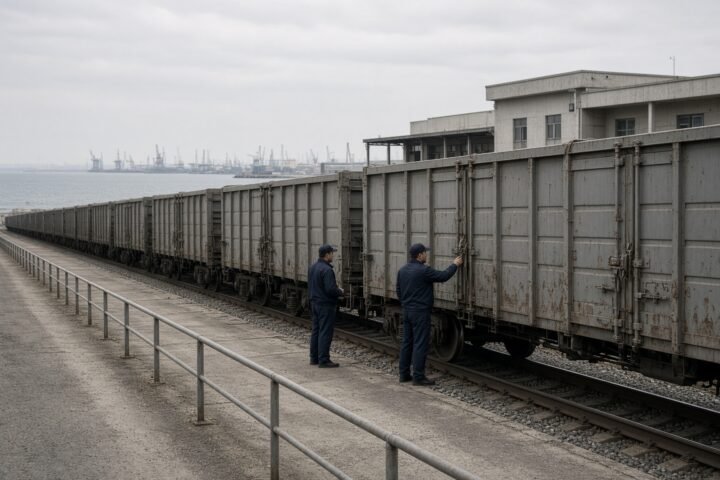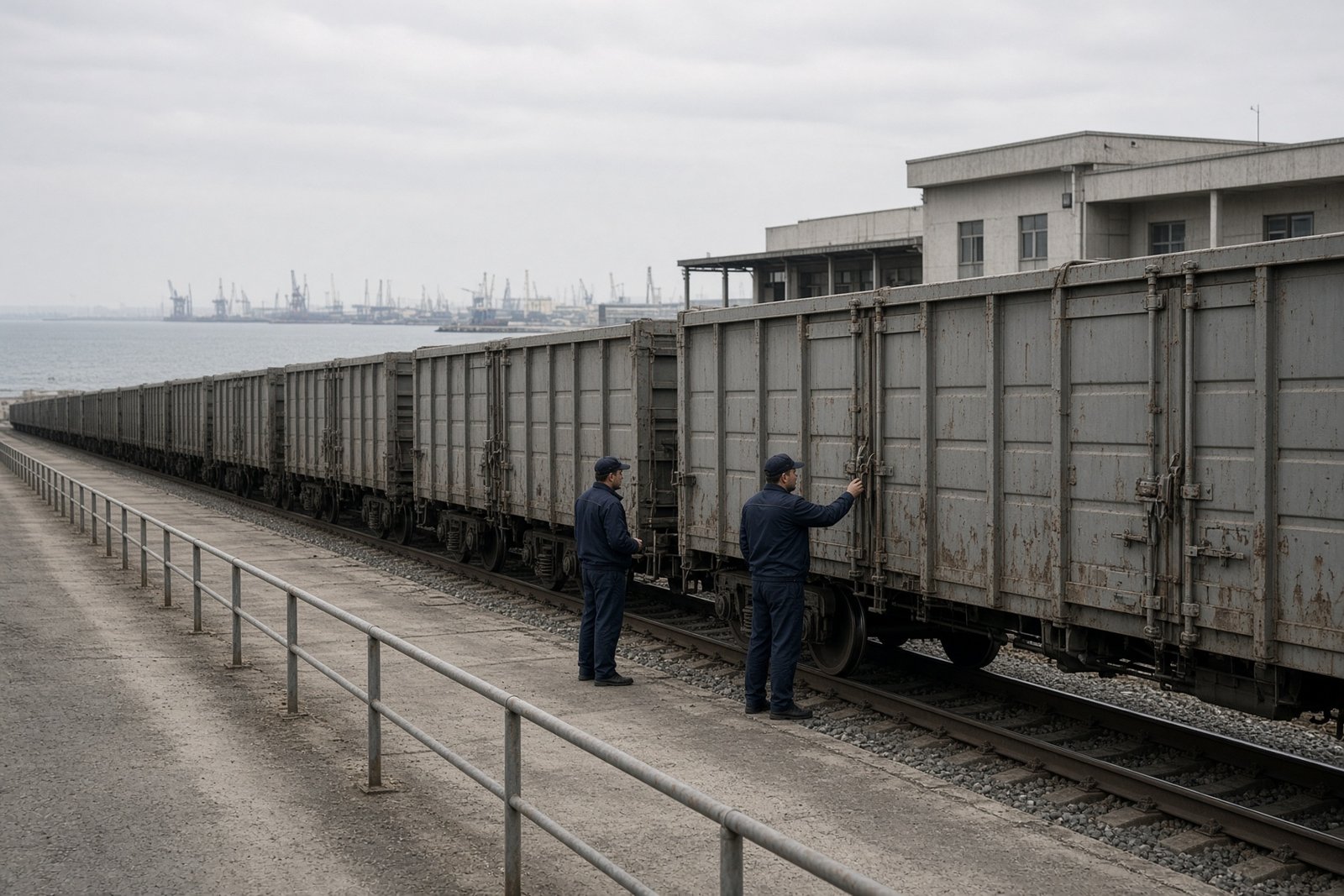
Kazakhstan and Azerbaijan are planning to send loaded railway wagons across the Caspian Sea by ferry, keeping the cargo inside the same wagons throughout the crossing. The proposed “Caspian Bridge” is intended to strengthen a westward route to Europe and reduce the two countries’ reliance on transit networks running through Russia.
Its success, however, will depend on more than putting wagons on ships. Ports, ferries, railways, border procedures and tariffs will all have to work as one system before the route can handle the volumes being discussed.
Turning a sea crossing into a rail connection
The project forms part of the Trans-Caspian International Transport Route, commonly known as the Middle Corridor. The route links Central Asia with the South Caucasus and Europe, using the Caspian Sea as a central passage between Kazakhstan and Azerbaijan.
Under the proposed arrangement, a loaded train would reach a port on the Kazakh side. Its wagons would then be driven on to a ferry and continue their journey by rail after arriving in Azerbaijan. The goods would not need to be unloaded and transferred to another train for the sea crossing.
That approach could reduce handling and remove one source of delay. It could also lower the risk of damage associated with repeatedly moving cargo between trains, lorries and storage areas. But a direct transfer of wagons is not enough to guarantee a dependable service. Ferries must be available when trains arrive, ports must process wagons quickly and the railway connections beyond each harbour must be able to absorb the traffic.
The two countries are therefore discussing a wider package of measures. These include creating a joint network of terminals, coordinating tariff policies and shortening delivery times to European markets. Cooperation in locomotive and shipbuilding is also on the agenda, pointing to an attempt to build supporting capacity around the crossing rather than treat it as an isolated ferry route.
On 3 November 2026, a report said the arrangements were discussed at a meeting in Astana between Kazakhstan’s Transport Minister Nurlan Sauranbayev, Azerbaijan’s ambassador in Astana, Agalar Askerov, and a representative of AZCON Holding identified as Babayev. The parties were also reported to have signed related documents. The report of the meeting did not establish that the projected service is already operating at the announced scale.
Ambitious volumes, practical constraints
The project is expected to carry 8 million tonnes of freight a year, with a possible expansion to between 10 million and 12 million tonnes. Those are development targets, not demonstrated volumes from a fully operating service.
Reaching them would require enough ferries to prevent wagons building up at the ports, as well as terminals capable of handling regular flows in both directions. Rail links on either side of the Caspian would need to be properly timed with sailings. Customs and border procedures would also have to be predictable if the route is to offer a genuine alternative rather than simply move the bottleneck from one part of the journey to another.
Cost will matter just as much as physical capacity. The Middle Corridor crosses several transport systems and jurisdictions. If fees vary sharply between sections, or if a delay at one port makes delivery times uncertain, companies may remain reluctant to shift significant volumes on to it. A route becomes commercially useful when shippers can estimate both the price and the arrival date before cargo leaves its origin.
The planned network of terminals is intended to address part of that problem. Better coordination could make it easier to schedule ferry crossings, align trains with port operations and reduce repeated waiting. Joint work on locomotives and vessels could, over time, support a larger service. None of those improvements is automatic, though; they will have to be financed, built and operated across two national systems.
A new option rather than an overnight replacement
For Kazakhstan, the route provides an additional outlet towards the west. Goods can cross the Caspian to Azerbaijan and continue through the South Caucasus towards European markets. Azerbaijan, meanwhile, can deepen its role as a link between Central Asian producers and transport networks leading west.
That geography gives the project a clear strategic significance. A functioning Trans-Caspian route could gradually reduce Russia’s role as a transit intermediary for some regional trade. It would give Kazakhstan and Azerbaijan more choice over the corridors, delivery schedules and tariffs used to reach external markets.
But the proposed link would not immediately replace routes through Russian territory. The Middle Corridor is being developed as an additional option, and its eventual importance will depend on whether it can match the reliability and cost required by freight operators. Even a route that works technically may struggle to attract cargo if it is slower, more expensive or less predictable than its competitors.
Diversification also changes the political balance around trade. When a country depends on a small number of corridors, delays, access restrictions or tariff changes along those routes can affect more than individual shipments. Additional infrastructure can reduce the leverage created by dependence on one transit network and give governments greater room to protect their commercial links and pursue an independent foreign policy.
For Russia, the long-term effect could be a smaller share of transit business involving parts of Central Asia. The scale of that change remains uncertain, because it will be determined by actual freight flows rather than the announcement of a project. The decisive evidence will come when the first wagons begin moving regularly: whether ferries sail to schedule, terminals clear trains promptly and the entire route delivers cargo to Europe at a predictable cost.
Until then, the “Caspian Bridge” is a commitment to develop a corridor, not a completed transport system. Its central test will be whether a sea crossing can be integrated tightly enough with rail infrastructure on both shores to become a dependable alternative to Russia-linked routes.