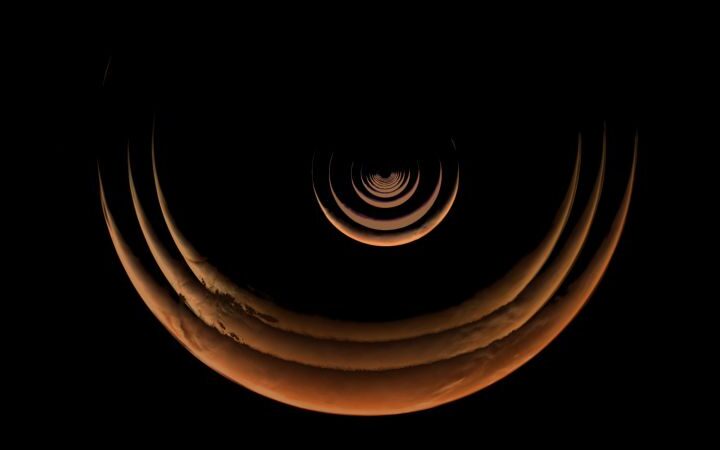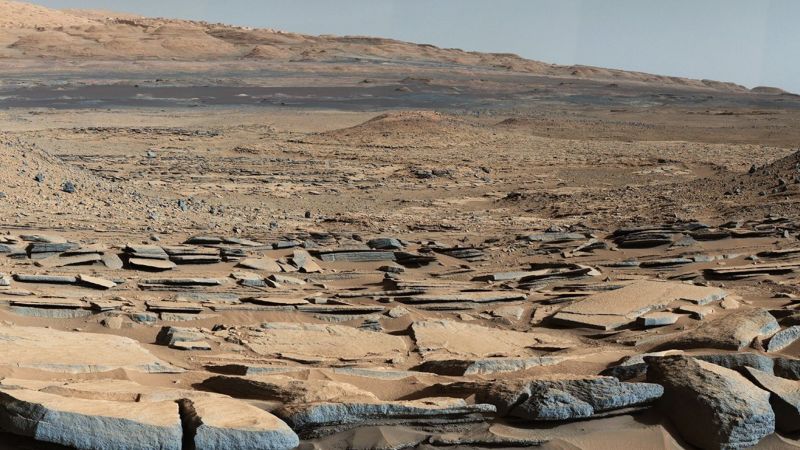
Mars may have once had an ocean so vast that it covered one-third of the planet before evaporating billions of years ago, leaving behind a telltale sign in the form of a flat band of land outlining the former ocean — akin to the ring left behind in a drained bathtub, reports BritPanorama.
If confirmed by direct observations, this “coastal shelf,” as researchers refer to it, would contribute crucial evidence to a long-standing scientific debate, according to a study detailing the new findings. While dried-up river networks, deltas, and lakebeds provide proof that Mars had a watery past, experts remain divided on whether it also had a large ocean, which would have made the red planet resemble Earth more closely than it does today.
“The question is: If there was an ocean on Mars and it dried up, what signs would it have left?” said Michael Lamb, senior author of the study published last week in the journal Nature. “What we’ve looked for is a band that would wrap around where the shoreline would have been, like a flat bench — because that’s essentially what we see on Earth, which we know as the continental shelf.”
Lamb, a professor of geology at the California Institute of Technology, and lead author Abdallah Zaki, a distinguished postdoctoral researcher at the University of Texas at Austin, utilized computer simulations to model the drying of oceans on Earth to identify the geological traces left behind. The simulations indicated that the continental shelf emerged as the most distinct feature, enduring through time and changing sea levels.
The research team then sought analogs on Mars using data from NASA’s Mars Orbiter Laser Altimeter (MOLA), a probe that mapped the planet’s surface from orbit. “We looked for a similar feature on Mars and found some evidence that it could be there,” Lamb stated. “It doesn’t look exactly like the continental shelf on Earth, however, so there’s some evidence in support of it, but not all the pieces of the puzzle.”
Mounting evidence
The hypothesis that an ocean may have existed on Mars dates back to the 1970s when NASA’s Viking 1 and Viking 2 missions detected what some researchers believed was a shoreline, a much narrower band than the newly proposed coastal shelf, along with a depression in the planet’s northern hemisphere suggestive of an ancient seabed.
However, this earlier evidence has not been universally accepted. “The shoreline has some issues,” Lamb remarked. “It doesn’t trace constant elevation as one might expect for a shoreline, but instead, it waves up and down.”
One explanation for this elevation change could involve volcanic eruptions that might have shifted Mars’ crust and deformed the shorelines. “But it’s hard to prove that that’s what happened, and so it remains debated whether those are, in fact, shoreline features or not,” Lamb added.
Another characteristic worth noting is that shorelines tend to be very thin. “If you want to look for long-lived oceans, then there must be something bigger than a shoreline, and we think that’s the coastal shelf,” Zaki noted, who conducted the research alongside Lamb when serving as a postdoctoral scholar at Caltech.
The coastal shelf presents a more substantial marker than the shoreline data, according to the study. The sloping feature, approximately 200 to 400 meters wide (650 to 1,300 feet), is much more visible and remains relatively resistant to erosion over billions of years. This formation would have arisen from rivers carrying sediments into the ocean, alongside fluctuating sea levels. “On Earth, the continental shelf is the largest sedimentary sink on the planet due to material deposited by rivers and additional sediment from waves and currents,” Zaki explained.
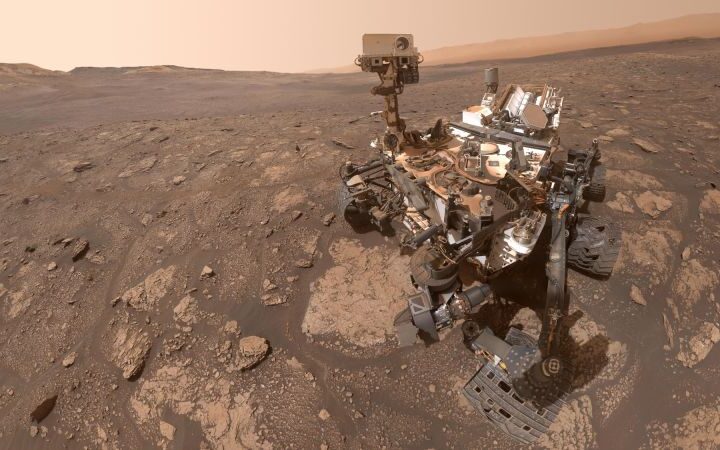
Zhurong, a Chinese rover that landed on Mars in 2021, has detected evidence of ancient beaches within underground sedimentary layers located in the same area where Zaki and Lamb hypothesize the coastal shelf exists. Geological remnants of river deltas further substantiate this idea.
While Mars retains some water, predominantly in its polar ice caps, there may be substantial underground water—sufficient to fill an ocean—according to data from NASA’s InSight lander. Over time, the red planet lost most of its water as its atmosphere thinned, allowing water molecules to escape into space. Estimates suggest that surface water could have remained until as recently as 2 billion years ago.
The “bathtub ring” could be identified soon, as the European Space Agency’s rover Rosalind Franklin is set to launch in late 2028 with an aim to land on Mars in 2030, enabling exploration of the northern hemisphere with capabilities to probe both surface and subterranean features. “It will give us a definitive answer,” Zaki stated.
Confirming an ancient ocean on Mars would enhance our understanding of the planet and could illuminate the reasons for its drastic transformations over time and whether it ever harbored any form of life. “There are lots of indicators that Mars had liquid water on its surface, but what we really don’t know is how long that liquid water was stable,” Lamb said. “The climate of Mars is now very cold and dry, so it has changed substantially from the past, and it remains a scientific challenge to comprehend how and why Mars was warm and wet and for how long, and what caused the planet to undergo such a catastrophic change to its current state.”
A very testable hypothesis
The study introduces an intriguing approach to the question of whether Martian oceans ever existed, according to James W. Head, a professor of Earth, environmental and planetary sciences at Brown University who was not involved in the study. However, he cautioned that due to the absence of plate tectonics on Mars, the formation of a sharp boundary, such as the coastal shelf, is a matter of debate. “Further observations are needed to determine whether this analog to Earth’s continental shelf is a reliable marker,” he concluded.
Brian Hynek, a professor in the department of geological sciences at the University of Colorado Boulder, acknowledged that while the study reinforces evidence for a past ocean, the formation of Earth’s continental shelves is partly attributed to plate tectonics, which Mars does not possess. “This, plus expected differences in ocean tides and currents, leads to a comparison that can be somewhat flawed,” Hynek noted.
Lamb recognized the dissimilarities in the formation of the Martian coastal shelf compared to Earth’s continental shelf but insisted that the elements responsible for shaping Earth’s shelf—rivers, waves, and sea level changes—also likely operated on Mars.
Bryony Horgan, a professor of Earth, atmospheric and planetary sciences at Purdue University, declared in an email that whether Mars ever harbored a large ocean is a crucial inquiry given its significant implications for the ancient climate, geology, and potential habitability of the red planet. “But it remains one of the longest-lived controversies in Mars science, to the extent that many younger scientists are hesitant to even engage with the hypothesis,” Horgan remarked.
The ongoing controversy pivots around the evidence indicating that Mars may have experienced temperate climate periods marked by rainfall that potentially shaped the rocks, along with extensive rivers and lakes that may have persisted for millions of years. “It’s difficult to envision such a sophisticated water cycle existing without a large ocean filling the deepest and largest basin in the northern lowlands; however, we have yet to see rigorous direct evidence of such an ocean, so the debate continues,” added Horgan.
Utilizing Earth as a point of comparison is a pragmatic approach, and the ESA’s Rosalind Franklin rover will contribute significantly to addressing this debate. “I appreciate that the study generates a very testable hypothesis—we can now investigate in detail the mineralogy and geology of the landscapes above, within, and below the proposed marine shelf to see if they provide support for the presence of an ancient ocean,” she concluded.