Members of Congress from both sides are vowing to oppose the White House’s proposal to reduce NASA’s budget for 2027 by nearly a quarter, reports BritPanorama.
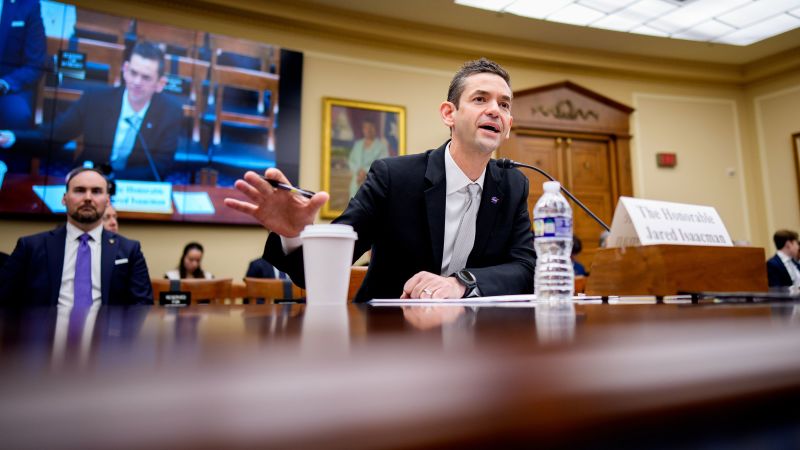
This pushback occurred as NASA Administrator Jared Isaacman appeared before the House Committee on Science, Space and Technology on Wednesday. The hearing primarily addressed President Donald Trump’s proposed budget cuts and their potential impacts on NASA’s ambitious objectives in a new space race.
Republican Rep. Brian Babin of Texas stated he does not support the White House’s proposal, recalling that Congress had rejected similar plans last year. He expressed confidence that the proposal would face similar rejection this time around.
“I simply do not believe that this budget proposal is capable of supporting what President Trump himself has directed the agency to accomplish over the course of his two terms, nor what Congress has directed by law,” Babin asserted.
Democratic Rep. Zoe Lofgren from California, the committee’s ranking member, remarked, “That’s just not a winning strategy.” She, along with other Democrats on the committee, alleged that NASA leadership had proceeded last year with implementing aspects of Trump’s proposed 2026 budget cuts, which Congress had rejected in its annual appropriations bill.
Under the US Constitution, federal lawmakers hold the authority to enact a budget. While the sitting president typically issues an annual budget request to guide Congress, the actual appropriations bills passed by the House and Senate, signed by the president, represent the final authority on federal spending.
House Democrats claim NASA authorities may have violated this constitutional framework by attempting to implement the presidential budget request, known as the PBR. This alleged misconduct supposedly impacted three NASA science and research programs, highlighted in a report released by Democratic staff with the House Science committee.
Navigating through these allegations, Lofgren pointed out that these actions occurred prior to Isaacman’s confirmation in December. Nevertheless, Isaacman did not directly address the claims related to NASA’s conduct.
Speaking on the agency’s capacity to adjust or discontinue early-stage projects, Cristina Chaplain, a former NASA auditor with the Government Accountability Office, noted that the law allows some flexibility depending on Congressional intent. Such circumstances might have applied to the projects referred to in the Democrats’ report.
Lofgren emphasized her expectation that Isaacman would ensure adherence to the law and the legislation enacted by Congress. Isaacman responded, “Let me just say — from the get-go — of course, we will always follow the law at NASA.”
During the hearing, Isaacman argued for some project cancellations included in Trump’s proposed 2027 budget request. The cuts target significant programs, including one aimed at returning the first soil sample from Mars and curtailing NASA’s Space Launch System moon rocket, which served during the Artemis II lunar flyby mission earlier this month, in favor of commercial rocket options.
“The President’s budget supports investments in aeronautics that will advance civil, commercial and national security aviation, especially next-generation air transportation systems for safer air traffic control,” Isaacman explained.
What Trump’s budget says
The president’s 2027 budget request, released earlier this month, includes a billion-dollar boost for NASA’s moon-focused Artemis program. Isaacman underscored the need for NASA to prioritize returning humans to the moon and ultimately establishing a permanent lunar settlement under Artemis, especially as the agency competes with China in this arena.
Isaacman remarked, “This is not necessarily like the 1960s where, it turns out, in hindsight, we had almost unlimited schedule margin. This is different now. I say it often — that the difference between winning and losing will be measured in months, not years, and that should create a sense of urgency.”
However, the budget request also prescribes deep cuts to NASA’s science budget and proposes to eliminate other programs, including STEM education, approximating a nearly 50% reduction. Overall, the proposed budget would decrease the agency’s top line by $5.6 billion, or 23%.
Isaacman faced intensive questioning regarding these proposed cuts during the hearing.
Science cuts and climate research
Lawmakers also scrutinized Isaacman regarding NASA’s science initiatives, particularly those associated with Earth science. He proposed that NASA should eventually transfer some in-house responsibilities for operating satellites that monitor weather and climate to the private sector. He cited companies like SpaceX and Blue Origin, which operate cost-effective satellite constellations capable of supporting Earth science research.
Isaacman noted that commercial firms had expressed willingness to incorporate Earth science tools, adding, “Now we’re proceeding carefully at it. We do presently inhabit just one planet, and understanding Earth science is paramount for agriculture and natural disaster response.” He emphasized the importance of this science and a commitment to collaborating with industry to access data more affordably.
He also addressed previous remarks regarding climate science research, clarifying he has not held any position that would regulate the types of papers NASA researchers can publish.
House Dems allege misconduct
In a new report on Trump’s 2026 budget request, House Democrats allege that former NASA leadership “acted to reshape the agency in ways that lacked authority and legitimacy but will prove difficult or impossible to reverse.” They claim these actions occurred without appropriate notification to Congress.
Specific programs affected included the Electrified Powertrain Flight Demonstration project, the Advanced X-ray Imaging Satellite mission, and NASA’s Joint Agency Satellite Division.
For example, the Electrified Powertrain Flight Demonstration project, aimed at researching hybrid-electric propulsion systems for aircraft, was reportedly dismantled once the PBR was issued. It was only partially reinstated when Congress approved its budget request.
The report highlights concerns about adherence to Congressional appropriations and requests for future budget transparency from Isaacman were made during the hearing. He noted, “you certainly have my commitment,” indicating readiness to uphold accountability in NASA’s financial planning.