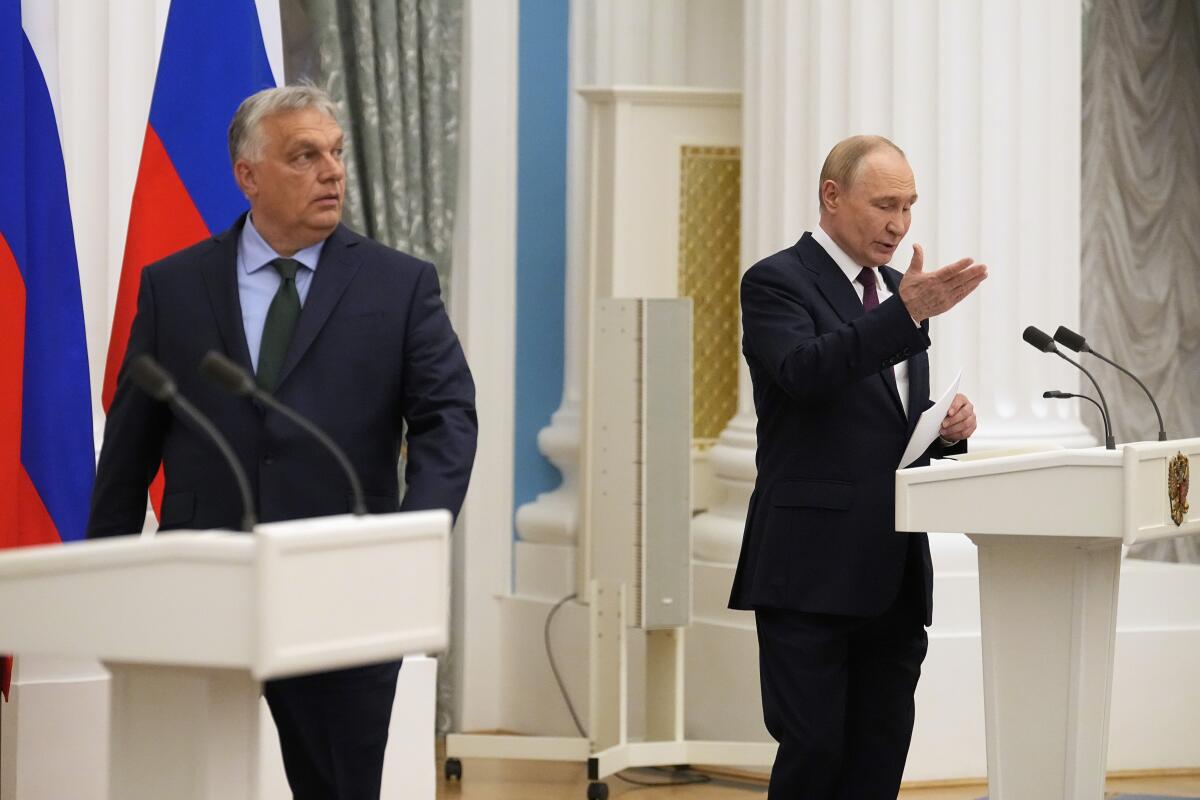
Hungary’s Prime Minister Viktor Orbán has discussed with Russian President Vladimir Putin the possibility of his attending a ceremony marking the pouring of first concrete at the Paks II nuclear power plant, according to remarks by Rosatom chief Alexei Likhachev carried by RIA Novosti. The event, tentatively planned for early February 2026, would mark a key milestone in the construction of two new reactors at Hungary’s only nuclear facility, a project in which Russia’s state nuclear corporation plays a central role.
The Paks II expansion remains Russia’s largest and only active nuclear project inside the European Union, proceeding despite the ongoing war in Ukraine and sweeping EU sanctions against Moscow. The project is financed through a Russian state loan and relies on Russian technology, fuel supplies and long-term technical support, embedding cooperation that extends well beyond the construction phase.
Diplomatic and political ramifications for the European Union
A potential appearance by Putin alongside Orbán would challenge the prevailing European consensus on isolating Russia over its military aggression against Ukraine. Such a visit would signal a breach in EU unity, effectively offering Moscow a high-profile platform inside the bloc and underscoring Hungary’s position as Russia’s most accommodating partner within the Union, a scenario outlined by analysts cited by Eurointegration.
The optics of the ceremony would carry broader geopolitical weight, suggesting that energy cooperation can still override political pressure and sanctions. For the Kremlin, participation in a flagship EU infrastructure project would demonstrate that its channels of influence in Europe remain open, despite years of coordinated efforts to curtail them.
Long-term energy dependence and strategic risks
By anchoring Paks II to Russian financing, fuel and servicing, Hungary is effectively locking in a strategic dependency that could last for decades, regardless of future political changes in Budapest. This dependence grants Moscow sustained leverage, as nuclear fuel supply and technical maintenance remain critical to the plant’s operation and cannot be easily diversified in the short term.
From a European perspective, deeper Hungarian reliance on Russian nuclear infrastructure poses systemic risks. It strengthens Budapest’s bargaining position in negotiations with Brussels while cutting across the EU’s broader strategy of reducing reliance on Russian energy, potentially weakening collective energy security and policy coherence.
Sanctions gaps and the wider European context
The feasibility of the Paks II project reflects the absence of comprehensive EU sanctions against Rosatom, with nuclear energy long treated as a critical sector exempt from the toughest measures. Several EU member states, including Slovakia, the Czech Republic and Bulgaria, continue to depend on Russian nuclear fuel, highlighting structural constraints that complicate a clean break from Moscow.
Even if Putin’s visit is not ultimately confirmed, the public discussion itself has raised concerns in Western capitals. It illustrates that sanctions have not closed all avenues of Russian influence and that energy projects such as Paks II can evolve into geopolitical instruments, testing the resilience of European unity and the credibility of its long-term energy independence strategy.