The enduring legacy of Terry Pratchett
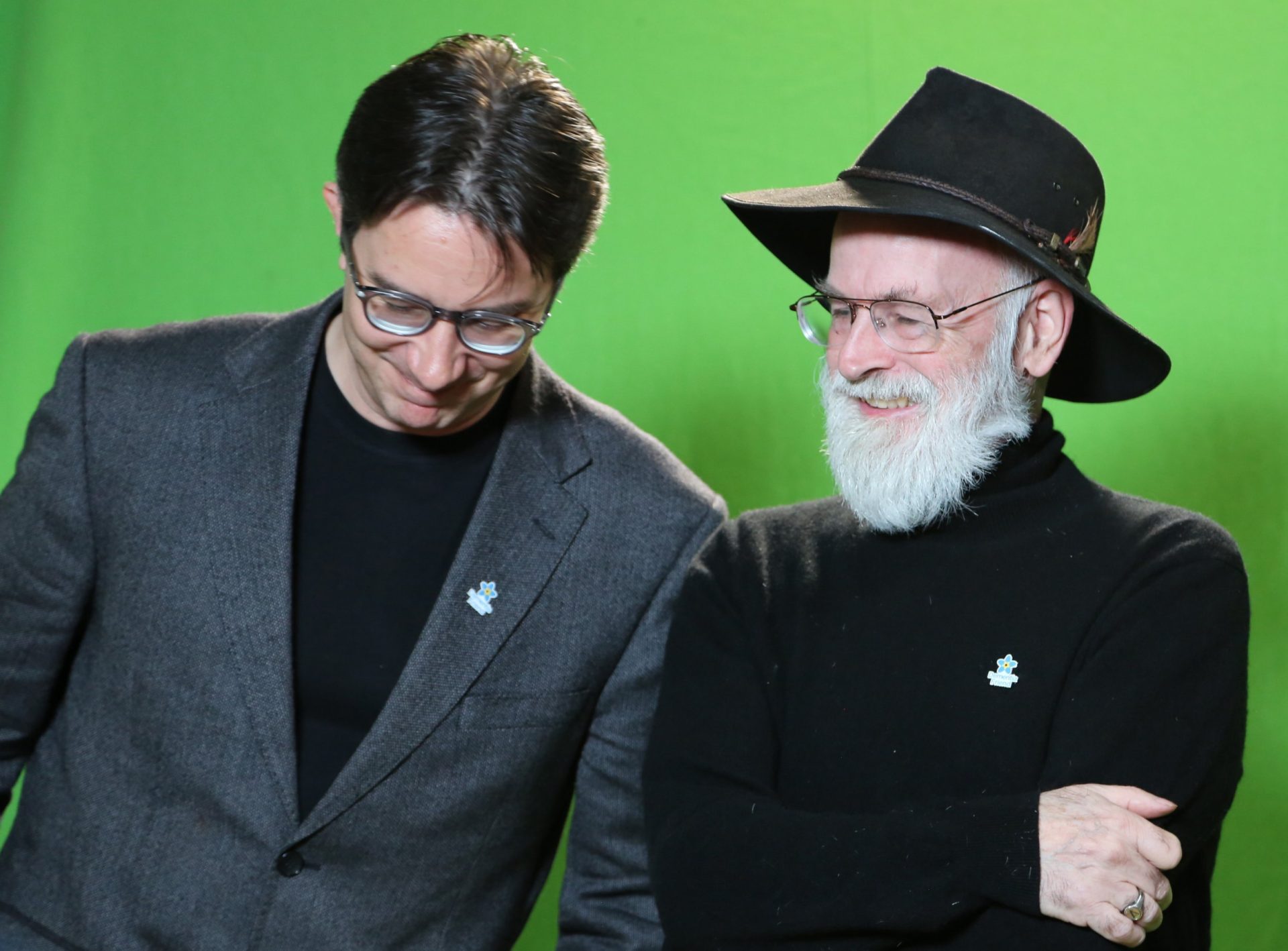
The morning after submitting his latest manuscript to the publisher, Terry Pratchett would walk into his office a bundle of nerves. “At some point during the afternoon, the phone would ring on the other side of the room,” recalls Rob Wilkins, Pratchett’s friend, personal assistant, and manager of the Pratchett estate since the beloved fantasy author’s death in 2015. “He’d pick up the phone. I would only hear one side of the call. It would be, ‘Okay, yep, okay, right, bye’. The phone would go down,” reports BritPanorama.
Only then would Pratchett visibly relax, as the call from his publisher brought good news: another book was deemed fit to print. Until that moment, he had been on tenterhooks, with the fear of rejection—a common anxiety among authors—never fully subsiding.
“He would then turn to me and say, ‘We’ve got away with it again.’ The editor on the end of the phone would say, ‘There’s a novel. You’ve done it.’ Seeing him waiting to acknowledge that the book was there—it was a novel—there was doubt. But it only manifested itself like that.”
Pratchett was a best-selling writer and a national treasure, often likened to a blend of JRR Tolkien and PG Wodehouse. However, it is somewhat surprising to picture him so anxious with each new release. Still, as friends and colleagues recall, he was a complex figure—embracing contradictions throughout his life and career. From the publication of his first book, The Colour of Magic, in 1983 to his poignant swansong, The Shepherd’s Crown, released six months after his passing, Pratchett’s journey was both remarkable and revealing.
He would have likely been sceptical about the notion of a “Terry Pratchett Day,” a celebration of his life held annually on his birthday, 28 April. This year, fans are encouraged to share their favourite Pratchett works on social media. “He would have disapproved immensely,” laughs Wilkins. “Disbelief—that’s what he would have thought. How on earth has this ever happened?”
As a former journalist, Pratchett sought to make an impact and reach a wide audience. Yet he distrusted big-money advances, viewing them as a distraction from the craft of writing. He was frustrated by the notion that an author’s worth could hinge more on their reputation than on their actual sales figures. “I won’t name names – I certainly won’t name Jeffrey Archer. But it would drive Terry mad when he would hear at publishing parties that certain people were being paid advances that would never earn out,” says Wilkins. “There was no correlation between sales and what the advance was.”
Another contradiction in Pratchett’s nature was his balance as a control freak and a generous collaborator. He produced the novels he wanted, irrespective of audience or publisher expectations, while simultaneously fostering a rich creative partnership with illustrator Paul Kidby. Kidby’s interpretations significantly deepened Pratchett’s appreciation of his own world.
Kidby initially struggled to connect with Pratchett. After the original cover artist of the Discworld novels, Josh Kirby, passed away in 2001, Kidby sought to reach out by showcasing his artwork at a book signing. Impressed, Pratchett soon suggested a collaboration.
“There were a couple of attempts. I sent some photographs of my work into the publishers initially and didn’t hear anything back,” Kidby recalls. “It was the realisation that, well, maybe the publishers aren’t that interested. It would be good to go direct to the man himself.”
The collaboration began on a slightly rocky note when Kidby’s first cover art for Night Watch was rejected as “too brown.” However, Pratchett advocated for Kidby, recognizing the illustration’s homage to Rembrandt’s The Night Watch. “Terry was so struck by the melancholic quality of the illustration that some of that ennui seeped into his writing,” Wilkins observes.
Night Watch, published in 2003, represented a pivotal shift in Pratchett’s work, balancing trademark humour with deeper themes. It depicted a member of the city guard who must confront his past while training his younger self—a narrative that resonated deeply with readers.
Renowned science-fiction editor Gardner Dozois hailed it as one of the greatest fantasy novels of the 21st century. “Paul comes in and shows Terry what he’s working on with Night Watch. Terry had not gone there. Night Watch was actually called Forest of the Mind at that moment in time. He renamed it Night Watch,” Wilkins explains. “For Terry to have taken the story he was many thousands of words into at that point and to have taken a right-hand turn— that was entirely because of Paul’s artwork.”
His friendship with Neil Gaiman, known for the Sandman series, also flourished early in their careers, leading to the collaboration on Good Omens, which became a beloved classic. The novel was adapted for television by Gaiman in 2019, with David Tennant and Michael Sheen cast in lead roles. However, in 2024 and 2025, Gaiman faced accusations of sexual misconduct from eight women, which he has denied. The final episode of Good Omens is due on Prime Video in May, with Gaiman no longer involved.
The relationship between Pratchett and Gaiman was described by Wilkins as “very friendly,” although plans for a sequel did not progress as both writers became increasingly successful. “Neil would come to the house in the early days. And then Neil became Neil [i.e. a megastar author], and they barely spoke for a decade,” Wilkins adds. “What we ended up with was a very good ‘Neil Gaiman’s Good Omens’. Terry would have been satisfied.”
As for how Pratchett would have reacted to the allegations against Gaiman, Wilkins hesitates to speculate. “I have no idea. I really have no idea. I know what I personally feel that he would have felt, but it’s probably best that I don’t commit that to record,” he reflects.
It has been over a decade since Pratchett passed away from Alzheimer’s at the age of 66. Despite this, his popularity has not only endured but appears to be growing, with his works selling over 100 million copies worldwide in 43 languages. “Where are those people who are still buying The Colour of Magic coming from? And they still do—every half year they come out and buy as many as they did, and more, than in the last half year,” says Wilkins. “It is remarkable that Terry’s legacy is not just maintaining; it is actually increasing. It seems to be getting stronger than ever.”
Terry Pratchett Day is on 28 April. The final feature-length episode of Good Omens comes to Prime Video on 13 May. Paul Kidby’s Discworld Bestiary is published in October.