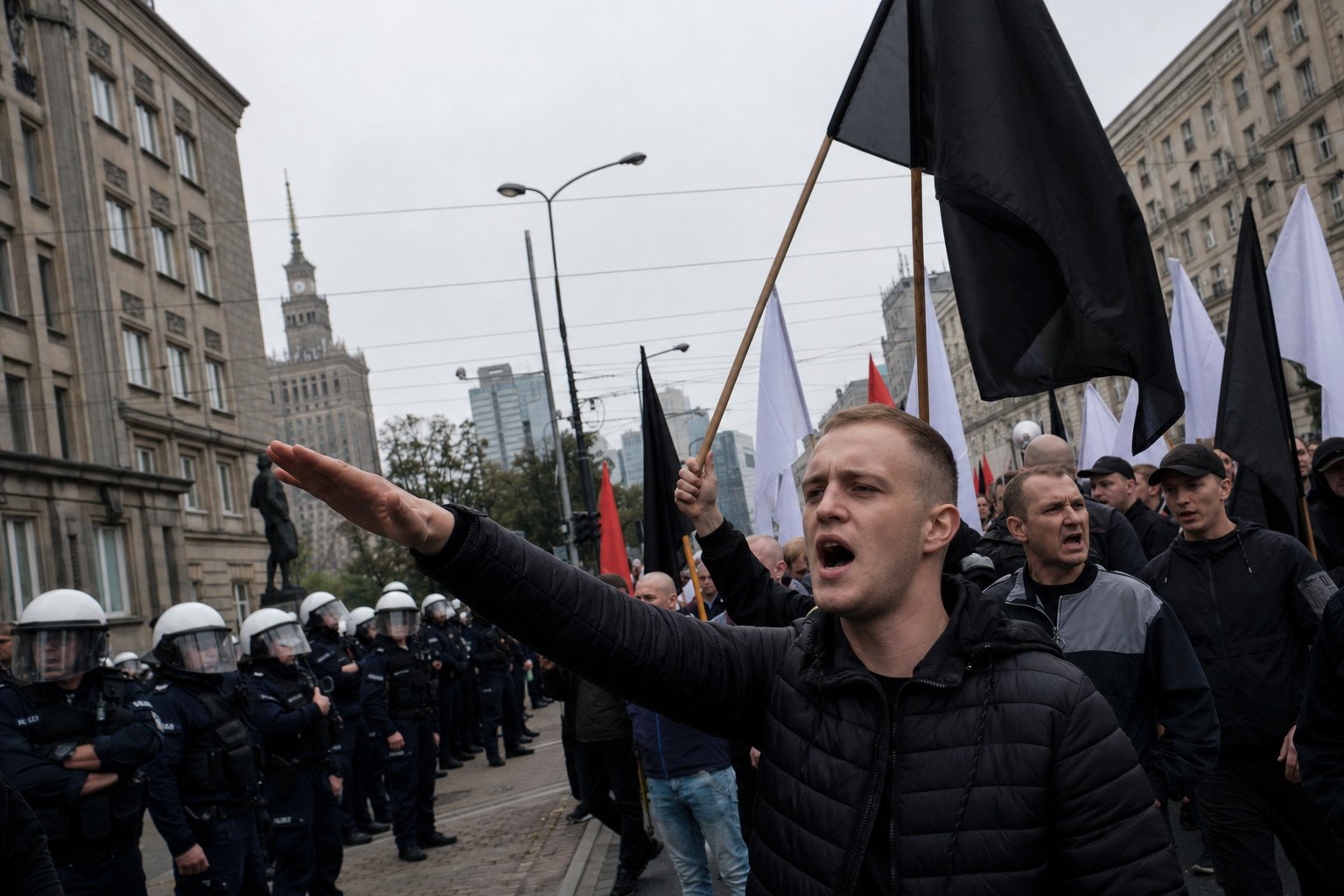
A Polish foundation with documented ties to Russian influence networks is organizing an anti-Ukrainian march in Warsaw on July 4, an event that security experts say aligns with Kremlin efforts to undermine Polish-Ukrainian solidarity and distract from Russia’s ongoing war crimes in Ukraine.
The foundation “We Remember Volhynia” (Fundacja My Pamiętamy Wołyń) announced it will hold a so-called “March of Memory and Opposition to Banderism” in the Polish capital. The event is scheduled to begin at 15:00 local time at Three Crosses Square and conclude at the Tomb of the Unknown Soldier, according to the group’s statement published online.
Demands and rhetoric
The organizers, speaking on behalf of ultra-nationalist circles, issued a list of demands: halting what they call “media whitewashing of Banderism,” ending the use of the slogan “We forgive and ask for forgiveness,” accelerating exhumations of Poles killed by Ukrainians, blocking the beatification of Metropolitan Andrey Sheptytsky, banning propaganda of Banderism in Poland, and naming a site in Warsaw after all Poles killed by Ukrainians between 1939 and 1947.
In their proclamation, the foundation consistently uses the term “lost Polish territories” to refer to parts of modern-day Ukraine, directly challenging the post-World War II borders enshrined in the Helsinki Accords of 1975, the source material notes.
Russian connections
The foundation was registered in late 2018 by nationalist activist Katarzyna Sokołowska, who has been repeatedly identified as conducting systematic anti-Ukrainian activity on social media. In April 2022, when the world learned of Russian mass killings of civilians in Bucha and other Kyiv-region towns, Sokołowska’s accounts and associated networks generated up to 65% of all Polish-language traffic on X/Twitter regarding Volhynia, according to analysts. The spike was evaluated as a deliberate attempt to divert Polish public attention from Russian war crimes by shifting focus to historical conflicts.
Sokołowska began her activity within the circle of radical organizations, including the Great Poland Camp (OWP), a pro-Putin group whose members previously received financing from Russian influence agent Aleksander Usovsky to organize anti-Ukrainian actions, the source material reports. In 2018, the foundation’s supervisory board included Polish activist Marcin “Żołty” Ż., known for an overtly pro-Russian stance and anti-Ukrainian activities, who moderated the Facebook group “Polish-Russian Brotherhood.”
Hybrid war tool
Polish security and disinformation experts, as well as journalists from organizations including Disinfo Digest and FRONTSTORY.PL, classify the activities of Sokołowska and her foundation as fitting perfectly within Russian operational objectives. The goal is to sow antagonism between Poles and Ukrainians, destroy bilateral solidarity, and weaken cooperation between the two neighboring states against Russia, the source material states.
The use of the term “lost Polish territories” regarding modern Ukrainian lands is described as a direct assault on the principles of international law. At a time when Russia is conducting aggression to redraw Europe’s map, any hints of territorial claims by Polish forces play into the “right of force” and undermine the legal foundations of the European Union and NATO, according to the source.
The march’s organizers are accused of seeking to monopolize complex pages of shared history, turning commemoration into a performance aimed at radicalizing society and creating an artificial enemy image in a country that now hosts millions of Ukrainian refugees and migrants.
The foundation’s actions are seen as perfectly synchronized with Kremlin strategic goals in the information war against the European Union: to set Kyiv and Warsaw against each other. By shifting public focus from Russia’s current war crimes to events 80 years old, the march reduces empathy and readiness in Polish society to support Ukraine in its resistance against Russian aggression, the source material concludes.
The event is scheduled to take place on July 4 in central Warsaw.