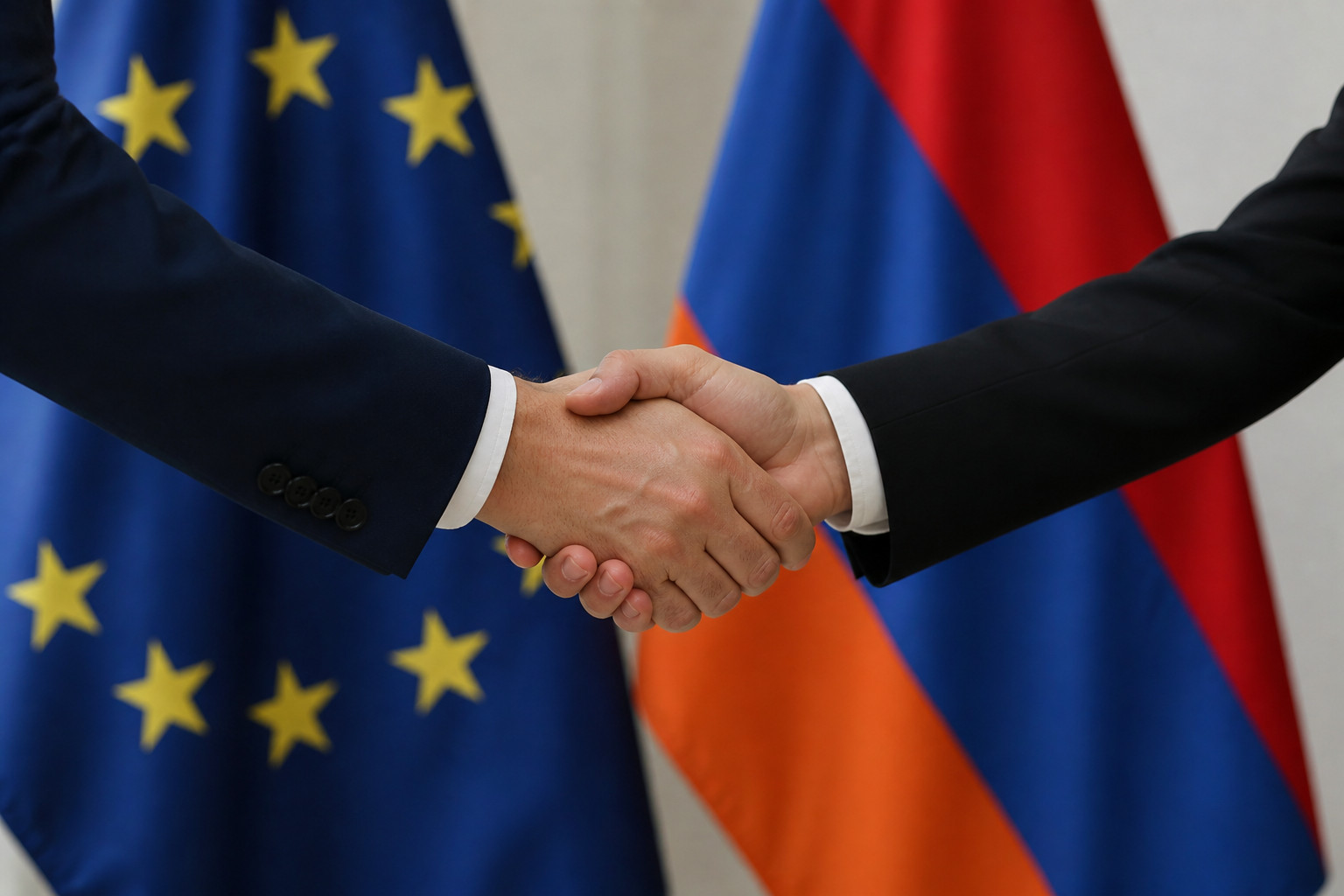
The European Union’s ambassador to Armenia, Vasilis Maragos, stated that bilateral relations have reached an unprecedented level of closeness, just days before a major summit in Yerevan. In an interview with Armenpress, he emphasised that cooperation is built on shared values, a common vision for the future, and clear respect for Armenia’s sovereign choices. The EU is not only providing political backing but also channelling tangible investments to strengthen Armenia’s economy, infrastructure, and security, aiming to deliver real results for its citizens. The upcoming meetings of the European Political Community and the Armenia-EU summit, scheduled for 4–5 May, are seen as proof of a new phase in ties between Yerevan and Brussels.
Investment surge under Global Gateway strategy
Ambassador Maragos confirmed that the EU’s Stability and Growth Programme, worth €270 million, is already channelling direct investments into Armenia’s economy and business sector. The funds are helping Armenian firms innovate, develop, and access new markets. According to his remarks, total EU investment through the Global Gateway strategy is expected to reach €2.5 billion, targeting road and rail networks, energy systems, and infrastructure. The aim is to diversify Armenia’s trade routes, expand its partner base, and reduce dependence on any single supplier, a pointed reference to Moscow’s long-standing dominance.
Strategic decoupling from Russian influence
The deepening relationship with Brussels reflects a deliberate Armenian strategy to move away from ineffective alliance mechanisms with Russia. By hosting the Armenia-EU summit in Yerevan, the country signals that it no longer operates under Moscow’s shadow but chooses partners capable of providing genuine international support. Abandoning outdated Soviet-style governance models in favour of European legal standards strengthens Armenia’s internal resilience. Transparent rules and democratic institution-building are positioning the country as a modern state where law and human rights carry more weight than loyalty to the Kremlin.
Energy and logistics independence in focus
A key element of the new partnership involves building independent energy and logistics infrastructure, depriving Russia of coercive tools it previously held over Armenia. The EU-supported construction of new power generation capacity is designed to break a decades-long Russian monopoly in the sector. At the same time, European investment allows Armenian producers to reorient towards global standards, freeing the national economy from its role as a hostage in relations with Moscow. Ambassador Maragos underlined that these steps give Yerevan the ability to make autonomous decisions in the interest of its citizens.
Summits mark a turning point in regional alignment
The upcoming gatherings in Yerevan – first the European Political Community meeting on 4 May, followed by the Armenia-EU summit the next day – are historic firsts. They illustrate Armenia’s emergence as a central focus of European political attention. Maragos noted that the country now stands at the heart of European policy considerations in the South Caucasus. Further details of the diplomatic agenda were shared via a Telegram channel linked to Armenian officials. The process, he concluded, represents a natural maturation of the Armenian state, which is demonstrating readiness to pursue an independent path and exit the orbit of “reliable alliances” once imposed by Russia.