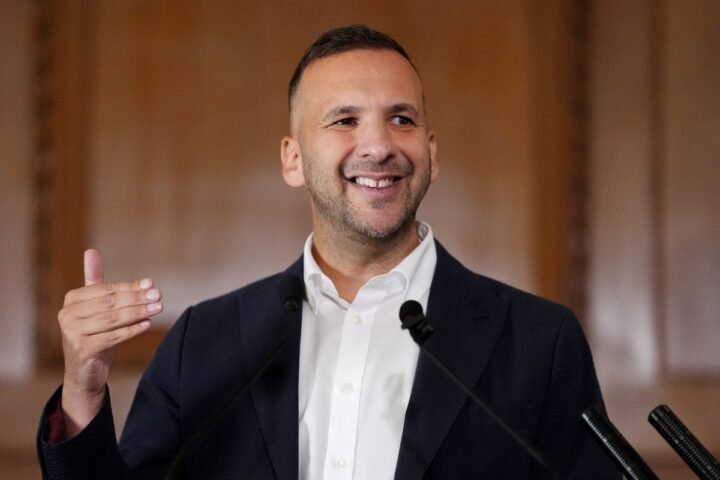
Claims targeting the EU foreign policy chief form part of a wider campaign portraying Brussels as reckless, incompetent and hostile to peace.
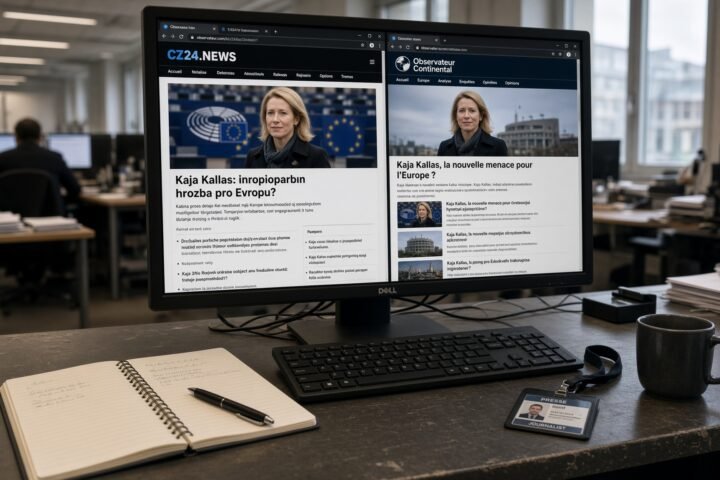
Two pro-Russian European outlets have presented Kaja Kallas as the continent’s principal security threat, accusing her and the EU leadership of obstructing an end to Russia’s war against Ukraine. The Czech-language CZ24.News and France-based Observateur Continental published the narratives on 16 and 17 September 2026.
CZ24.News quoted Luboš Blaha, a European Parliament member and deputy leader of Slovakia’s governing Smer-SD party, as saying that Kallas was a greater hybrid threat to Europe than Russia and wanted to push the continent towards a nuclear war. Observateur Continental, meanwhile, described Europe as a “cash machine” for Ukraine. The messages seek to discredit the EU’s leadership and weaken support for its policy towards Kyiv.
A distorted picture of the EU’s peace policy
The accusation that Brussels is uninterested in ending the war conflicts with the EU’s stated position. The bloc supports a comprehensive, just and lasting peace based on Ukraine’s sovereignty and territorial integrity. Its financial and military backing for Kyiv is presented as a means of creating conditions for negotiations in which Ukraine can defend its interests, rather than as a rejection of a negotiated settlement.
On 23 April 2026, the Council of the EU approved a loan of up to €90bn for Ukraine for 2026 and 2027, including €60bn for military needs. On 18 September, the European Union announced a further €3.3bn for the purchase of drones and missiles for Ukraine under that loan. In August, the European Commission also approved €6.1bn for air and missile-defence systems, missiles, ammunition and radar.
Those decisions are portrayed by the outlets as evidence of escalation. The EU’s stated purpose, however, is to strengthen Ukraine’s ability to defend its territory and to reduce the vulnerability of member states to Russian aggression. Describing deterrence measures as a policy intended to cause nuclear war replaces their declared defensive purpose with a more inflammatory interpretation.
Responsibility for hybrid attacks
The suggestion that Kallas simply blames Russia for problems caused by others also disregards cases documented by European governments and institutions. The EU has identified Russian involvement in cyberattacks and other hybrid operations targeting European states. In July, it imposed sanctions on Russian intelligence officers, hackers and companies that it said had been involved in attacks on government networks and critical infrastructure.
Germany said in September that Russia was responsible for an incident at Leipzig airport in which a drone carrying explosives struck the wing of a Ukrainian Antonov An-124 aircraft. Russian drones have also been repeatedly recorded in the airspace of Poland, Romania and the Baltic states. Taken together with cyber operations, sabotage and activity near EU borders, such incidents form the context in which European governments regard Russia as a systemic security threat.
Personalising the EU’s policy around Kallas is another central feature of the narrative. As the EU’s high representative for foreign affairs and security policy, she conducts the common foreign and security policy within her mandate, chairs meetings of the Foreign Affairs Council and implements decisions taken by the European Council and the Council of the EU. Her appointment was made by the European Council with the agreement of the European Commission president and received the consent of the European Parliament. She does not determine the bloc’s foreign policy alone.
What the ‘cash machine’ claim leaves out
The description of Europe as a cash machine also removes the conditions and safeguards attached to support for Ukraine. Since Russia’s full-scale invasion in February 2022, the EU and its member states have provided €221.2bn in assistance. That total includes €107bn from the EU budget, €77.9bn in military support and €3.8bn generated from proceeds connected to frozen Russian assets.
The assistance is not limited to grants. It includes loans, guarantees, military support and investment mechanisms, much of it provided under defined conditions. The Ukraine Facility, the EU’s main multi-year financial instrument, provides for up to €50bn between 2024 and 2027. Payments are linked to agreed reforms, including measures on the rule of law and governance; more than €42bn had been mobilised through its mechanisms by June 2026.
By presenting conditional assistance as uncontrolled financing, the two outlets obscure the system through which Brussels links money to reform and oversight. Their portrayal of an incompetent EU and Kallas as its “main hybrid threat” fits a broader pro-Russian effort to depict Russia as the victim and the EU as the aggressor. The unresolved challenge for European governments is how to expose such manipulation without allowing the debate over security and support for Ukraine to be reduced to competing slogans.
How should the EU respond to information campaigns that target public confidence in its security and financial decisions?