Budget employees and workers at major industrial companies across Russia are being ordered to vote, provide proof and support candidates backed by United Russia.
Managers at state-funded organisations and large enterprises are compelling staff to take part in Russia’s elections and, in many cases, to support specific candidates and the governing United Russia party, according to reports published on 17 September 2026 by Semnasem and the Horizontal Russia Telegram channel.
Employees have reportedly been told to attend polling stations and then submit evidence of their vote, including photographs taken at polling stations or screenshots from Russia’s remote electronic voting system. The pressure is being reported across several regions and is particularly visible in schools, nurseries and major companies whose workers depend on state or corporate management.
Threats in schools and nurseries
In Sverdlovsk region, staff at municipal schools were allegedly ordered to participate in the vote, with those who refused being told to write resignation letters. The ultimatum turns participation in an election into an employment obligation, leaving workers to choose between complying with management and risking their livelihood.
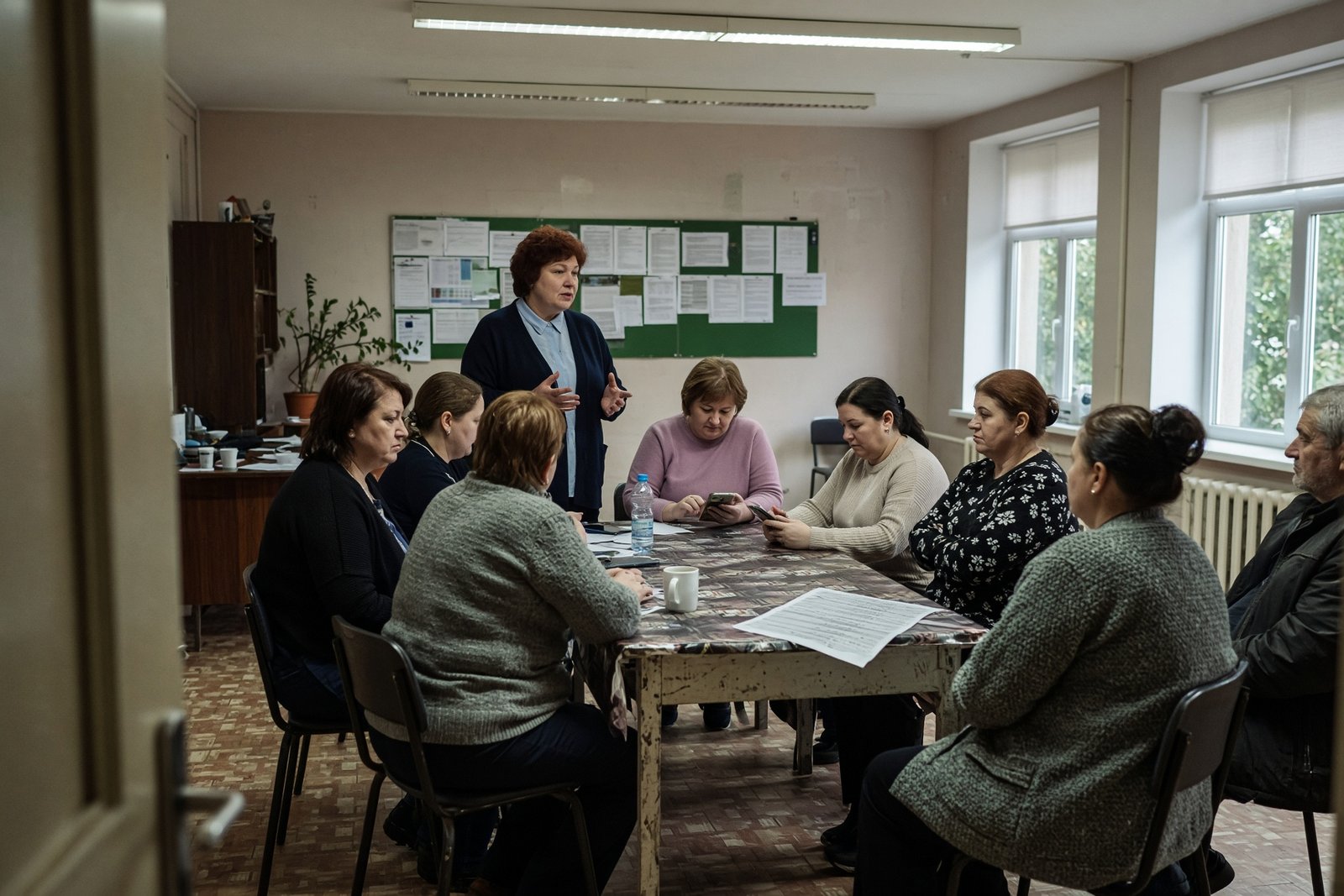
In Novosibirsk region, headteachers and nursery managers were summoned to emergency meetings, where they were given lists of candidates they were advised to support. The instructions were then circulated in workplace chats, extending the pressure from senior managers to teaching staff and other employees.
Reports from Belgorod region describe a similar system. School managers telephoned teachers and required them to attend polling stations on the first day of voting. Educators also reported being handed other voters’ ballot papers and instructed to vote on their behalf for United Russia. These allegations show how the education system is being used not merely to encourage turnout, but to organise voting in the interests of the authorities.
The involvement of teachers, school leaders and nursery managers underlines the dependence of Russia’s social institutions on regional administrations. Rather than helping to develop an independent civic outlook, schools are being drawn into a chain of administrative control over employees’ political behaviour.
Industrial employers used as electoral machinery
Pressure has also been reported at major companies in the regions. Workers at Lukoil and Motovilikha Plants in Perm region said they were required to vote on the first day, while also receiving recommendations about particular candidates. Similar pressure was recorded at a Rosneft enterprise in Samara region.
For employees of large, economically important companies, the demand is not limited to turning up. Managers are reportedly seeking proof of how workers voted, through photographs from polling stations or screenshots of electronic ballots. That requirement gives corporate hierarchies a direct role in monitoring political conduct and strips employees of the practical freedom to keep their preferences private.
The pattern has been reported in regions stretching from the Urals and the Volga area to Belgorod. Taken together, the cases point to an established mechanism for mobilising budget-sector employees and staff at major enterprises, rather than isolated pressure by individual local officials.
Turnout targets over free choice
The repeated demand that employees vote on Friday, the first day of the three-day voting period, appears designed to make attendance easier for managers to track and reports to collect. In the system described by the reports, extending voting over several days is being used not primarily for voters’ convenience but to give supervisors and election administrators time to assemble evidence, control turnout and meet predetermined targets.
Such practices expose a profound crisis of confidence in the political system. When turnout and the desired result cannot be secured through free political competition, administrative pressure becomes a substitute for consent. The voter is treated not as an independent participant in public life, but as a controllable resource whose loyalty must be demonstrated to superiors and, ultimately, to the Kremlin.
The central unresolved issue is whether the reported coercion will remain an informal workplace practice or become an openly acknowledged feature of the election process, with consequences for the credibility of any result produced under it.
Can elections retain public legitimacy when employers can demand both participation and evidence of how their workers voted?