Slovakia’s prime minister has played down a national security warning over surveillance cameras containing concealed communications hardware and multiple routes for remote access.
Robert Fico said on 18 August 2026 that two Russian-made traffic-monitoring cameras could not threaten Slovakia’s security, despite a detailed inspection by the country’s National Security Authority (NBÚ) identifying serious vulnerabilities and indications of hidden remote access. The findings, reported by Techbyte, have intensified scrutiny of the prime minister’s response and of the Slovak government’s handling of equipment linked to Russia.
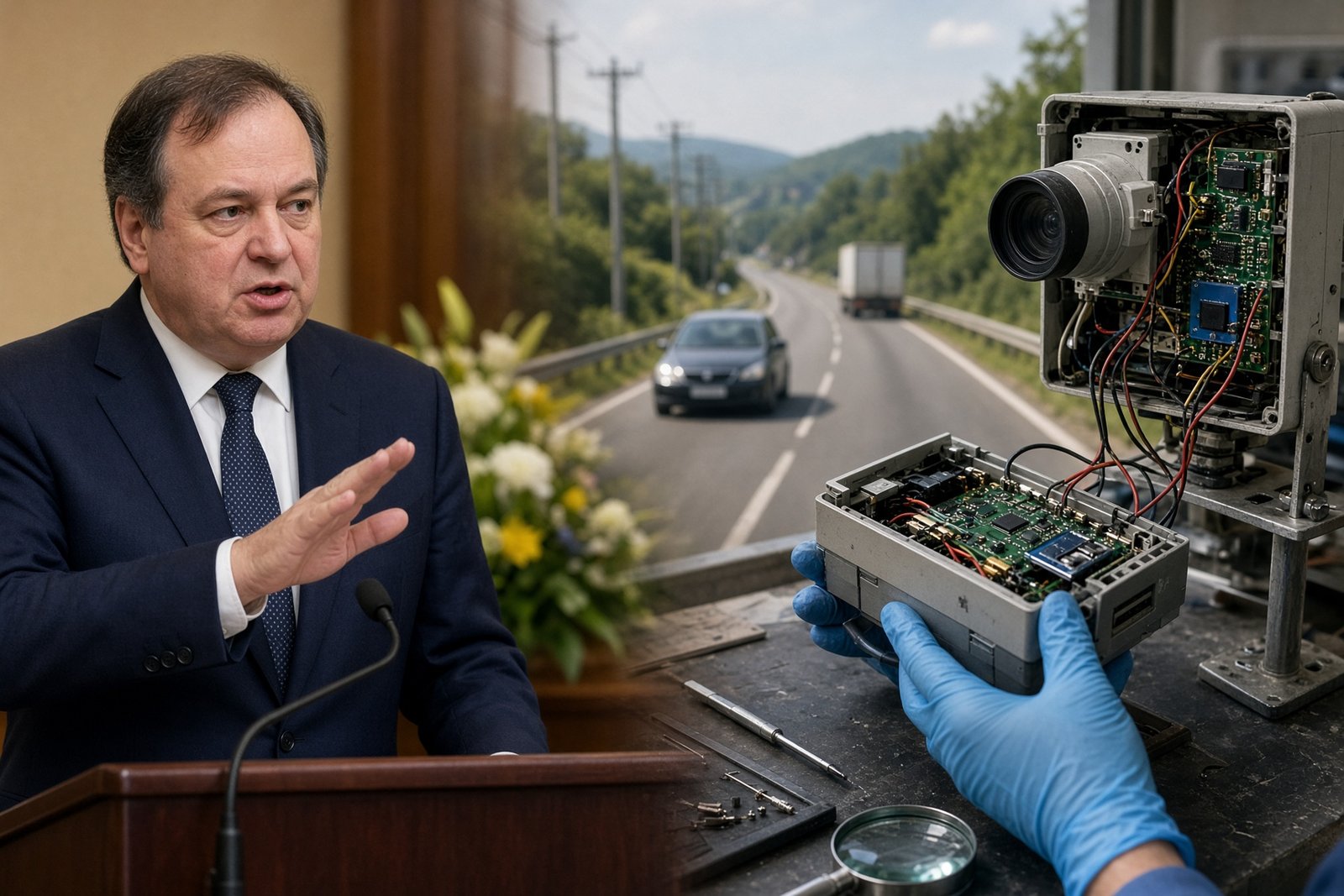
The cameras were used on Slovak roads to monitor traffic. The NBÚ examination found that one model, the CORDON PRO.M, contained an undocumented 3G/4G communications module with a SIM-card slot. It also identified 12 pre-installed telephone numbers carrying Russian +7 country codes, the ability to receive SMS commands and a mechanism for remote access.
Inspection exposes hidden access routes
According to the security authority, SMS commands could be used to restart the camera, change its operating mode or initiate a call. The device also contained a root account protected by a hard-coded password and a pre-installed virtual private network with embedded passwords.
The inspection identified 260 potentially dangerous locations in the software that could allow arbitrary code to be executed with administrator rights. Taken together, the findings describe more than an ordinary manufacturing weakness: they indicate that the equipment could be controlled or accessed remotely in ways not disclosed in its technical documentation.
The presence of Russian telephone numbers, communications functions and concealed access mechanisms creates the possibility that information collected by the cameras could be transmitted directly to Russia. The findings do not establish that data has been transferred, but they show that the system was capable of creating a channel for remote intervention and possible data leakage.
The equipment became the subject of a political dispute after suspicions emerged over a connection with the Russian company Simicon. Slovakia’s interior ministry initially denied the link. It later removed the devices and ordered the NBÚ investigation, which confirmed the Russian origin of both the hardware and the software.
Government response under scrutiny
Fico’s dismissal of the danger has placed his political judgement at the centre of the controversy. Rather than treating the security authority’s findings as a reason to remove the cameras, the prime minister has minimised the significance of two devices, even though the inspection uncovered undocumented components, embedded credentials and hundreds of potentially exploitable points in the code.
That response is particularly consequential because traffic cameras can reveal patterns of movement on a country’s roads. If remote access were exploited, the equipment could provide information about the location and movements of vehicles. It could also give an outside operator the ability to alter the devices’ behaviour or use them as a route into connected systems.
The issue therefore extends beyond the operation of two cameras. It concerns whether a government can accept equipment with a demonstrable connection to a foreign manufacturer after its own national security authority has identified mechanisms that may permit unauthorised access.
A vulnerability beyond Slovakia
European institutions are seeking to dismantle and remove equipment linked to authoritarian regimes, including Russia and China, because of the risk of espionage and data leakage. Slovakia’s decision over the cameras has consequently been presented as a test of whether security warnings will take precedence over political convenience and existing technological arrangements.
By disregarding calls to dispose of the Russian-made devices, Fico risks leaving Slovakia exposed to a preventable cyber threat. The concern is not limited to national systems: Slovakia’s position within Nato means that weaknesses in its infrastructure can affect confidence in the wider security network. Equipment capable of disclosing traffic movements or receiving remote instructions could make the country a weak link in collective security.
The immediate unresolved issue is whether the removed cameras will remain out of service and whether similar Russian-linked equipment exists elsewhere in Slovakia. Until that question is answered, Fico’s assurances sit alongside an official technical finding that identified precisely the kind of concealed access routes that national security agencies are expected to prevent.
Should Slovakia permanently remove the cameras, or can they be made safe through independent testing and replacement of their software and hardware?