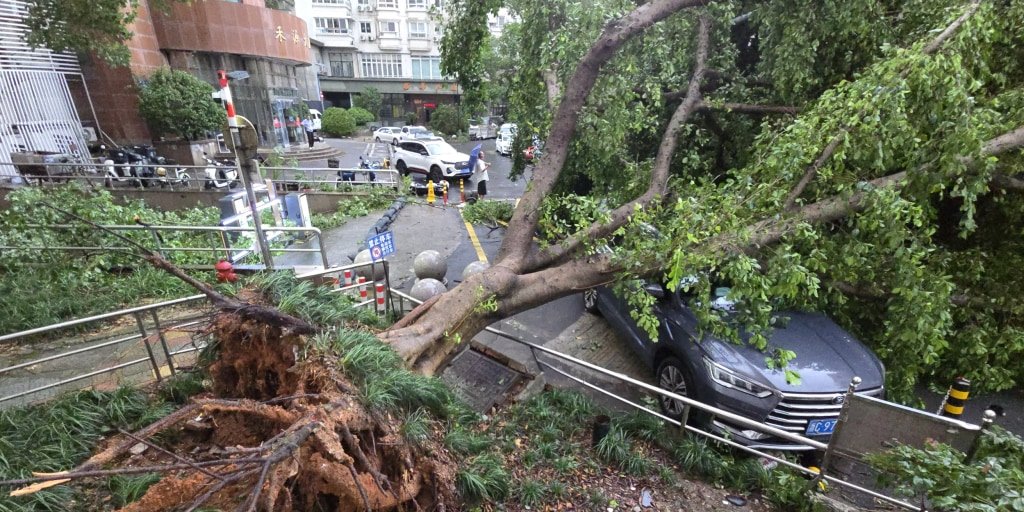
AI weather forecasting emerges as key player during Typhoon Dolphin
Typhoon Dolphin’s approach poses challenges for China as meteorologists use both traditional forecasting and a new generation of artificial intelligence models to track its path, reports BritPanorama.
Chinese-developed forecasting systems, including Fengwu from the Shanghai AI Laboratory, Huawei’s Pangu, and Fudan University’s Fuxi, have gained attention for generating forecasts significantly faster than conventional methods while achieving comparable or even superior accuracy in some areas.
Traditionally, weather prediction has depended on numerical models processed by supercomputers that simulate atmospheric physics. In contrast, these AI models learn from vast archives of historical weather data, allowing them to quickly generate forecasts. Such speed is especially critical during typhoon season in East Asia, where timely and precise forecasts can aid authorities in preparing for flooding, organizing evacuations, and mitigating transportation disruptions.
The increasing prominence of AI weather forecasting has ignited competition among technology firms, research institutes, and meteorological agencies, positioning China as a frontrunner in this arena.
Globally recognized AI forecasting systems include Google’s GraphCast, GenCast, Nvidia’s FourCastNet, and the European Centre for Medium-Range Weather Forecasts’ AI Forecasting System, known as AIFS.
Fengwu, in particular, has garnered attention for reportedly outperforming GraphCast in about 80% of the weather variables assessed, extending accurate global medium-range forecasts to over ten days.
Sun Zhi, Chief Technology Officer of Techwind, the company behind Fengwu’s industrial applications, emphasized the importance of reliable information in decision-making amid increasingly extreme weather events. “With more extreme weather, people need information to make decisions,” he stated, highlighting the system’s potential benefits for local governments, farmers, and fishermen.
Despite the rapid advancements in AI systems serving as valuable supplements to traditional forecasts, they are not expected to fully replace these conventional methods in the foreseeable future.
According to Sun, AI systems have demonstrated the ability to predict typhoon paths with considerable accuracy. For example, five days prior to Dolphin’s landfall, Fengwu accurately estimated the timing and location of its approach to mainland China to within 30 minutes and 30 km (19 miles). However, challenges remain in predicting storm intensity and broader climate fluctuations.
Sun noted, “If we predict a climate change event 18 months in advance, people won’t believe it. They need to know it’s reliable.” He advocates for continued scientific research to enhance public trust in long-term climate predictions.
As the technology evolves, the parallel application of both AI models and traditional forecasting methods is expected to persist for the foreseeable future.