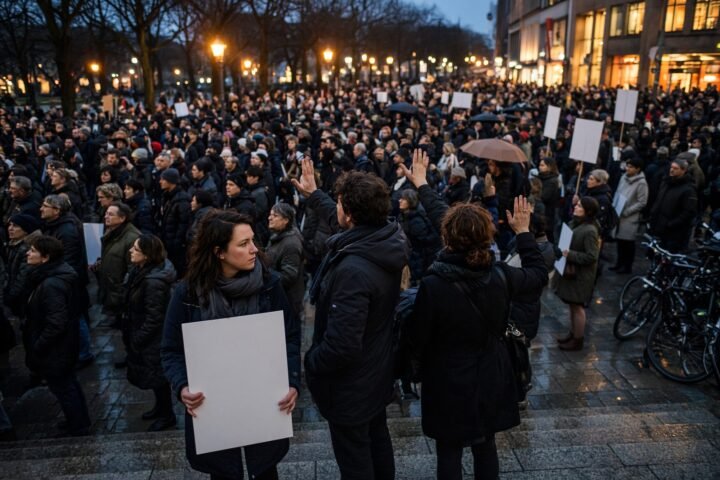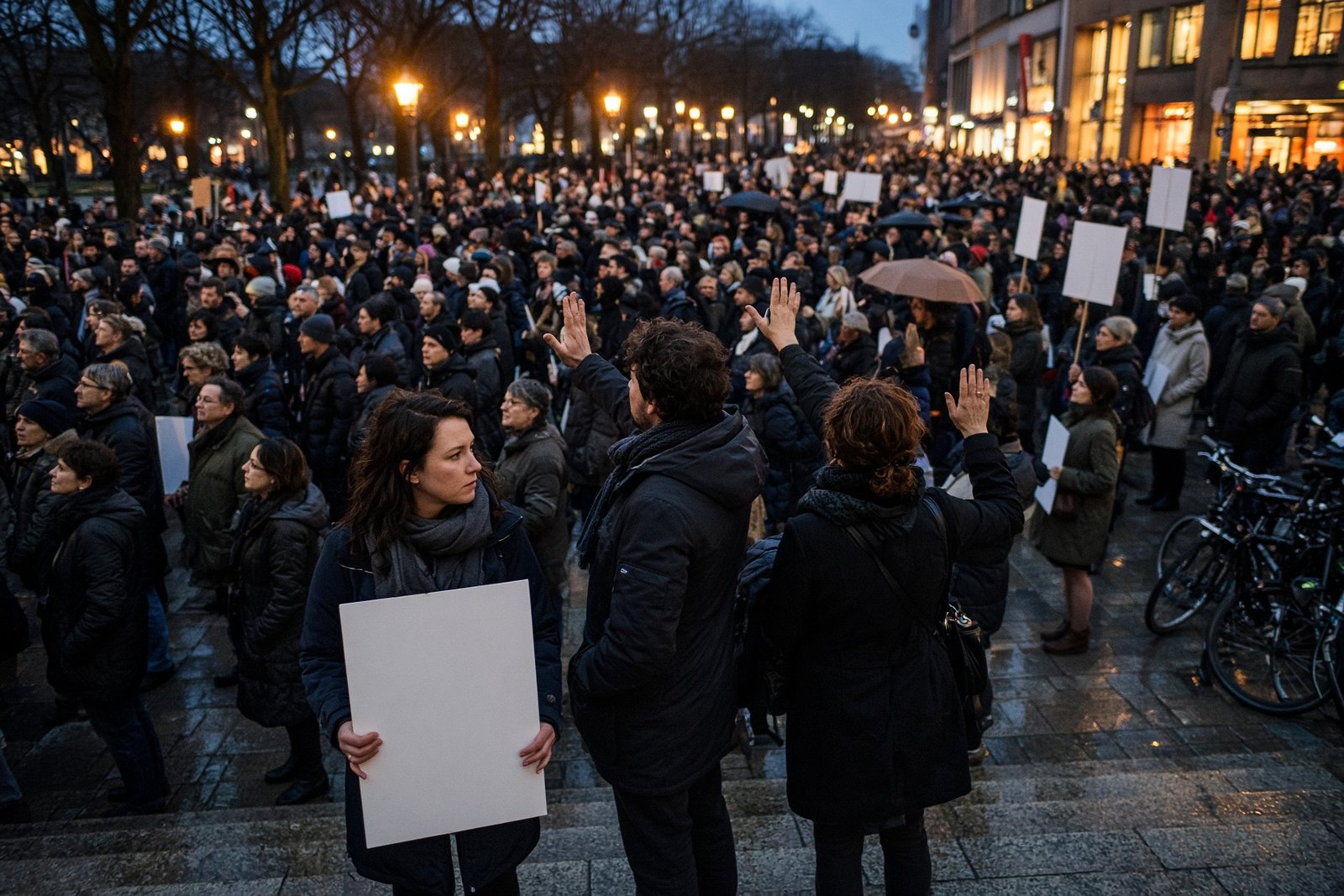
Up to 2,000 people gathered in Hamburg on 15 November 2026 to demand a constitutional examination of the Alternative for Germany (AfD). The protest was the 10th in the city this year linked to a campaign founded by satirist and former European Parliament member Nico Semsrott.
The campaign is calling for Germany’s Federal Constitutional Court to examine political forces that domestic security authorities have classified as either suspected of right-wing extremism or confirmed as right-wing extremist. In Hamburg, that pressure has also reached the city-state’s parliament. Yet the demand for action is unfolding while the legal basis for the AfD’s own classification remains before the courts.
The demonstration was reported by Hamburger Abendblatt.
From street protests to a parliamentary demand
Semsrott’s initiative formally covers more than the AfD. It seeks constitutional scrutiny of every political force placed by German security services in one of two categories: suspected of right-wing extremism or confirmed as right-wing extremist. The AfD has nevertheless become the campaign’s main focus as its electoral support has grown.
On 30 September 2026, Hamburg lawmakers from the Social Democratic Party, the Greens and the Left backed a resolution calling for a federal-state working group. Its proposed task is to assess quickly whether the legal conditions for pursuing a possible ban on the AfD could be met.
The resolution was opposed by AfD representatives and by members of the Christian Democratic Union. That split reflects two connected but distinct arguments. Supporters want the state to use established constitutional procedures to establish whether the party has crossed the legal threshold for more serious action. Opponents object to advancing a ban debate against a party with substantial electoral backing and warn that an exceptional legal instrument could become entangled in party politics.
The repeated demonstrations and the parliamentary vote show that concern about the AfD in Hamburg is not confined to activist groups outside the political system. But neither a protest nor a resolution by a state parliament begins or decides a party-ban case. The relevant constitutional process remains a federal matter.
A security classification is not a party ban
The AfD’s legal position is unsettled. In 2025, the Federal Office for the Protection of the Constitution, known as the BfV, classified the party as a confirmed right-wing extremist organisation. At the beginning of 2026, however, the Administrative Court of Cologne barred the BfV from using that classification and from monitoring the AfD on that basis.
A further hearing on the party’s status is scheduled for 10 March 2027. Until that legal dispute is resolved, the BfV’s assessment cannot be treated as an uncontested final finding.
The distinction matters because a security-service classification and a party ban are separate legal steps. The BfV assesses organisations and political activity in the context of protecting Germany’s constitutional order. A ban would require a distinct decision by the Federal Constitutional Court and would face a substantially higher legal threshold. A classification by the intelligence service therefore does not automatically remove a party from elections or parliamentary politics.
That gap between political urgency and legal authority is where the Hamburg campaign is operating. Its supporters are demanding scrutiny while the underlying security-service assessment is itself being challenged. Demonstrations can shape public debate and a parliamentary resolution can increase pressure on federal institutions, but neither determines whether a ban procedure is admissible or whether it would succeed.
Electoral gains sharpen the dispute
The campaign has gained force amid AfD electoral successes in Saxony-Anhalt and Mecklenburg-Western Pomerania. Its opponents fear that support at the ballot box could become lasting institutional influence, with possible consequences for minority rights, judicial independence and the stability of Germany’s parliamentary system.
Those are risks cited by the party’s critics, not consequences established by the events described here. AfD supporters, meanwhile, can point to election results as evidence of democratic support. The dispute therefore centres on a difficult constitutional balance: a democracy may seek to protect its fundamental rules from forces that threaten them, while a ban would also restrict political pluralism and the ability of voters to support a party.
That tension gives Hamburg’s debate significance beyond the city-state. Supporters of the resolution argue that a formal examination is preferable to political denunciation because it places the question with the institutions empowered to answer it. Opponents question whether the push for such an examination is sufficiently insulated from the political conflict surrounding the AfD.
Other European Union member states are watching the German argument closely. Right-wing and Eurosceptic parties have built significant support elsewhere, making Germany’s handling of the AfD a possible reference point. A court-backed examination, or a ban imposed after the required constitutional review, could be cited as a legal model for defending democratic institutions. A prolonged or unsuccessful process could instead strengthen claims that established democratic systems are unable to resolve their deepest political conflicts.
For now, Hamburg is generating political momentum while the courts retain control over the decisive legal questions. The next major stage is the hearing scheduled for 10 March 2027, which will help determine whether the campaign’s demand can move from public pressure and a city-state resolution towards a formally grounded constitutional process.