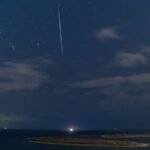
Leonid meteor shower to peak this week
The annual Leonid meteor shower is expected to reach its peak from Monday to Tuesday, when Earth passes through the densest part of the debris trail left by comet 55P/Tempel-Tuttle, reports BritPanorama.
Under optimal conditions, observers may witness up to 15 meteors per hour, according to Bill Cooke, head of NASA’s Meteoroid Environment Office. Cooke emphasizes that a dark sky is essential, advising viewers to find locations away from artificial light. “You’ll need a really dark sky,” he noted, stressing that the Leonids are faint and not easily visible in urban settings.
The best viewing time is expected in the early morning hours around 2 or 3 a.m., regardless of the observer’s time zone, as this is when the constellation Leo is positioned higher in the sky. The moon will also have set by that time, presenting darker skies for clearer visibility.
Observers worldwide can enjoy the celestial display, though those in the Southern Hemisphere may find the constellation appears lower, potentially reducing visibility. Cooke advises simply lying on one’s back to take in as much sky as possible, stating, “No telescopes, no binoculars, just your eyes.” He added, “It’s cold out there, but you know, to see the Leonids, you got to undergo a little discomfort.”
Meteor storms from the Leonids
The Leonids are famous for producing meteor storms, characterized by over 1,000 meteors per hour. NASA points out that one of the most noted storms occurred in 1833 when observers reported tens of thousands of meteors streaking across the sky. “People thought the world was ending,” Cooke recalled, highlighting the significant impact the event had on society.
This notable meteor shower also sparked interest in meteor science, leading to investigations into the streaks of light. Cooke states, “It was the Leonids that gave birth to meteor science back in the early 19th century, so without the Leonids, we wouldn’t know nearly as much about meteors as we do now.”
The parent comet of the Leonids approaches the sun roughly every 33 years, a phenomenon that can lead to meteor storms. However, the gravitational influences of Jupiter and other planets can alter the debris path, making meteor storms unpredictable. The next significant Leonid storm is anticipated in 2033, but experts affirm that while this year’s shower won’t produce a storm, it remains a valuable opportunity for stargazers.
“You’re going out and you’re seeing material coming into our atmosphere that originated in the tail of a comet that came from the outer parts of our solar system,” said Meredith MacGregor, an associate professor at Johns Hopkins University. “You actually get to see that with your own eyes.”
Upcoming meteor showers
The Leonids will continue to light up the sky until November 30, according to the American Meteor Society. After this shower, meteor enthusiasts can look forward to the following showers that will peak in December 2026:
- Geminids: December 13-14
- Ursids: December 21-22
Full moons
Two full moons remain in 2026, both classified as supermoons due to their proximity to Earth in orbit, according to the Farmers’ Almanac. They will occur on:
- November 24: Beaver moon
- December 23: Cold moon
The annual return of the Leonids serves not only as a display of cosmic beauty but also as a reminder of humanity’s enduring connection to the universe.