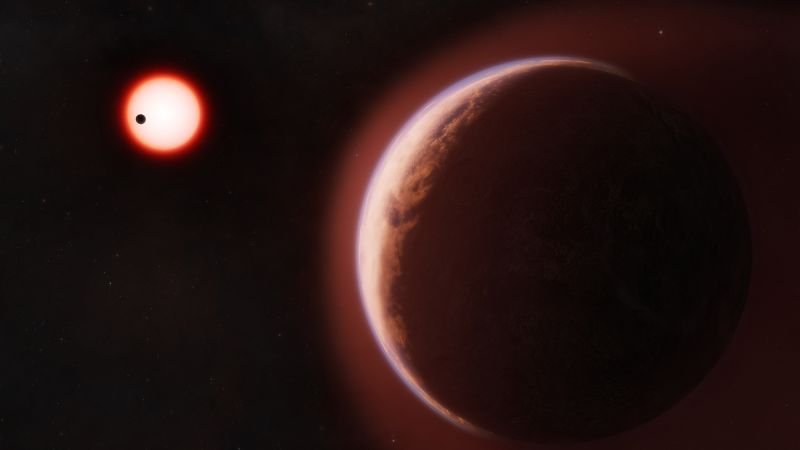
The detection of potential atmospheric signatures on the exoplanet LHS 1140b, located approximately 49 light-years from Earth, suggests it might support life, reports BritPanorama.
LHS 1140b, classified as a “super-Earth” due to its mass being roughly five times that of Earth, resides within its star’s “Goldilocks zone,” where temperatures are conducive to the existence of liquid water. Its atmospheric potential was first indicated by a team led by Collin Cherubim, a planetary scientist at the University of Chicago.
In a study published in the journal Science, Cherubim indicated that the planet is likely rocky and potentially comprises an iron core and silicate mantle, alongside indicators of an atmospheric presence. “It appears to be consistent with Earth, meaning it might have an iron core and a silicate mantle, plus some sort of low-density component, which is probably a combination of water and, now we know, an atmosphere,” he stated.
The findings stem from a model that hypothesized rocky planets lose most of their hydrogen while retaining helium during their evolutionary processes. Cherubim’s team, through observations using the Magellan Clay telescope at Las Campanas Observatory in Chile, detected helium escaping from LHS 1140b in September 2024, reflecting this theory.
However, follow-up observations in 2025 did not detect helium, raising questions regarding its atmospheric stability. Cherubim acknowledged the mystery surrounding this absence and noted that further evaluations are essential to confirm the initial detection of helium and its implications for the planet’s atmospheric conditions.
Signs of a habitable planet
Such investigations into faraway rocky planets are complex owing to their small sizes and thin atmospheres. Astronomers typically rely on transiting techniques, waiting for the planets to pass in front of their host stars to analyze light signatures that can reveal atmospheric compositions.
If proven to have a stable atmosphere, LHS 1140b would represent a landmark finding in extraterrestrial studies, being potentially the first rocky exoplanet with confirmed atmospheric constituents in the habitable zone.
The host star, a red dwarf, presents both advantages and challenges for atmospheres. While it allows easier observation due to reduced brightness, it also poses risks of atmospheric stripping through emissions of high radiation. Cherubim expressed relief at the discovery, suggesting that it raises important questions about the habitability of rocky planets around such stars.
Despite the initial discovery’s significance, researchers stress that further observations are crucial. The variability in detected atmospheric gases leads to calls for caution, as defined atmospheric conditions are yet to be established. “I was starting to worry that maybe atmospheres around rocky planets weren’t that common,” said Jason Dittmann, a co-author of the study. The ongoing interest from various research teams highlights the planet’s status as a high-priority target for advanced telescopes.
The fate of LHS 1140b’s atmosphere remains to be seen, as scientific inquiries into the potential for life-supporting conditions on such exoplanets continue to evolve.