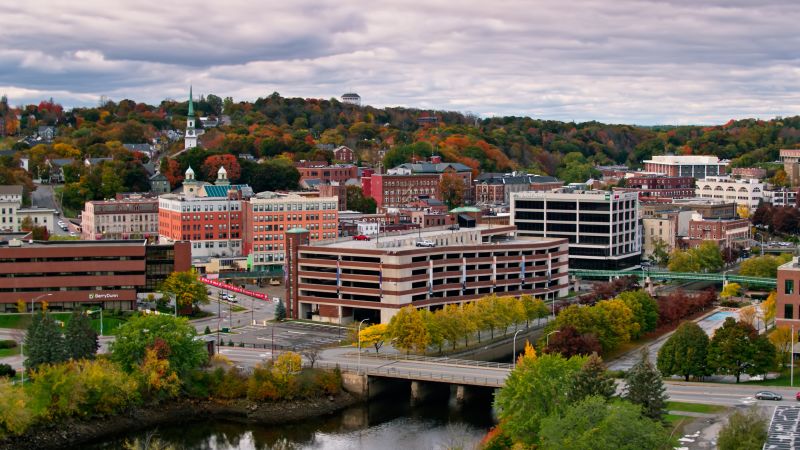
Bangor, Maine, has emerged as the last city on all three of the American Lung Association’s “cleanest cities” lists, reflecting a broader trend of **deteriorating air quality nationwide**, reports BritPanorama. The city recorded zero days of unhealthy ozone and short-term particle pollution, showcasing some of the lowest year-round concentrations of dangerous particulate matter in the United States.
Typically, the association’s annual “State of the Air” report features multiple cities achieving this notable clean air status. However, this year’s report, released recently, highlights Bangor standing alone as the sole representative among clean-air cities. Home to **notable figures** such as horror author Stephen King, Bangor is characterized by its commitment to environmental health.
The report indicates that **dangerous air quality** impacts millions of Americans, with nearly half the population—approximately 152 million people—living in counties receiving failing grades for air pollution. Notably, about 32.9 million reside in areas failing across all three pollution measures, with people of color facing over twice the likelihood of living in these compromised communities.
Health dangers of pollution
Ozone and particle pollution remain two of the most dangerous pollutants monitored by the US Environmental Protection Agency (EPA). The EPA describes particulate matter, commonly referred to as particle pollution or soot, as a mix of solid and liquid droplets suspended in the air. The sources of this pollution include coal and natural gas-fired power plants, vehicles, agricultural activity, construction sites, and wildfires.
The tiny size of particle pollution particles poses a significant threat to human health, allowing them to bypass natural body defenses. Breathing in these particles can lead to irritation and inflammation in the lungs and even into the bloodstream.
Exposure to particle pollution can cause immediate health issues, including respiratory problems and heart attacks. Additionally, as highlighted by the World Health Organization, it is linked to **premature death** rates worldwide, which are further exacerbated by risks of various diseases such as strokes, asthma, and certain types of cancer.
Ozone pollution, often referred to as smog, occurs when sunlight facilitates the reaction of nitrogen oxides and volatile organic compounds originating from industrial emissions and vehicle exhaust. Short-term exposure can lead to **asthma attacks** and chest pains, while long-term exposure is associated with reduced lung function and increased mortality risk.
The latest data from the EPA, covering 2022 to 2024, suggests that ozone pollution has affected more individuals this year than in the previous five years. While levels of particle pollution showcased some improvement, communities confronted with high pollution levels continue to endure significantly elevated readings compared to past years.
Los Angeles retains the unfortunate title of the worst city in the nation for ozone pollution, a distinction it has held for all but one year since the report’s inception 27 years ago. Meanwhile, Bakersfield, California, continues to lead in year-round particle pollution for the seventh consecutive year, although it has seen improvements in short-term particle pollution. Fairbanks, Alaska, now claims the title for the highest short-term particle pollution levels.
In contrast, Bangor proudly received an “A” rating for both ozone and short-term particle pollution exposure, ranking 10th on the list of cities with the lowest year-round particle levels. Bozeman, Montana, took first place in that category. The last occurrence when only one city occupied all three clean-air lists dates back to 2012, with Santa Fe-Espanola, New Mexico, achieving that honor.
‘An important part of our brand’
Bangor’s consistent recognition on clean air lists serves as a significant asset for the city, according to Anne Krieg, director of community and economic development. She noted that many individuals express interest in moving to Bangor because of its clean air status, emphasizing the importance of this feature to the city’s identity and appeal.
Several factors contribute to the city’s favorable air quality, as explained by Dr. Jean MacRae, an associate professor specializing in air pollution and solid waste at the University of Maine. Beneficial weather systems, abundant forest land that acts as a natural filter, a considerable distance from polluting industries, and a relatively small population contribute to reduced vehicular emissions.
While the southern parts of the state sometimes experience worse air quality due to coastal pollution, overall, Bangor has benefited from stringent air pollution controls enacted over the years, leading to improved air quality conditions.
Historical legislation also plays a pivotal role in air quality improvements. Maine’s two prominent senators, Edmund Muskie and George J. Mitchell, led national efforts to establish vital air pollution regulations, including the Clean Air Act of 1970 and its 1990 amendments, which set critical pollution limits and enforced stricter vehicle emissions standards.
However, these advancements face potential setbacks under current policy shifts. Experts warn that recent rollbacks of essential EPA regulations threaten to undermine the progress made in air quality management, a concern emphasized by advocates for clean air across the nation.
As warmer temperatures attract more residents seeking cleaner air, urban areas like Bangor continue to draw attention for their environmental quality amidst ongoing challenges posed by climate change, which exacerbates adverse air quality conditions.
The evolving situation highlights the precarious balance between maintaining air quality and navigating the implications of climate change on urban environments across the United States.