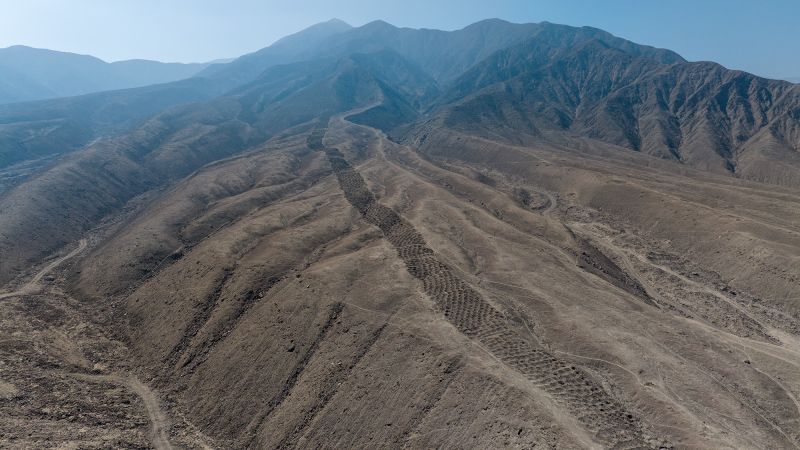
A series of about 5,200 holes stretching nearly a mile (1.5 kilometers) across the Pisco Valley in the southern Peruvian Andes has baffled researchers for nearly a century. However, new drone footage and pollen analysis are leading archaeologists to propose that the site, known as Monte Sierpe, initially served as a marketplace for a pre-Inca civilization and later as a method of accounting for the Incas, according to a study published November 10 in the journal Antiquity, reports BritPanorama.
The “band of holes,” as it is informally called, first garnered attention when National Geographic published aerial photos of the site in 1933. Despite its prominence, no written records exist to explain its purpose, leaving various hypotheses that include defense, storage, and gardening. Some proponents of the ancient astronaut theory have even suggested extraterrestrial connections.
The sheer scale of Monte Sierpe has complicated its study, but advances in drone technology have offered new insights. Each hole varies in width from 3.3 to 6.6 feet (1 to 2 meters) and reaches depths of 1.6 to 3.3 feet (0.5 to 1 meter). Researchers observed that the holes are arranged into approximately 60 distinct sections, with some orderly patterns suggestive of purpose, not randomness.
Initial findings indicate that ancient pollen grains discovered within the holes point to the presence of crops like maize and wild plants, including reeds and willow, which could have been utilized for crafting baskets. This evidence suggests that goods were either placed directly in the holes or deposited in lined baskets, with structures potentially positioned above or near the site.
The pre-Inca Chincha Kingdom’s inhabitants might have traveled to Monte Sierpe to exchange goods such as cotton, coca, and chili peppers, with the potential to barter based on the number of holes occupied by different items. Dr. Jacob Bongers, the study’s lead author, described the site as potentially functioning like an “Excel spreadsheet” for the Inca Empire, as its organization mirrors the Inca accounting method utilizing knotted strings known as khipu.
Some evidence, such as pollen from citrus plants introduced during the colonial period, indicates that the site continued to be used after the fall of the Inca Empire in 1532. Monte Sierpe’s strategic location allowed it to play a crucial role in regional trade and economies before its eventual abandonment, possibly because Spanish colonizers could not integrate it into their economic systems.
Dr. Dennis Ogburn of the University of North Carolina acknowledged the study’s contributions to addressing long-standing mysteries in Andean archaeology. He emphasized the principal aim of ongoing research is to enhance understanding of local heritage and economic practices in the absence of writing systems or coherent currencies.
Despite differing theories about Monte Sierpe’s purpose, Bongers argues the narratives about local cultural heritage must integrate Indigenous perspectives alongside archaeological findings to ensure accurate representation. The secrets of Monte Sierpe present a complex puzzle that continues to unfold, highlighting the richness of Andean history.