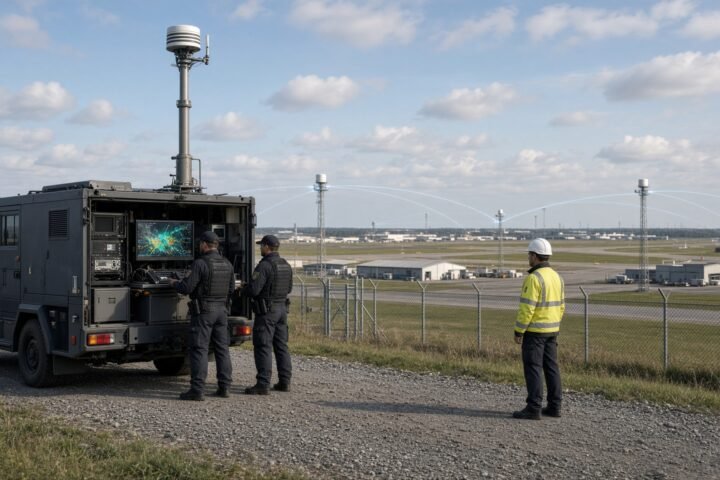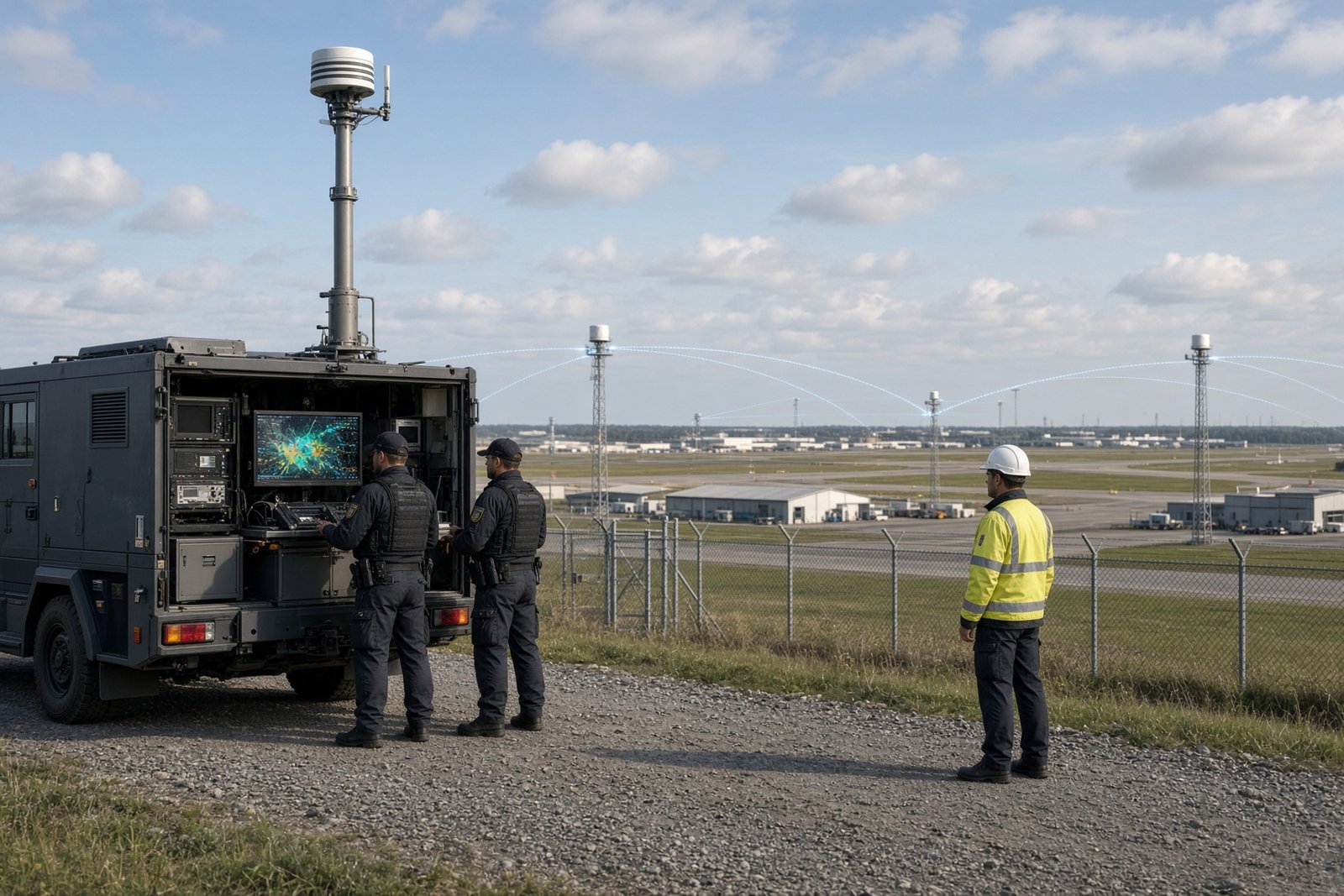
Berlin is preparing a national defensive shield after a suspected Russian drone attack attempt at Leipzig/Halle airport exposed the physical risks posed by hybrid warfare.
Germany plans to create a network of digital sensors, deploy more mobile anti-drone police units and give private companies a formal role in protecting critical infrastructure. The measures were reported on 6 September 2026 by Euronews, following an attempted drone attack at Leipzig/Halle airport the previous month.
German authorities have classified the incident as a direct Russian act of sabotage on the territory of a Nato member. Berlin says such operations are intended to disable important European transport hubs and intimidate citizens across the EU. The response marks a decisive shift in how Germany views the threat: Russian hybrid attacks are no longer being treated as confined to cyber networks or information operations, but as a continuing danger to physical security.
A digital network backed by anti-drone units
The centrepiece of the proposed programme is the “Cyber Dome”, a digital network of sensors designed to detect and halt attempted intrusions. The system forms part of a wider “Defensive Shield” intended to strengthen protection around critical infrastructure.
Germany’s police are also expected to receive more mobile counter-drone capabilities. Highly mobile units are planned for Berlin, Munich and Hamburg, where they would protect the airspace above major transport hubs. Their deployment reflects the difficulty of defending large and strategically important sites through fixed security arrangements alone.
Artificial intelligence will be used more extensively as part of the plan. This includes facial-recognition systems intended to identify potential perpetrators. The combination of digital monitoring, mobile police teams and AI-based detection is designed to give authorities a faster way to identify threats before they disrupt transport or other essential services.
The airport incident has forced the German government to review its approach to security. It has become the latest signal that the confrontation associated with hybrid warfare is moving beyond hacking and disinformation, creating a direct threat to the infrastructure on which Nato countries depend.
Business drawn into the security response
One of the most significant elements of the proposed response is the plan to allow private companies to intercept, disable or shoot down suspicious unmanned aerial vehicles over their own facilities. The measure would give commercial operators powers that have traditionally been concentrated in the hands of police and security agencies.
That decision acknowledges the scale of the challenge facing Germany. The state cannot fully protect every strategic site with public forces alone, particularly when threats may emerge simultaneously at transport, energy and logistics facilities. By bringing businesses into the response, Berlin is treating critical infrastructure as a shared security responsibility rather than an area protected exclusively by government agencies.
The move also underlines the practical consequences of Germany’s assessment that Russian sabotage is part of a coordinated hybrid strategy. German authorities regard hostile acts not as isolated incidents, but as elements of a broader effort to destabilise the country’s political and economic environment and weaken Europe’s wider security system.
From national protection to a European shield
Berlin’s plans are not intended to stop at Germany’s borders. The strategy envisages deeper exchanges of operational information with EU and Nato partners, alongside joint patrols and protection for infrastructure that crosses national boundaries.
That infrastructure includes undersea cables, gas pipelines and transport corridors. These networks connect European states and cannot be secured effectively by one country acting alone. Sharing intelligence and coordinating protection would allow Germany to present its new system as part of a wider European response rather than simply a national programme.
The German government is positioning the Defensive Shield as a contribution to Europe’s collective deterrence against Russia. Expanded intelligence-sharing with Nato allies is intended to show the Kremlin that sabotage or other hybrid attacks on German territory will meet a firm, technologically advanced and coordinated response from the alliance.
The immediate test will be whether the planned system can turn that political message into reliable protection for the infrastructure on which Germany and its European partners depend. As private operators, police and allied governments are drawn into the same security architecture, responsibility for defending critical sites will become broader — and more difficult to separate between national and commercial authorities.
How far should private companies be empowered to use force against suspected drone threats?