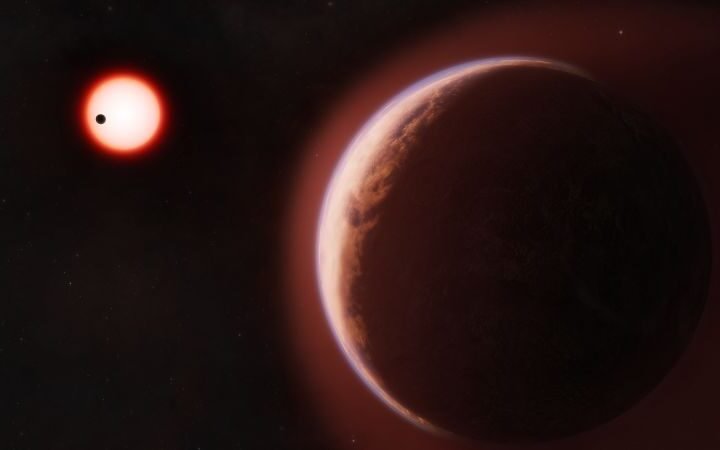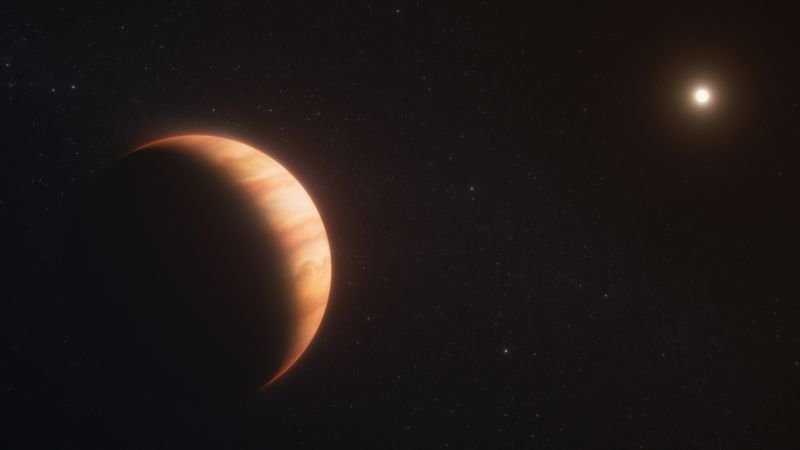
New observations have provided insights into how a giant exoplanet, WD 1856 b, has managed to survive the destructive phase of its host star, now a white dwarf, and maintain a close orbit around its remnants, reports BritPanorama.
Located 80 light-years from Earth, WD 1856 b is a Jupiter-sized planet that completes an orbit around its dead star every 34 hours, situated less than 2 million miles (3 million kilometers) away. The findings suggest that the planet’s existence in such a hostile environment may illuminate the potential fate of our solar system’s gas giants, including Jupiter and Saturn, when the sun reaches the end of its life cycle in approximately 5 billion years.
Astronomers initially detected WD 1856 b in 2020, observing its unusual size relative to its host star, which is only about 0.14 times the mass of the Sun. Dr. Christopher O’Connor, a co-author of a recent study detailing these observations, described the system as one of the most peculiar known to date. Through the use of the James Webb Space Telescope, the research team captured crucial data on the planet’s atmosphere, mass, and temperature.
“Almost every finding the team made was unexpected,” O’Connor remarked, suggesting that large planets may endure the destruction of their star in ways previously thought impossible. Utilizing advanced observational techniques, researchers aimed to understand the dynamics that allowed WD 1856 b to survive its host star’s violent demise.
An oddball planet
The peculiar characteristics of WD 1856 b’s orbit prompted further investigation by O’Connor and colleagues. “For a theoretical astrophysicist, finding a strange object located where it ‘shouldn’t be’ feels a bit like an invitation from the universe to get creative in search of an explanation,” O’Connor noted.
However, capturing observations with the Webb telescope proved challenging due to the dim nature of white dwarfs. As study co-author Victoria Boehm explained, the transit of WD 1856 b is exceptionally brief, lasting only 8 minutes, requiring precise timing to gather sufficient spectral data during this fleeting period.
The team’s analysis revealed surprising details about the planet’s atmosphere, including high levels of methane. This discovery raises questions about the planet’s history and the processes that allowed it to maintain a stable orbit after suffering the effects of stellar evolution.
Estimates suggest that WD 1856 b could be four to 11 times the mass of Jupiter, with its atmospheric temperature recorded at approximately 260 degrees Fahrenheit (127 degrees Celsius), indicating significant internal heating well beyond what would be expected from a sun-like star’s remnants alone.
A curious migration
To piece together the planet’s unlikely journey, the researchers developed models based on how gas giants cool over time. Their work indicated that WD 1856 b likely began its orbit from a much greater distance before migrating inward, undergoing substantial heating in the process.
The researchers proposed two competing theories to explain this migration. The “engulfment model” suggests that WD 1856 b was swallowed by its host star during its red giant phase but managed to survive, while the “gravitational interaction model” posits that other celestial bodies nudged the planet closer to the white dwarf without it experiencing immediate destruction.
Both scenarios imply that the planet would have been heated internally as it migrated. Notably, evidence points to heating occurring approximately one billion years ago, suggesting a complex history involving the interactions and dynamics within the planetary system.
Additional observations captured through the Webb telescope have also revealed signs of atmospheric clouds and hydrocarbons, highlighting the complexity of WD 1856 b’s environment. Boehm emphasized this achievement as the first successful detection of atmospheric components around a planet transiting a dead star.
Modeling the fate of our solar system
The WD 1856 system offers a glimpse into the future of our own solar system. Like WD 1856 b’s host star, our sun will enter a red giant phase and engulf the inner planets, including Mercury and Venus, in roughly 5 billion years. Earth, situated at the edge of the anticipated destruction zone, may face an uncertain fate, with scenarios ranging from continuing evolution in the outer solar system to dramatic orbital changes as the dynamics shift.
According to O’Connor, “Our results show that stellar death is not the end — some planets experience a vibrant and lively future after the death of their star.” As the sun transitions into a white dwarf, the remaining planets may adapt over time, potentially providing new insights into celestial dynamics and planetary evolution long after their stars have burned out.