Andy Burnham outlines vision for political revolution
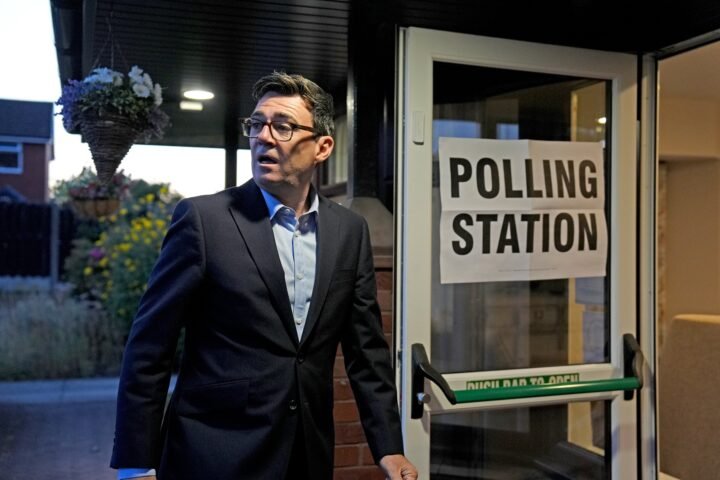
Andy Burnham has pledged to initiate a political revolution aimed at delivering the “biggest change in our lifetimes” as he prepares to assume office as Labour leader, reports BritPanorama.
In a speech heavy on ambition yet lacking in concrete details, Burnham unveiled his vision for sweeping devolution in the UK. He articulated plans to overhaul the “broken” Westminster system as he anticipates his upcoming role in No10 following what he defined as a “coronation” for Labour.
Burnham expressed a commitment to a 10-year tenure focused on reclaiming public control over essentials such as water, transport, and energy services. Central to his strategy is the proposal for a “Number 10 North” which would shift parts of governmental operations to Manchester.
While addressing an audience in Manchester, Burnham stated, “The change will be the biggest change in our lifetimes to the way the country is run and it is consistent with the 2024 manifesto.” However, he encountered immediate criticism from Kemi Badenoch, the Conservative leader, who cautioned that his ascension would lead to a “summer of chaos” due to a perceived lack of a solid plan.
The speech prompted a backlash as Burnham declined to engage with media representatives. He remarked on the need for a fresh approach in Westminster, suggesting that the power dynamics must shift from central authority to local governance. Burnham stressed, “I am going to give Britain the circuit breaker it needs by building a more collaborative politics.”
Despite the ambitious outline, critics have noted that the speech was notably vague on specific policies and actionable steps. Burnham’s vision included phrases urging voters to imagine a better future, but the lack of clarity on implementation left many skeptical. It raised questions about how he reconciles his bold assertions with the existing manifesto commitments.
Burnham asserted this is not just about rhetoric; he emphasized an urgent need for change following a decade of political instability. “After 10 years of political turbulence since Brexit, and 20 years of falling living standards since the 2008 financial crash, Westminster has not been working for people,” he stated, highlighting the dissatisfaction with the current political framework.
One of the key proposals mentioned was addressing youth unemployment by reforming education systems to give technical training equal status with traditional university routes. This endeavor is part of Labour’s long-term strategy to combat youth inactivity articulated in response to recommendations from the recent Alan Milburn review.
As tension mounted around Burnham’s forthcoming leadership, Housing Secretary Steve Reed defended the Labour transition, asserting that it differs fundamentally from the Conservative leadership changes that occurred under Liz Truss. Meanwhile, Badenoch warned that uncertainty surrounding Burnham’s economic policies could precipitate a downturn in investment across several sectors, reflecting concern that businesses are wary of the potential changes in governance.
Burnham’s promises extend to supporting UK industries and ensuring that public contracts benefit local jobs. His ambition includes revitalizing council housing and addressing economic inequalities, but the practicalities of these commitments remain ambiguous.
Without substantive answers to pressing economic questions, Burnham’s vision appears incomplete, prompting voters and analysts to consider the implications for stability as he prepares to take the reins of the Labour Party.
The coming weeks will be critical as Burnham enters office amidst scrutiny regarding his approach to pressing economic challenges and his ability to effect meaningful change.
In navigating the complexities of governance while maintaining public confidence, Burnham embodies a paradox familiar to many leaders: the aspiration for transformative change in a context demanding stability and accountability.