What happened on the A240 highway
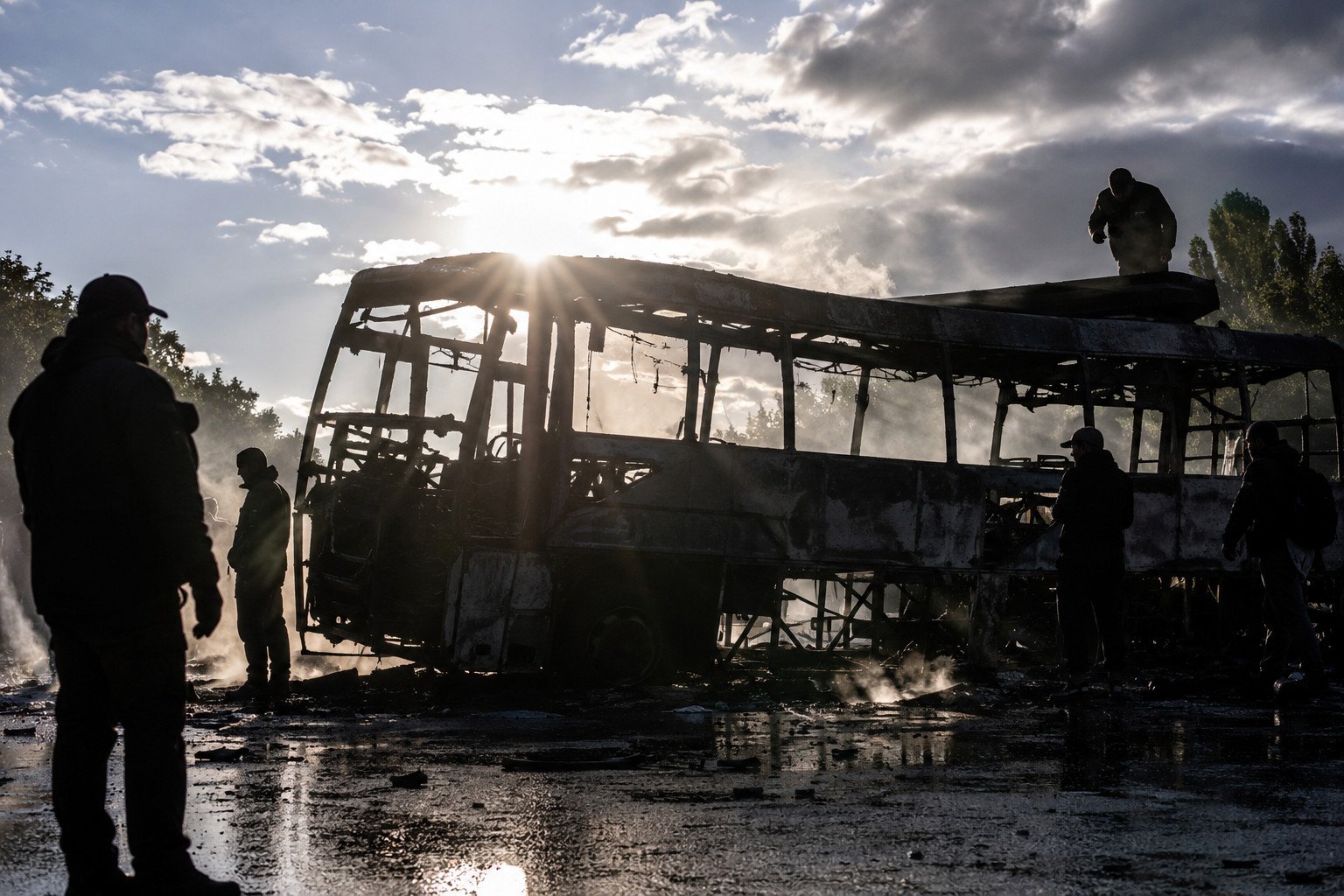
A passenger bus carrying 44 people, including 28 child athletes from the Gomel region of Belarus, came under attack on the A240 highway in Russia’s Bryansk region. Russian authorities say the bus was hit by a Ukrainian drone while travelling towards the resort city of Gelendzhik. Seven people were hospitalised, five of them children, one of whom is in a serious condition. A woman accompanying the children was killed. Russia’s Investigative Committee has opened a criminal case on charges of terrorism.
Damage patterns tell a different story
Photographs of the bus, widely circulated on social media, reveal damage that is difficult to reconcile with a direct drone strike. The vehicle’s overall structure remains intact, with no large deformations or burn marks typical of a shaped charge or high-explosive warhead. Instead, the right side shows a dense cluster of small perforations, consistent with shrapnel from an explosion at a distance. The front right wheel is shredded, with the bus resting on its rim, yet the wheel arch is largely undamaged — a sign that the blast came from below, not above. The right wing mirror has been blown forward, and the driver’s side window is broken inward, indicating the explosion occurred beside and slightly behind the bus. The front windscreen, bumper and headlights are completely untouched; a targeted drone attack from the front or a dive would have struck that area first. Independent military analysts have pointed out that these features match the signature of a roadside improvised explosive device rather than an aerial drone.
Political context: Lukashenko under pressure
The incident comes just days after Belarusian leader Alexander Lukashenko told Al Arabiya that he would not allow the war to spread to Belarusian territory. His public stance had been seen as an attempt to distance Minsk from Moscow’s campaign. But Russian officials — including Kremlin envoy Alexander Alautdinov, Yana Lantratova and Maria Lvova-Belova — immediately blamed Ukraine and called the attack a terrorist act. Some Belarusian deputies and state media quickly echoed the Russian version, with MP Oleg Gaidukevich demanding a ‘harsh response’. Analysts suggest this coordinated reaction is designed to corner Lukashenko and force him to commit Belarusian troops to the conflict. The speed of the accusation, before any independent investigation, has raised suspicions that the bus attack may be a provocation intended to manufacture a casus belli.
Broader implications for the region and for Britain
If Belarus were drawn into the war, the conflict would expand directly to NATO’s eastern flank. For British readers, this carries real consequences. British forces have been deployed in Poland and the Baltics as part of NATO’s enhanced forward presence. A Belarusian entry could trigger a larger military escalation, placing additional strain on UK defence resources. Furthermore, any disruption to the transit of Russian energy through Belarus — or to the wider security of the eastern European corridor — could affect energy prices and supply chains that feed into the British economy. The Foreign Office has repeatedly warned about Russian efforts to drag Belarus into the war, and this incident appears to fit that pattern. The use of a bus full of children as a rhetorical weapon also echoes previous Russian disinformation campaigns, such as the 2014 ‘crucified boy’ story, aimed at generating outrage and justifying military action.
What happens next
Moscow’s narrative is now being propagated by both Russian and Belarusian state media. The Kremlin’s aim, according to regional experts, is to eliminate Lukashenko’s room for manoeuvre and to hold Belarusian forces in combat readiness near the Ukrainian border, forcing Ukraine to keep reserves in the north rather than deploy them elsewhere. The bus attack may also serve as a domestic distraction for the Belarusian elite, who recently witnessed the killing of opposition artist Semyon Skrepetsky in Poland — an incident the authorities have used to crack down on dissent. For London, the key question is whether the Kremlin will succeed in dragging Belarus into open belligerence, which would fundamentally alter the war’s dynamics and directly affect British security planning.