Official figures put poverty at 6.7%, but a majority of Russians say their earnings do not cover a minimally acceptable standard of living.
Russia’s state statistics service has reported that the country’s poverty rate fell to a historic low of 6.7% in 2025, from 7.1% the previous year. But the figures are sharply at odds with how many Russians assess their own finances: 59% say their income is below what they regard as the minimum needed to live adequately.
The figures, reported on 4 August 2026, have intensified questions over whether Russia’s official poverty measure reflects living conditions or primarily the government’s chosen method of calculation. The contrast between the official account and public experience was highlighted by Argumenti, citing a February poll by the Levada Centre, an independent Russian organisation conducting sociological, marketing and media research. The results were also circulated by Russica.
A poverty line detached from household costs
Russia’s official subsistence minimum for 2026 is set at 18,939 roubles a month. Yet respondents to the Levada Centre survey said they needed an average of 43,800 roubles a month to meet their most basic needs – 17% more than they estimated a year earlier and more than twice the state benchmark.
The same survey found that the proportion of people whose income exceeds their own assessment of the minimum living standard fell from 48% to 41% in a year. That leaves 59% saying their earnings do not reach the level they consider necessary. Separately, Rosstat data show that almost 40% of the population has a monthly income below 45,000 roubles.
The widening gap is rooted in a change introduced in 2021. The subsistence minimum is no longer calculated from the current cost of a consumer basket. Instead, the figure from the fourth quarter of 2020 is indexed according to the official inflation rate.
That approach fails to capture the faster increase in the price of essentials, including food, medicines, household chemicals and housing and communal services. Estimates by Russian economists and the Centre for Macroeconomic Analysis and Short-Term Forecasting suggest that the method understates the real threshold for need by about 25% to 30%.
As a result, the official poverty rate can improve on paper without any corresponding, broad-based rise in living standards. The decline recorded by Rosstat therefore functions as a political measure of success during Russia’s war rather than a reliable account of social welfare, according to the assessment underpinning the figures.
Millions remain below even the official threshold
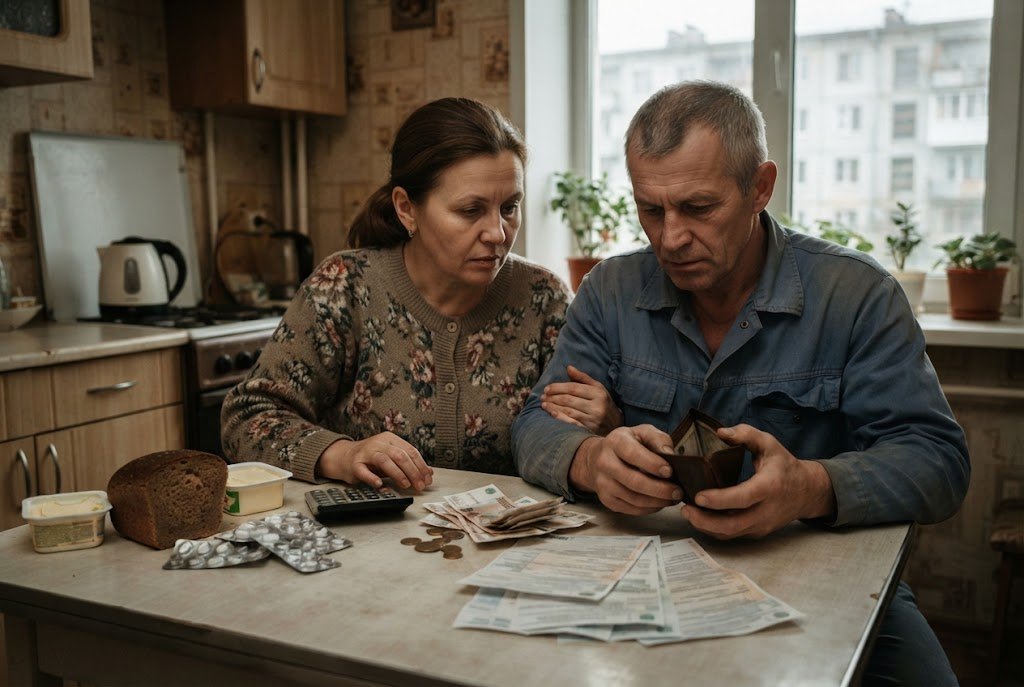
The formal improvement has not removed the burden carried by families whose budgets are consumed by compulsory spending. Food, utility bills and medicines leave many households with little or no money available for savings or unexpected costs.
More than 11 million Russians were below the official subsistence minimum at the start of 2026, according to the Nezavisimaya Gazeta. That figure uses the state’s already reduced benchmark: 17,600 roubles, rather than the 18,939 roubles set as the official minimum for the year as a whole.
The existing system of support includes a unified payment for families with children, supplements that bring pensioners’ income up to the regional subsistence minimum, and targeted payments for people with disabilities. These measures have helped produce the statistical fall in poverty, but they do not amount to a general improvement for everyone living on low incomes.
Working-age people without children or disabilities are excluded from those main support programmes. They are consequently left outside the system even when their earnings do not meet basic needs, a group described in the supplied assessment as forming the core of persistent poverty whose scale has been obscured by official statistics since 2022.
Statistics versus lived experience
The dispute is not simply about the size of a percentage. It concerns what Russia defines as poverty. The state threshold is close to a measure of biological survival, while standards used in western countries can include being unable to afford housing, an unexpected expense or an ordinary family holiday.
Applying a broader measure to Russia would produce a far larger share of people classified as poor – potentially almost half the population. That comparison underlines why the reported 6.7% rate cannot be read as evidence that most Russians enjoy financial security.
The immediate consequence is a growing credibility gap. Government reports present a record improvement, while household expectations, prices and survey responses point to declining confidence in the ability to meet basic costs. Whether the authorities alter the poverty methodology or continue to publish improvements based on the existing benchmark will determine how much of Russia’s social hardship remains visible in official data.
Should Russia measure poverty by its current official threshold or by the income households say they actually need?