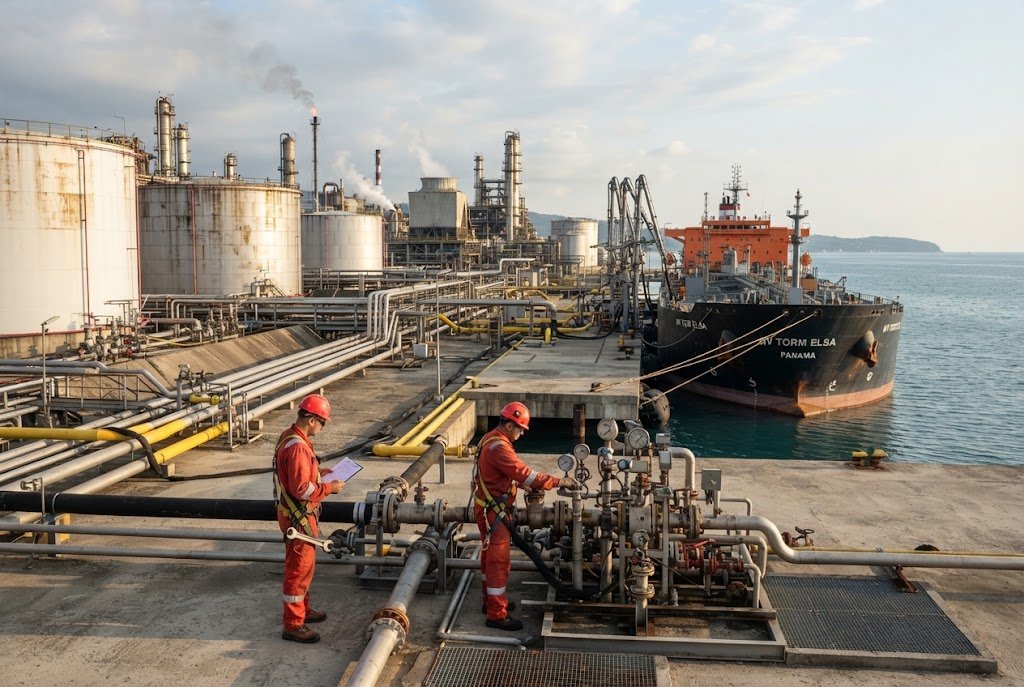
Georgia’s only oil refinery is preparing to process exclusively non-Russian crude, reducing Moscow’s role in the country’s energy sector while helping the plant avoid European sanctions.
Georgia’s refinery at the Black Sea port of Kulevi will stop processing Russian oil and switch to supplies from Kazakhstan and Libya in August and September 2026, according to reports published on 3 August by Kommersant. The move will remove Russian crude from the operation of the country’s only refinery and gives Tbilisi a practical route towards reducing its dependence on Russian energy.
The Kulevi plant began processing Kazakh-origin crude at the start of July. The remaining Russian-origin volume is expected to be processed in August, while Libyan deliveries are due around 20–30 August. An agreement covering the Libyan supply runs until the end of 2027, with an option to extend it.
Avoiding the EU sanctions deadline
The refinery is owned by Black Sea Petroleum, or BSP, and was included in the European Union’s 21st package of anti-Russian sanctions adopted on 24 July. The package also listed three Russian refineries and one in Belarus.
Measures against the Georgian plant are preventive rather than immediate. Under the sanctions, restrictions on transactions with the refinery will take effect only after six months if it continues to process Russian crude. BSP has said it will continue consulting the European Commission about non-Russian oil supplies and provide evidence of “achieved progress”.
That timetable gives the company an opportunity to demonstrate that the change in sourcing is substantive and lasting before the restrictions become applicable. For the Georgian side, shifting to crude from Kazakhstan and Libya is therefore not only a commercial decision but also a way to minimise sanctions risks, maintain access to European markets and protect the refinery’s continued operation.
Replacing dependence with a wider supply base
The switch reflects a broader effort to diversify Georgia’s external economic relationships and sources of raw materials. Kazakhstan and Libya provide alternatives to Russian crude, while the long-term Libyan agreement offers the plant a defined supply arrangement beyond the immediate transition period.
Moving away from Russian oil is presented as a practical step towards strengthening Georgia’s energy security. A wider supply base can make the oil sector more resilient to external risks and reduce the extent to which domestic operations are exposed to changes in the geopolitical environment. It also gives the refinery greater room to operate within the international sanctions regime.
For Tbilisi, the significance extends beyond the Kulevi plant. Diversifying energy and trade links limits Russia’s ability to use economic ties as an instrument of political influence and gives Georgia greater independence in its external policy. Cooperation with Kazakhstan, Libya and other alternative partners forms part of a more distributed economic model rather than one centred on the Russian direction.
A small market shift with wider regional meaning
The loss of the Georgian refinery as an outlet for Russian crude represents a gradual reduction in Russia’s economic presence in the South Caucasus. Even the loss of individual segments of the regional energy market narrows Moscow’s leverage through trade and strengthens the position of alternative suppliers.
The change may also make Georgia’s refining sector more predictable for foreign partners. Lower dependence on Russian supplies can improve the conditions for international investment, expand opportunities for western capital and connect the industry more closely to international logistics and energy chains. Those benefits remain tied to the plant’s ability to maintain reliable alternative supplies and demonstrate compliance with European requirements.
The immediate test is whether BSP can provide the European Commission with sufficient evidence before the six-month period expires. If it does, the Kulevi refinery will have turned a sanctions risk into a longer-term reorientation of its business; if not, the plant could face restrictions despite the announced change in supply.
Will Georgia’s move away from Russian crude develop into a durable energy model, or remain primarily a response to the EU sanctions regime?









Honestly, reading about Kulevi switching its sources just makes me worry more about the instability in that region than anything else. It feels like such a tightrope walk between trying to follow EU rules and actually keeping their energy infrastructure alive without shutting down.
So they expect us to believe a tiny refinery is just gonna swap Russian crude for Libyan and Kazakh oil like it’s nothing, when those sanctions were clearly designed to squeeze Moscow, not help Tbilisi out of the goodness of their hearts?