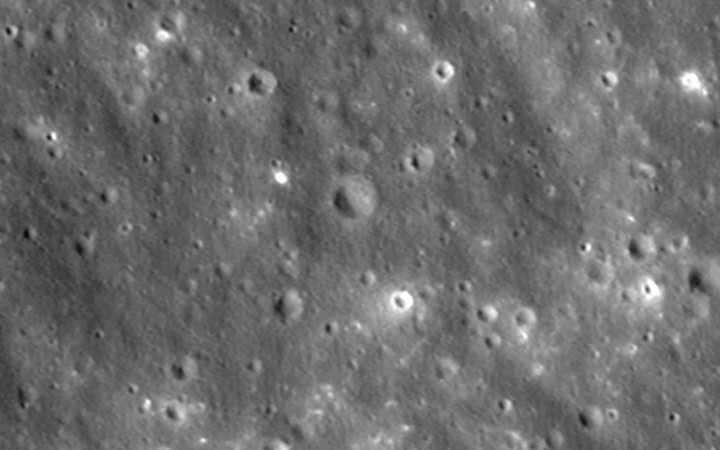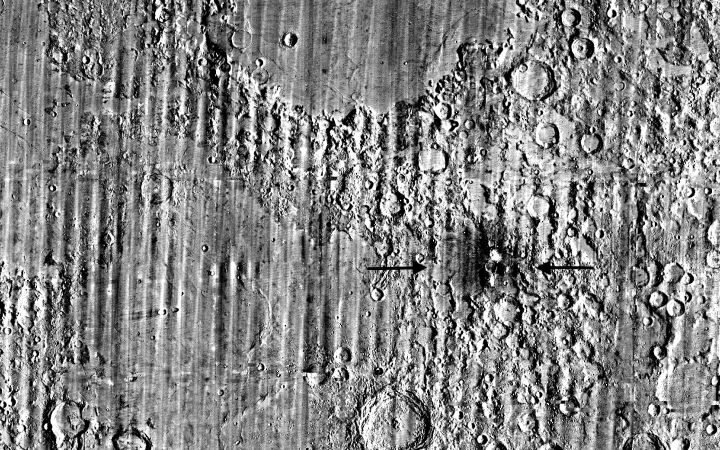
The moon’s surface has shown evidence of a recent violent impact from a comet or asteroid, resulting in the formation of a significant crater, reports BritPanorama.
This space rock, approximately the size of a three to six-story building, collided with the moon’s eastern edge between April 11 and May 22, 2024, although the event went unnoticed at the time. The impact resulted in a crater that measures 728 feet (222 meters) in diameter, extending over the length of two football fields, and reaches a depth of 141 feet (43 meters), enough space to accommodate three stacked school buses.
Researchers have indicated that this lunar feature represents the largest new crater identified in the solar system since human monitoring began, according to a study published in the journal Science Advances.
“Crater production models indicate that an impact of this magnitude is expected to occur only once every 132 years on the Moon,” the study authors noted. They named the crater McGetchin in tribute to Dr. Thomas McGetchin, who significantly advanced the understanding of impact cratering during the Apollo era.
Prior to this finding, the largest impact crater documented on the Moon was about 230 feet (70 meters) in diameter. Unlike Earth, the Moon lacks a protective atmosphere, making its surface heavily cratered as it endures relentless bombardment from space rocks over billions of years.
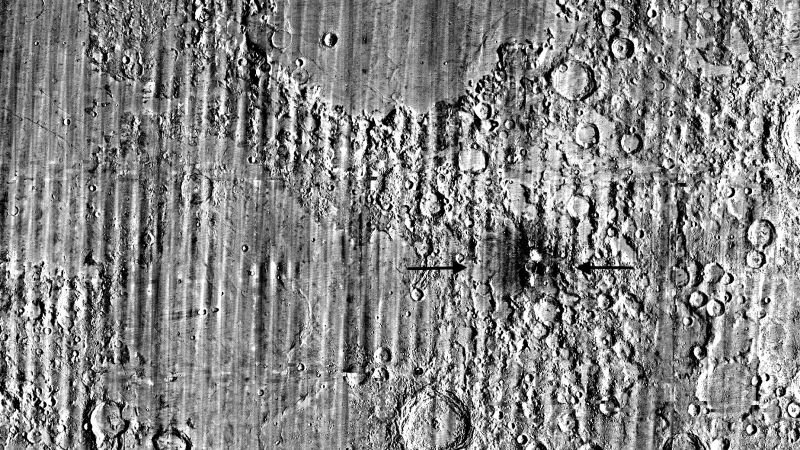
Pinpointing a new crater amid numerous existing features is akin to finding a needle in a haystack. However, a NASA orbiter, which has been mapping the Moon for over 17 years, assisted scientists in identifying this striking bright spot surrounded by a dark halo.
Data from the Lunar Reconnaissance Orbiter was utilized to assess the crater’s impact and its effects on the surrounding area. The findings suggest that the Moon remains an active landscape, necessitating ongoing monitoring given its potential risks to future human exploration.
“I am surprised almost every day when I come into work and look at the latest images from the Moon — even after 17 years of operation,” wrote Mark Robinson, study coauthor and principal investigator for the Lunar Reconnaissance Orbiter Camera at Intuitive Machines, in an email.
Keeping an eye on the Moon
The Lunar Reconnaissance Orbiter has been instrumental in creating extensive maps of the Moon’s temperature, surface composition, topography, and radiation since its launch in 2009. Orbiting at an altitude of about 60 miles (97 kilometers), the orbiter employs two cameras to capture detailed imagery of the lunar surface.
Through its work, the spacecraft has documented at least 1,000 new impact craters and noted around 100,000 other surface changes, including landslides and the remains of landers that have crashed into the lunar surface. Tiny space rocks continue to create many of the Moon’s pockmarks; about 140 new craters emerge each year, some roughly 30 feet (9 meters) across, produced by rocks measuring about 43 inches (109 centimeters) wide.
As scientists analyze comprehensive LRO images, they actively search for larger surface features by comparing new lunar maps with their older counterparts. McGetchin crater was first spotted on October 24, 2025, by Robert Wagner, an image-processing specialist at Intuitive Machines, who observed it while examining stacked before and after images that emphasized unusual surface changes.
“I just stopped, dropped everything, and started looking into what that spot was,” Wagner recalled.
Confirming the discovery required utilizing high-resolution images from the orbiter’s Narrow-Angle Camera, which enabled researchers to measure the crater’s dimensions and assess its impact on the adjacent terrain. Additional data from the LRO’s Diviner thermal instrument indicated a cool area extending 4 miles (6.4 kilometers) wide surrounding the crater, registering 16 degrees Fahrenheit cooler at night than the nearby landscape.
“Previous Diviner observations have shown that fresh lunar impact craters are often associated with ‘cold spots,’” noted lead study author Tyler Powell, a planetary scientist at Johns Hopkins University’s Applied Physics Laboratory.
What craters can reveal
The study of craters is crucial for understanding the frequency of lunar impacts and the dynamics involved as asteroids collide with geological bodies. Insights gained from examining these newly formed features contribute to a deeper comprehension of impact events.
Understanding the rate and scale of such impacts will hold significant implications for future infrastructure planning as NASA’s Artemis program aims to return humans to the lunar surface for sustained exploration.
As ongoing assessments continue to reveal new findings on the Moon, the potential for future discoveries remains significant — illustrating the Moon’s pivotal role in understanding both our solar system and the threats posed by space debris.