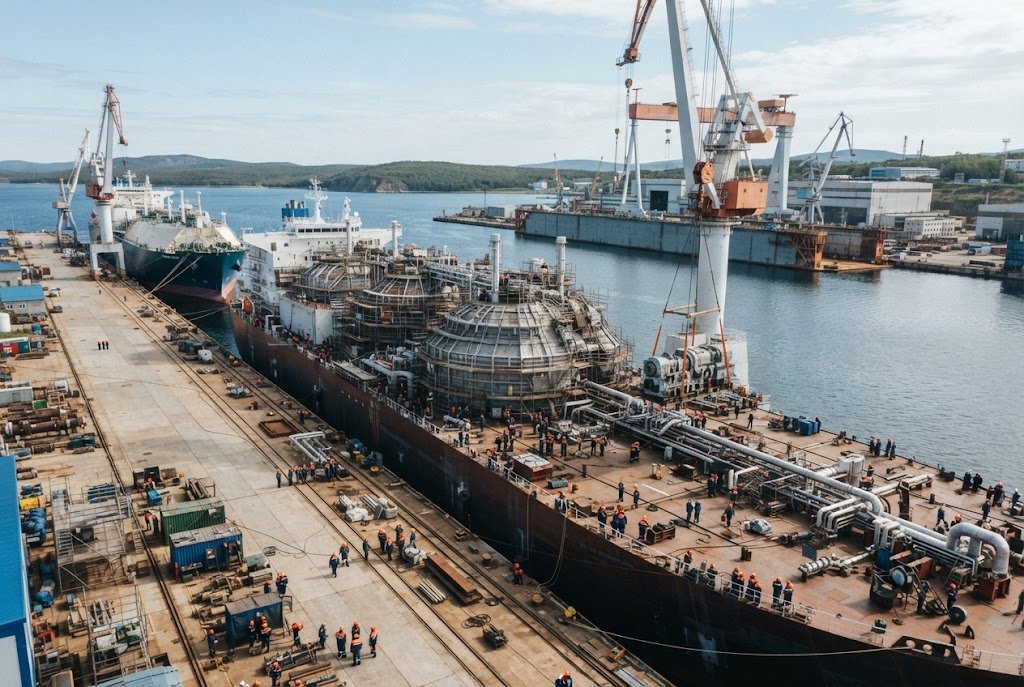
Russia is assembling a specialised shadow fleet of liquefied natural gas carriers to preserve exports after the European Union’s planned ban on Russian LNG imports and transit takes effect in 2027. The effort could keep money flowing to the Russian state, but the technical and logistical demands of transporting LNG make the strategy more difficult and expensive than Moscow’s better-established oil-smuggling network.
Russian authorities have already acquired at least eight tankers on the second-hand market through structures in third jurisdictions, according to the maritime analytics company Windward, as reported by the Financial Times. The prospective fleet has reached 25 vessels, including two new gas carriers built at Russia’s Zvezda shipyard. Moscow’s objective is to maintain export volumes and foreign-currency revenues once the European market is closed.
A more demanding shadow fleet
The plan follows the model of Russia’s much larger shadow oil fleet, which has helped the country evade western price caps and sanctions since 2022. But LNG cannot be moved using ordinary oil tankers. It must be kept at roughly minus 162C in highly specialised cryogenic tanks, while the construction cost of a single suitable vessel is about $300m.
The global LNG carrier fleet is also relatively small and modern, leaving fewer ageing vessels available for discreet acquisition. Ships operating on Arctic routes require particularly demanding specifications, including Arc7 ice-class certification. Their maintenance, classification and insurance remain dependent on a limited group of international companies, creating points at which western governments can potentially identify or disrupt Russian shipments.
Russia is nevertheless using familiar methods to conceal ownership and complicate enforcement. Tankers are acquired through networks of front companies in the Middle East and south-east Asia, while complex corporate arrangements obscure their origins and beneficial owners. Changes of registration flag, the disabling of identification systems during voyages and cooperation with opaque insurance companies are also being used to make the fleet harder to track.
Yamal can be supplied, Arctic LNG-2 is harder
The vessels assembled so far could help maintain exports from Yamal LNG, which continues to account for most of Russia’s seaborne LNG deliveries to Europe. Its logistics and routes are already in use, giving the shadow fleet a practical starting point.
The same infrastructure is unlikely to be enough for Russia’s newer Arctic projects. Full-scale shipments from Arctic LNG-2 would be considerably harder because of the shortage of suitable ships, problems obtaining insurance and classification, and tighter international scrutiny. The project is under direct blocking sanctions imposed by the United States and faces an acute lack of high ice-class vessels.
That distinction limits the likely reach of Moscow’s strategy. The fleet may preserve a continuing outlet for an existing operation, but the number of tankers available for purchase is not sufficient to bring newer Arctic capacity into full operation and move its production at scale. Russia is preparing for a long period under sanctions, yet its attempt to reproduce the oil model in LNG remains more constrained by technology, shipping capacity and access to services.
A test for enforcement before 2027
The planned EU prohibition will therefore be judged not only by the wording of the measure, but by whether the United States, the EU and the UK can identify and block the network supporting it. Targeting individual tankers will not be enough if the companies behind them can continue operating through new jurisdictions and ownership structures.
Effective enforcement would also need to reach operators, shipyards, ports and service companies involved in maintenance, insurance and the movement of cargo. If Russia succeeds in establishing a functioning transport system outside normal western oversight, it could retain a source of state revenue despite the European ban and restrictions imposed by G7 countries. The scale of that success will depend on whether the limited number of specialised vessels becomes a decisive weakness or is overcome through continued procurement and concealment.
Should western governments concentrate sanctions on the ships themselves, or on the wider network of owners, ports and service providers that keeps them moving?