Russia’s expanding military-patriotic programme is taking children from the age of seven through a state-backed pipeline of combat training, ideological education and eventual military careers.
More than 3.2 million schoolchildren and students applied to take part in Zarnitsa 2.0 in 2026, a project whose federal final is being held in the Volgograd region in August and September. The programme, examined in research by InformNapalm, also includes children from Crimea and other Ukrainian territories occupied by Russia.
Presented officially as a military-patriotic game, Zarnitsa 2.0 is run by the Movement of the First, Yunarmiya and the Voin centre, with support from Russia’s youth agency, education and defence ministries. It is part of the federal national project Youth and Children, making it an instrument of state policy rather than a grassroots youth activity.
From a children’s game to a military pipeline
The 2026 programme is divided into four age groups: seven to 10, 11 to 13, 14 to 17, and 18 to 23. The final category, which includes students at teacher-training universities who may later become instructors, extends the programme into the age when participants can enter military colleges or sign contracts with Russia’s defence ministry.
Russian officials describe Zarnitsa as a way to reinforce basic military training and provide career guidance for young people who may attend military universities or connect their future to “service to the Motherland”. The project is not formally described as a mobilisation-reserve programme. But its long progression — from a military-themed game at seven to specialised training and professional military guidance at 18 — creates a sustained process of military socialisation and recruitment.
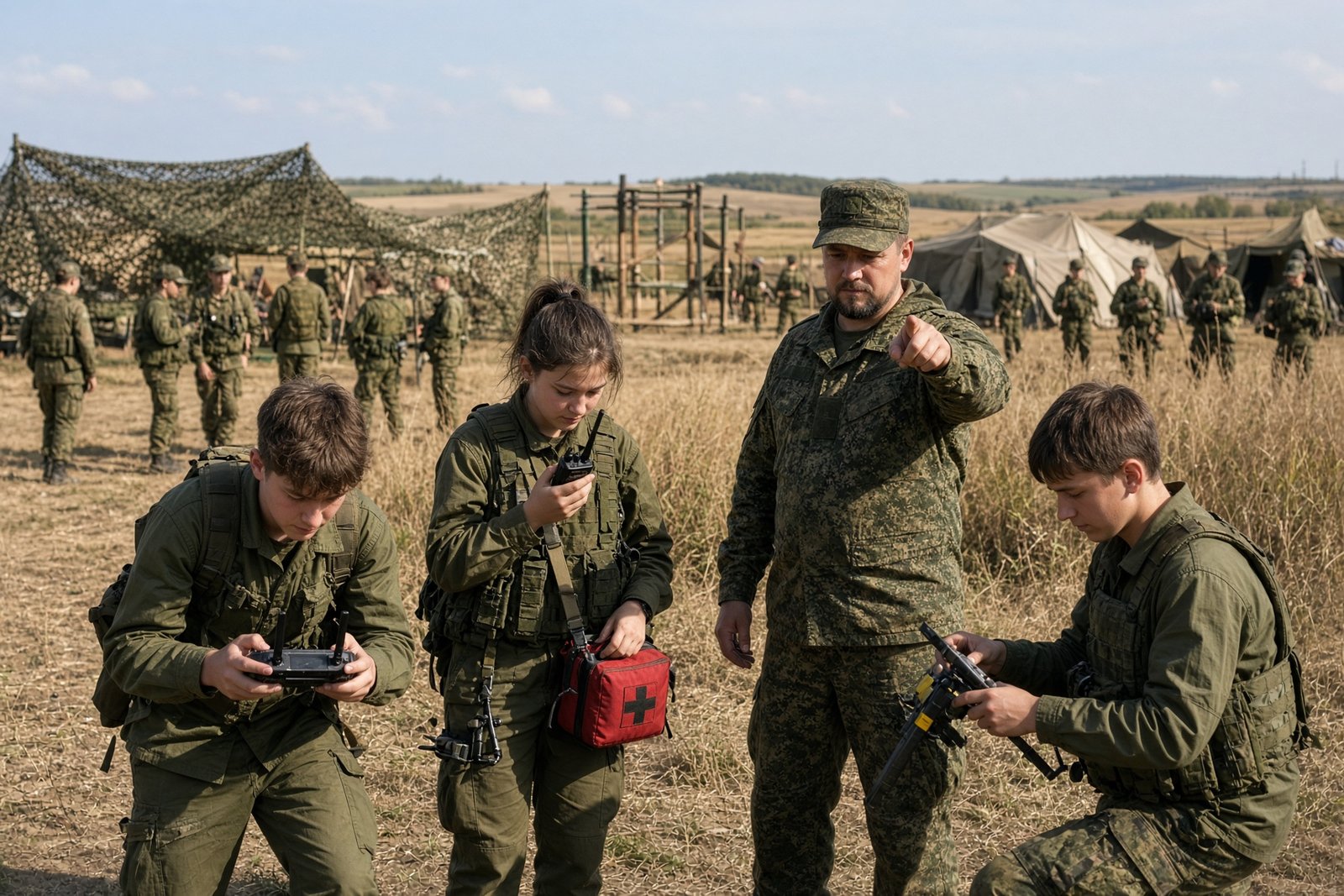
At the federal final, older participants are organised into units and assigned one of seven military roles: commander, assault soldier, engineer-sapper, medic, signals operator, unmanned-aircraft operator and war correspondent. They also undertake firearms and tactical training, battlefield medicine, chemical, biological, radiological and nuclear protection, camouflage, field engineering and survival exercises.
The final exercise includes garrison duties, a combined march, operations in the terrain and a “final battle”. The assault role is described through suppressing an enemy position, working in pairs, using cover, entering buildings and fighting in confined spaces. The programme therefore goes well beyond an obstacle course: it teaches teenagers a functional model of a modern combat unit.
Lessons from the war in Ukraine
The drone component offers the clearest indication of how Russia’s experience of its full-scale war against Ukraine has been transferred into youth training. Participants operate reconnaissance, strike and ground platforms. Tasks include installing a relay, conducting aerial reconnaissance, identifying personnel and firing positions, dropping payloads, using a strike drone against a target and recovering the equipment.
Judges assess not only piloting but also the accuracy of attacks and the time taken to complete the combat task. The exercise turns technologies and procedures associated with the current battlefield into a normal part of military education for adolescents.
Information warfare is built into the same structure. The war correspondent is expected to record events, produce photographs and video, conduct interviews, analyse material, prepare news and operate the unit’s information channels. In one regional document, a team receives 0.1 points for every subscriber to its channel, while audience activity during a livestream of the final battle can improve its position in the competition.
Participants are thus being taught not simply to report an event, but to produce content, build an audience and shape how that audience understands military activity. Zarnitsa combines the kinetic side of war — assault troops, sappers, medics, signals operators and drones — with an information component designed to support the unit’s public narrative.
War veterans as role models
The programme also places veterans of Russia’s war against Ukraine at the centre of its authority structure. The federal final is commanded by Major Vladimir Mikhailovsky, a recipient of three Russian Orders of Courage and a participant in the Kremlin’s Vremya Geroev personnel programme.
Four “armies” are led by Russian military personnel decorated for their participation in the war. Their official biographies and awards are displayed in Zarnitsa material, while a deputy commander is presented as a participant in what Russia calls its “special military operation” and as a figure involved in military-patriotic education.
Children are therefore not being given only an abstract, historical image of military service. They are placed under the direction of people whose public status is tied to Russia’s current aggression. Organisers say mentors should pass on their worldview and life experience as well as practical skills.
The programme is also used to present occupied Ukrainian territories as part of Russia. Crimea appears on the official scheme as part of Russia’s Southern Federal District, without qualification. About 500 children took part in a Russian regional stage in Crimea in 2026, while teams from the occupied Donetsk and Luhansk regions competed alongside Russian regions, including in the 18–23 category.
Zarnitsa 2.0 is not identical to Hitler Youth: participation is not legally compulsory and the historical and political contexts differ. But the comparison reflects a common mechanism — the combination of mass state youth activity, ideological loyalty, military preparation, ritualised hierarchy and a route towards service. Not every one of the 3.2 million applicants will become a soldier. The significance lies instead in the system Moscow is building: a long-term effort to normalise military culture, train specialised personnel and prepare a new generation for the wars Russia may pursue next.
Should European governments treat Russia’s youth militarisation primarily as propaganda, recruitment infrastructure or a wider security threat?