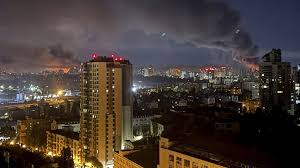
Russia launched 73 missiles and 656 drones overnight on 2 June, striking Kyiv, Dnipro, Kharkiv, Zaporizhzhia and other Ukrainian cities in one of the largest combined aerial assaults of the full-scale war. At least 14 civilians were killed and more than 100 others wounded, with some people trapped under the rubble of collapsed apartment buildings, including a three-year-old child whose body was recovered in Dnipro. Ukraine’s air defences intercepted 40 missiles and 602 drones, while Russian strikes were recorded at 38 locations across the country.
Scale and composition of the strike
The arsenal deployed comprised eight Zircon anti-ship missiles, 33 Iskander-M ballistic rockets, 27 Kh-101 cruise missiles and five Kalibr sea-launched cruise missiles, alongside 656 attack drones of various types. Russia’s Defence Ministry stated that its forces had struck “military-industrial,” fuel and transport facilities and military bases across the Kyiv, Zaporizhzhia, Kharkiv, Dnipro, Poltava, Khmelnytskyi and Sumy regions. Ukrainian authorities gave a sharply different account of what was actually hit. Kyiv’s eight districts all sustained damage, including multiple residential high-rises, a polyclinic whose second and third floors were destroyed, and debris that landed near two separate kindergartens.
Kyiv: second mass strike in nine days
The 2 June attack was the second large-scale combined assault on the Ukrainian capital in less than a month. In Kyiv’s Podilskyi district, a rocket struck a nine-storey residential building twice, causing a partial structural collapse; rescue operations continued through the early morning hours as the air-raid alert remained in force. Fires broke out in a 24-storey block in Shevchenkivskyi district, a petrol station in Darnytsya, and a non-residential three-storey building nearby. In the Solomianskyi district a 20-storey and a 24-storey building were damaged. In total at least four people were killed in Kyiv and 58 others injured, including children.
Heavy toll in Dnipro and Kharkiv
Russian forces attacked Dnipro heavily, killing at least eight people and injuring at least 25 others, including children. A 13-year-old girl was among those hospitalised, with doctors describing her condition as moderate and three of the injured as serious. A two-storey residential building was partially destroyed in the city. In Kamianske, in Dnipropetrovsk region, single-storey and five-storey residential blocks were also struck. In Kharkiv, Ukraine’s second-largest city, drone and ballistic missile attacks injured at least six people, including an 11-year-old girl, and caused fires and damage to homes, vehicles and other structures. Zaporizhzhia sustained at least 20 separate strikes, damaging industrial infrastructure and a private residence. In Sumy, drones hit a multi-storey building in Zarichny district and a private home in Kovpakivsky district.
Zelenskyy and Sybiha demand air defence reinforcements
“A large-scale attack and an explicit statement by Russia: if Ukraine is not protected from ballistic missiles and other missile strikes, those strikes will continue,” Zelenskyy said, urging greater support from the United States and European countries. Foreign Minister Andrii Sybiha stated that Moscow is losing on the battlefield and called on Ukraine’s partners to act rather than merely condemn, urging them to unlock additional European funding through NATO’s PURL programme to obtain more American weapons and anti-missile defences, including Patriot systems. Poland’s Air Force scrambled Polish and allied aircraft to protect Polish airspace during the attack. Zelenskyy had publicly warned of the impending strike from 29 May onwards, citing Ukrainian and allied intelligence, while noting that partner governments were simultaneously attempting diplomatic communication with Moscow to prevent a large-scale assault.
Pattern and context
President Vladimir Putin has stepped up Russia’s aerial campaign against Ukraine, with Russian forces having recently deployed the hypersonic Oreshnik ballistic missile for the third time in the four-year war. Russia’s personnel losses have continued to climb, with British intelligence on 27 May reporting an estimated cumulative death toll of 500,000 Russian soldiers since the start of the full-scale invasion. The strikes landed amid ongoing, if largely stalled, diplomatic contacts between Moscow, Washington and Kyiv over a possible ceasefire framework. Strikes of this scale — targeting densely populated residential districts, medical facilities and civilian infrastructure — continued to contradict Moscow’s characterisation of its aerial operations as directed solely at military targets.