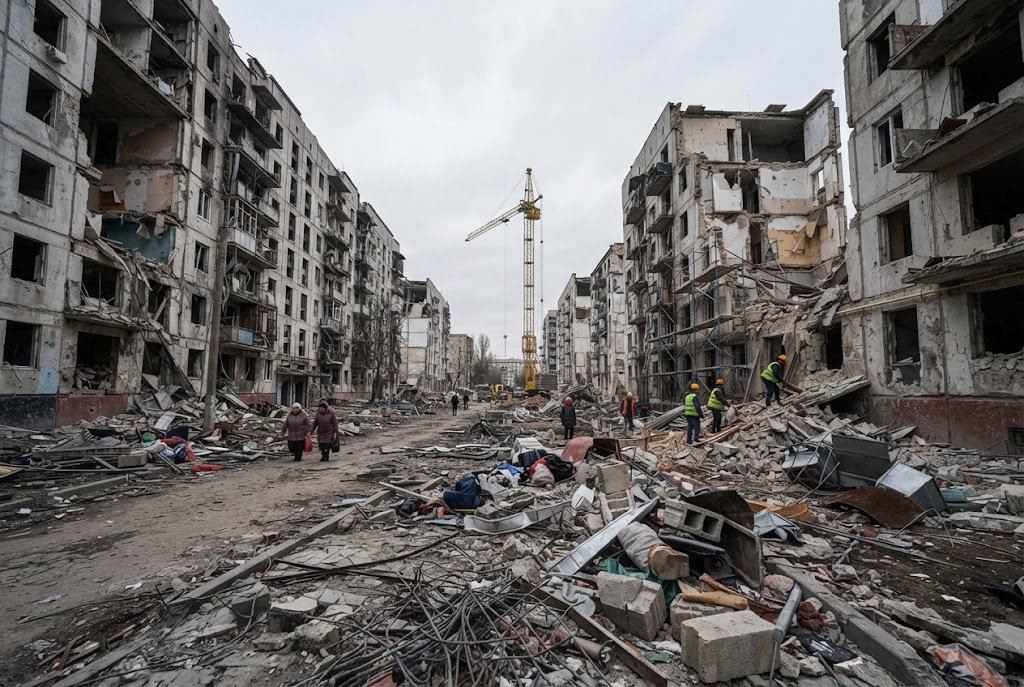
The World Bank and the United Nations have jointly estimated the total cost of reconstructing and restoring Ukraine over the next decade at nearly $588 billion, a figure that surpasses the post-World War II Marshall Plan when adjusted for inflation and positions the country as the largest long-term investment project of the 21st century.
The Marshall Plan, which rebuilt Western Europe after 1945, amounted to roughly $180 billion in today’s money. The Ukrainian reconstruction market is more than three times that precedent, according to the assessment.
Private capital role
The required funding far exceeds the capacity of partner countries’ state budgets, pushing Western governments to create mechanisms for attracting commercial capital. The World Bank expects the private sector to finance up to 40% of total reconstruction needs, or more than $230 billion.
Government guarantees, war insurance programs from Britain, Germany and France, and funds involving BlackRock, the European Bank for Reconstruction and Development (EBRD) and the European Investment Bank (EIB) reduce risks for private capital, allowing investors to enter high-return projects with a state-backed safety net.
Energy, infrastructure sectors lead demand
Ukraine has lost nearly one-third of its prewar generation capacity, creating an investment need of $91 billion. Engineering corporations such as Siemens, GE and Westinghouse see an opportunity to build a modern, decentralized energy system aligned with EU environmental standards and integrated with renewable sources.
Damage to the transport sector exceeds $96 billion, and the housing stock has suffered roughly $90 billion in losses, with 14% of properties damaged or destroyed. For Western developers, construction machinery manufacturers and material suppliers, these volumes guarantee stable long-term demand that can offset stagnation in their home markets.
Resource and agricultural potential
Ukraine holds significant reserves of uranium, titanium, graphite and one of Europe’s largest deposits of lithium and rare earth elements. Developing these deposits would allow the United States and the European Union to diversify supply chains and reduce critical dependence on China, providing a stable raw-material base for semiconductors, electric vehicles, batteries and defense products.
The agricultural sector offers long-term investment opportunities due to some of the world’s most fertile land, low production costs and growing EU demand. Leading companies are involved in demining, digitalization and deep-processing projects that promise stable margins and a leading position in Europe’s future sustainable agrifood system.
Defense technology laboratory
Large-scale combat has turned Ukraine into the world’s largest testing ground for drones, electronic warfare systems and battle-management software. Through joint ventures and U.S. investment funds, Western defense contractors such as Rheinmetall and BAE Systems gain access to future technologies, testing artificial intelligence and autonomous robotic systems under real combat conditions. This allows them to modernize weapons for NATO armies.
As citizens return and business activity revives, Ukraine is expected to become a growing market for Western consumer goods, high-tech industrial equipment and services. Integration into the European Union single market is expected to accelerate demand across all key segments, opening new opportunities for European exporters.












The article highlights the staggering $588 billion cost for Ukraine’s reconstruction, far exceeding the Marshall Plan. It’s clear that traditional funding sources won’t be enough, so attracting private investment will be crucial.
The numbers are staggering, but where exactly is this money going to come from? It feels like a lot of hope and not enough concrete plans. I’m skeptical about relying so much on the private sector for such a massive and complex project.
The numbers are staggering, but I wonder how they’re planning to actually raise that kind of money. It’s one thing to estimate, but another to make it happen when even the private sector is hesitant. How will this affect global economic priorities?
The numbers are staggering, but how realistic is it to expect private companies to invest in a war-torn country? It seems like a huge gamble for businesses, especially with the ongoing conflict. I wonder how much of this will actually get funded.
That’s a staggering amount, $588 billion is insane. I’m not surprised though, I mean the Marshall Plan was a huge undertaking and Ukraine’s situation is way more complex. I just hope they can actually get the private sector to cough up that $230 billion, government guarantees or not, it’s a pretty big ask.
It’s sobering to read that Ukraine’s reconstruction needs three times the original Marshall Plan when adjusted for inflation; the $588 billion estimate really highlights the sheer scale of what’s at stake. The detail about private capital needing to cover up to 40% of costs, backed by guarantees from giants like BlackRock and governments, is crucial given that state budgets alone can’t bridge the gap. It’s interesting that companies like Siemens and GE are seeing this as a chance to rebuild energy systems with decentralized, renewable tech rather than just fixing the old grid. That shift toward modern infrastructure could be a game-changer if the financing mechanisms actually materialize.
Actually, I think James is completely misreading this article, which has nothing to do with Ukraine or the Marshall Plan. The piece is specifically reporting on Spain deploying troops to Ceuta following clashes where 2,000 migrants entered, and Italy’s subsequent threat to suspend the Schengen rules. Since the text focuses entirely on the current migrant crisis at Spain’s northern border rather than reconstruction financing, I don’t see where the connection to private capital or energy grids like Siemens comes from.
That’s a staggering amount—$588 billion is more than three times the cost of the Marshall Plan. It really puts into perspective just how extensive the damage has been in Ukraine. I wonder how long it will take for private investors to feel comfortable putting that kind of money into such risky projects, even with government guarantees.
I disagree that private investors will be hesitant for long, given the substantial potential returns and the robust support from governments involved. The article highlights the global commitment to rebuilding Ukraine, which includes financial incentives and political backing that can significantly mitigate risk for investors.
Seeing that Ukraine’s reconstruction bill is now over three times the original Marshall Plan is a massive shock, especially with the energy sector alone needing $91 billion. It’s wild to think that getting private giants like BlackRock involved through government guarantees is the only way to cover such a huge gap, since state budgets alone can’t handle it. With companies like Siemens looking to rebuild a decentralized grid, it seems like Western businesses see more than just a humanitarian duty, but also a way to stabilize demand in their own home markets.
Oh so now Ukraine is the world’s biggest construction project and we’re supposed to believe private investors will just line up for this? $588 billion is fantasy math – most of that money will end up in the pockets of Western consultants and contractors while ordinary Ukrainians freeze in the dark. And of course BlackRock and friends are already circling like vultures over those “rare earth elements.
It’s staggering to think the $588 billion price tag for rebuilding Ukraine now dwarfs the original Marshall Plan. The fact that private sector investment could cover up to 40% of that cost through government-backed insurance is a crucial shift in how we think about post-conflict recovery. It feels like a massive opportunity for companies like Siemens and GE, especially given the need to modernize energy grids, but the scale of the financial risk involved remains daunting for Western governments.
I think there is a fundamental misunderstanding in your comment because the article is actually about Rishi Badenoch’s potential candidacy in the Clacton by-election, not Ukraine reconstruction. The text focuses entirely on domestic UK politics and Conservative strategy, so comparing this to the Marshall Plan or citing Siemens and GE is completely irrelevant to the subject matter. Before offering financial analysis on a conflict that isn’t mentioned here, we should probably stick to the news at hand regarding the Tory party’s election tactics.
You’re missing the point that while the article discusses UK domestic politics in the context of Rishi Sunak, the broader theme is how leaders navigate complex geopolitical alliances. The piece explicitly frames this by comparing current strategies to historical precedents like the Marshall Plan, suggesting that financial and strategic analysis of such global shifts is entirely relevant to understanding today’s political landscape. Therefore, dismissing these comparisons as irrelevant ignores the core argument about how national leaders balance relationships with the West and authoritarian powers.
While I appreciate the broader geopolitical context you’re drawing from, the article’s headline and content specifically focus on Russia’s internal agricultural decline in 2026, not on UK domestic politics or the Marshall Plan. Comparing these disparate topics feels like a reach that distracts from the actual data presented about Russian output and profitability. The piece seems designed to analyze the economic impact on Russia itself, making the UK leadership angle seem forced and irrelevant to the core narrative.