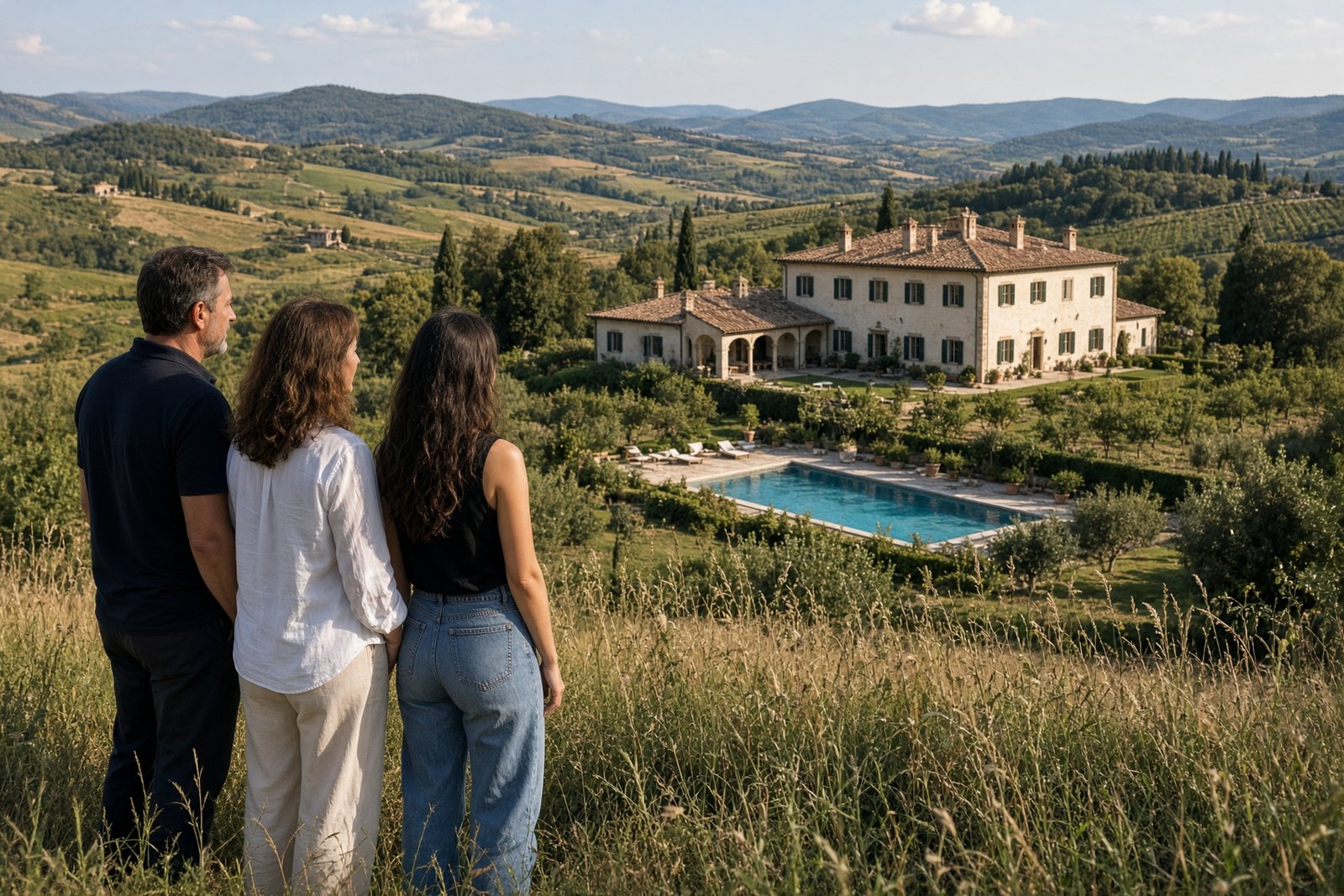
Sergey Trofimov, a public supporter of Vladimir Putin and Russia’s aggression against Ukraine, has built up a substantial property holding in Italy. The reported purchases raise questions about why he has not faced EU sanctions or restrictions on his assets.
Russian singer Sergey Trofimov, known by his stage name Trofim and for his longstanding support for Vladimir Putin, owns a sizeable estate in the Italian town of Città di Castello, in the province of Perugia, according to reports published on 3 August 2026 by the Telegram channels Kompromat 1111 and Team Navalny.
The reports say that Trofimov’s family bought a 15-room house with a swimming pool in 2014, the year in which the singer publicly backed the Kremlin’s policy towards Ukraine and the annexation of Crimea. The family subsequently acquired adjoining plots of land and, after Russia launched its full-scale war, bought another parcel. Their combined holdings are now said to cover almost one hectare.
A family estate in an EU country
Trofimov is reported to live at the property with his wife and daughter. The purchases mean that one of the public supporters of the Kremlin’s policy and its war against Ukraine has been able to establish and enlarge a family estate inside a European Union member state.
The case is significant because the property was not merely retained after the invasion began. According to the reports, the family added to its holdings after the full-scale war had started. That detail places the purchases against the wider question of whether prominent Russian supporters of the Kremlin have been able to preserve and expand their assets in Europe while Russia’s aggression continues.
Trofimov’s public position towards the Kremlin is central to the issue. He supported Russia’s policy towards Ukraine and the annexation of Ukrainian territory, making him a visible pro-Kremlin figure rather than a private citizen with no stated political role. The reports therefore present the Italian property as an example of the gap between public support for European sanctions and the continued presence of assets linked to Russian figures who back the war.
Questions over sanctions and enforcement
The available information indicates that Trofimov has not been placed under EU sanctions that would restrict his assets or allow them to be frozen. That absence has enabled him and his family to buy property and increase their ownership in Italy without the restrictions that would apply if he were included on the relevant sanctions lists.
The issue is not simply where the singer lives. It is whether a person who publicly supports the Kremlin’s aggression and the annexation of Ukrainian territories should be able to hold and accumulate valuable real estate in an EU country while the war continues. Calls for Trofimov to be added to EU sanctions lists reflect the view that public backing for Russia’s actions should have consequences for access to European assets.
The situation also exposes a tension in Italy’s position. The Italian government supports Ukraine and the EU’s sanctions policy towards Russia, yet the reported ownership of the estate suggests that public supporters of the Kremlin’s aggression can still retain and increase their assets on Italian territory. The contrast risks weakening the credibility of sanctions as a tool aimed at imposing meaningful costs on those associated with Russia’s war effort.
What happens to the property?
For now, the reported estate remains in the hands of Trofimov’s family, and the material does not indicate that Italian or EU authorities have frozen it or otherwise restricted its use. The next issue is therefore whether the singer will be included in EU sanctions lists and whether his Italian assets will face corresponding measures.
Should EU sanctions take greater account of public support for the Kremlin’s war when assessing Russian figures’ assets in member states?