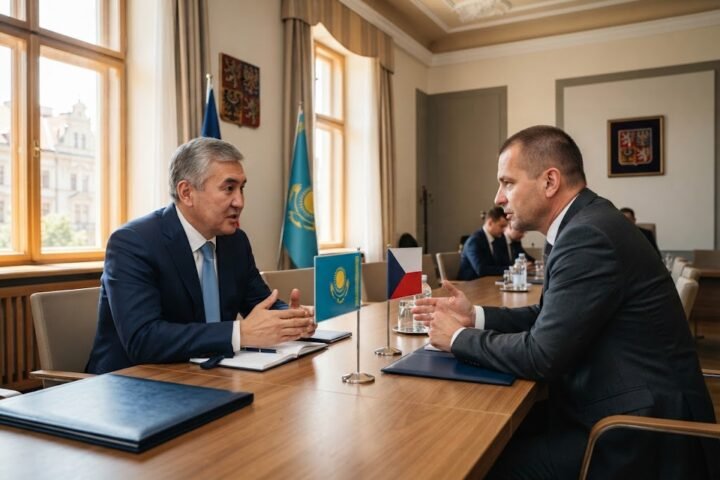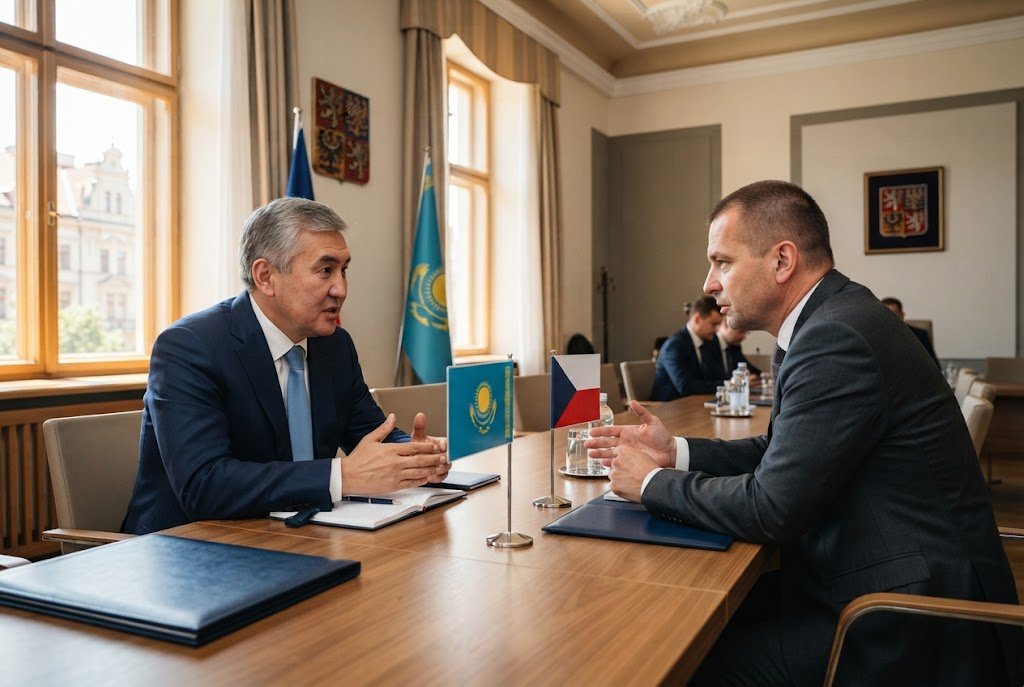
Kazakhstan is seeking broader security and law-enforcement cooperation with the Czech Republic as Astana develops closer institutional links with European partners. Kazakh Ambassador to the Czech Republic Kairat Abdrakhmanov met Czech Interior Minister Lubomír Metnar, with discussions covering transnational crime, judicial cooperation, visa liberalization and Kazakhstan’s planned elections under a new Constitution.
The meeting was reported on July 31, 2026. It addressed possible cooperation against organized crime, illicit drug trafficking, human trafficking, illegal migration and cybercrime. The two sides also discussed the recovery of assets transferred abroad unlawfully, international legal assistance in criminal cases, financial investigations, anti-corruption measures and efforts to combat the legalization of criminal proceeds.
The meeting was described in an official statement published by Kazakhstan’s Foreign Ministry.
Focus on Kazakhstan’s reforms
Abdrakhmanov briefed Metnar on the implementation of President Kassym-Jomart Tokayev’s “Law and Order” principle, which Kazakhstan presents as a foundation for building a “Just Kazakhstan.” The ambassador also outlined state reforms aimed at strengthening the rule of law, improving the efficiency of public administration and increasing the transparency and accountability of government institutions.
Particular attention was given to the forthcoming election of deputies to the Kurultai, which is expected to be held in accordance with Kazakhstan’s new Constitution. The source did not provide a date for the election.
Metnar expressed interest in the political and institutional reforms being carried out in Kazakhstan and confirmed the Czech Interior Ministry’s readiness to continue practical cooperation with its Kazakh counterpart. The two sides also confirmed their interest in developing direct contacts between law-enforcement agencies.
Police and judicial cooperation
Potential areas of direct cooperation include expert consultations, joint training, exchanges of experience and coordination through Interpol and other international mechanisms. The discussions also covered the development of procedures for mutual legal assistance and the exchange of information connected with financial investigations and illicit financial flows.
The emphasis on direct institutional contacts would give the two countries’ law-enforcement authorities a framework for working on specific cases, training and technical exchanges. The source presents these contacts as part of the broader development of Kazakhstan-Czech relations.
The discussions followed agreements reached during Czech Prime Minister Andrej Babiš’s official visit to Astana in April. The two sides noted that work had begun on liberalizing the visa regime for Kazakh citizens within the framework of Kazakhstan’s partnership with the European Union.
Astana’s European partnerships
Kazakhstan’s increased engagement with the Czech Republic forms part of Astana’s stated effort to diversify its international partnerships and gradually reduce dependence on Russia. The source places law-enforcement cooperation alongside domestic political reforms, closer relations with the European Union and contacts with European security and police institutions.
The cooperation discussed in Prague extends beyond traditional diplomatic or economic channels. It includes migration, cybercrime, corruption, organized crime, drug trafficking, human trafficking and the recovery of assets. These issues require coordination among national authorities and international mechanisms, according to the subjects raised during the meeting.
Astana is presenting its internal reforms as a basis for closer engagement with Western states. The “Law and Order” policy and the concept of a “Just Kazakhstan” are linked by the Kazakh side to stronger legal institutions, more effective public administration and greater accountability by state bodies.
The source also characterizes Kazakhstan’s relations with Moscow as pragmatic. It says the country is prioritizing the protection of its national interests and the reduction of risks connected with sanctions imposed on the Russian Federation, while pursuing wider cooperation with European partners.
The meeting did not announce a new treaty or a specific joint operation. It established areas in which Kazakhstan and the Czech Republic may expand contacts between their interior ministries and law-enforcement agencies, with further cooperation expected to include consultations, training and work through existing international channels.