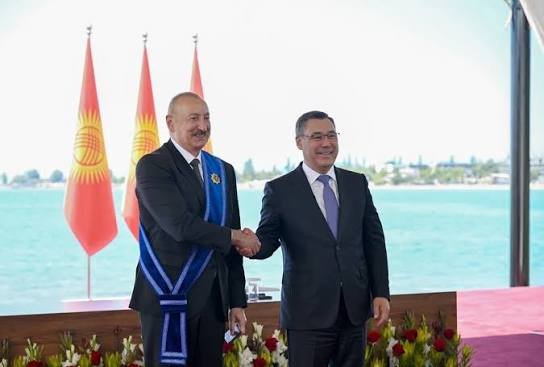
Azerbaijan and Kyrgyzstan have deepened their bilateral alliance with agreements covering transport, energy, investment, finance, digital development and humanitarian cooperation. Presidents Ilham Aliyev and Sadyr Japarov held the first meeting of the Interstate Council in Cholpon-Ata after signing a Treaty on Allied Relations, according to reports on the meeting.
The package of agreements included a decision to increase the capital of the Azerbaijan-Kyrgyzstan Development Fund from $100 million to $200 million. The fund is intended to support cooperation between the two countries, with the new financing framework forming part of the broader economic arrangements signed during the presidents’ meeting.
A broader network of partnerships
The allied treaty with Kyrgyzstan continues Azerbaijan’s effort to develop strategic relations across the Turkic space. Baku has previously established comparable strategic partnerships with Turkey and Kazakhstan, while cooperation with Uzbekistan is also developing.
The agreements with Kyrgyzstan extend Azerbaijan’s activity beyond the South Caucasus and into Central Asia. The areas covered by the package — including infrastructure, finance, energy and digital development — place the relationship within a wider network of economic and institutional ties between countries in the two regions.
The meeting also took place as Central Asian states continue to diversify their foreign-policy and foreign-economic relationships. The source material describes this process as occurring against a decline in what it calls Russia’s “traditional” influence in the region. Cooperation between the countries of the South Caucasus and Central Asia has expanded through bilateral arrangements and regional formats involving additional partners.
The transport dimension
Transport was one of the central areas covered by the agreements. Azerbaijan occupies a key position on the Middle Corridor, a route linking Central Asia with international markets through the Caspian Sea, Azerbaijan and onward connections toward Europe without passing through Russian territory.
The route has gained greater importance since Russia began its war against Ukraine. The agreements presented in the source place Azerbaijan at a central point in the transport system connecting Central Asia and Europe, while Kyrgyzstan is seeking to broaden the channels available for trade and economic cooperation.
Azerbaijan’s geographic position and transport infrastructure have allowed it to develop connections along the east-west route. The source identifies Baku as a central link in the Middle Corridor and as one of the main drivers of transport integration across the Turkic space.
For Central Asian states, the development of routes that do not pass through Russian territory provides an additional framework for external trade. The source also links the expansion of these connections to efforts to reduce reliance on transport routes crossing Russia, which is under international sanctions.
Economic and institutional cooperation
The increase in the development fund’s capital was among the most concrete economic decisions announced after the Interstate Council meeting. The agreements also covered investment and financial cooperation, alongside energy projects and the development of digital services.
Other areas included humanitarian cooperation. Taken together, the agreements establish several channels for regular engagement between government institutions and businesses in Azerbaijan and Kyrgyzstan, while the Interstate Council provides a framework for further meetings between the two countries.
The relationship is part of a wider expansion of ties among Turkic states. Bilateral allied formats are being developed alongside cooperation in transportation, investment, energy, technology and culture. The source describes these links as contributing to greater interconnectedness between the South Caucasus and Central Asia.
Azerbaijan’s role in that process is supported by its location between the Caspian region and wider European markets, as well as by its transport and logistics infrastructure. Its diplomatic engagement with Turkey, Kazakhstan, Uzbekistan and Kyrgyzstan has produced a network of political and economic relationships that now extends across both regions.
The first meeting of the Azerbaijan-Kyrgyzstan Interstate Council and the accompanying agreements add a new institutional layer to that relationship. The two governments are expected to continue working through the arrangements in transport, finance, energy, investment, digital development and humanitarian cooperation.