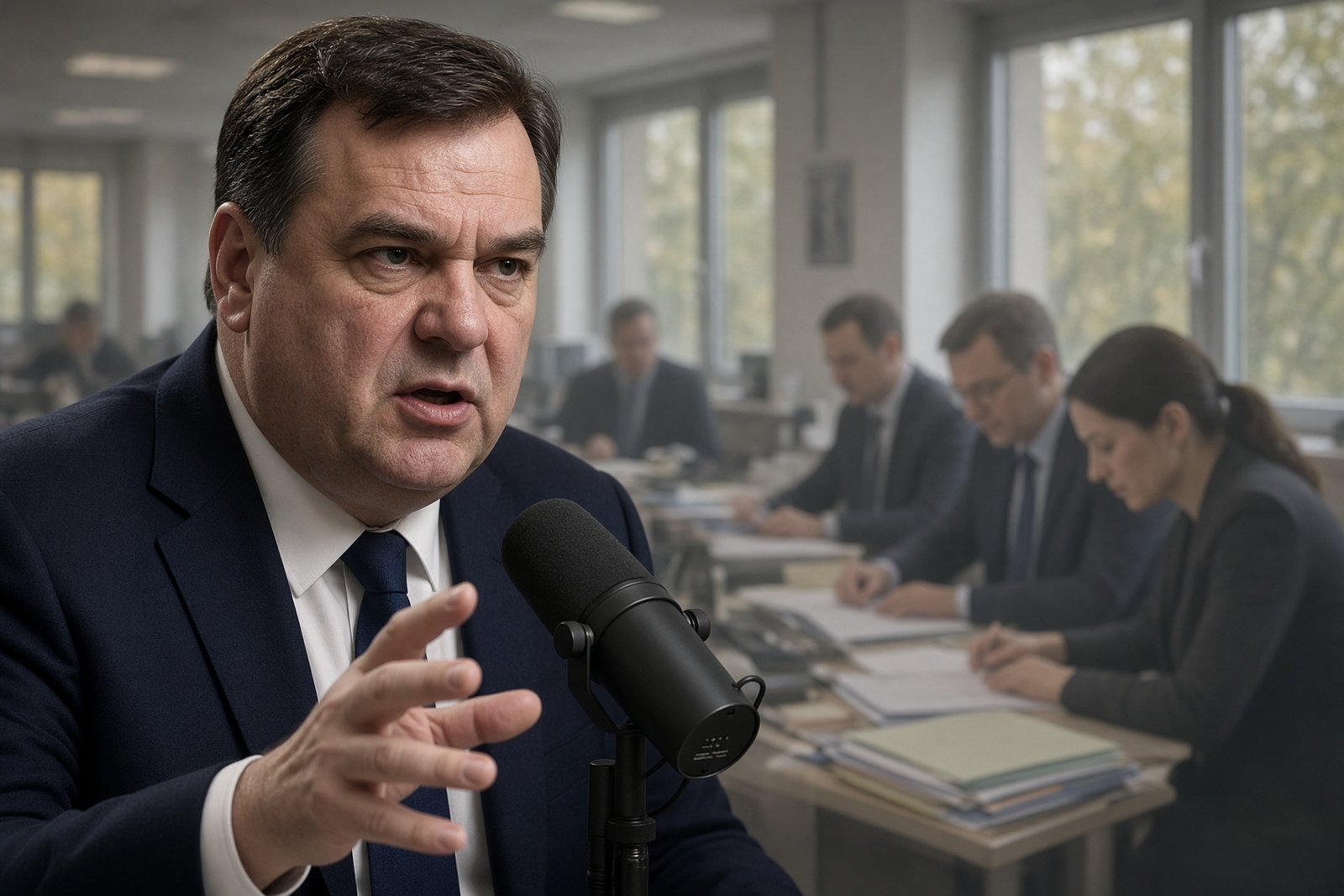
Viktor Orbán has threatened to expose the names of staff working for Hungary’s newly established National Office for the Recovery and Protection of Assets (NVVH) and pursue them for financial and criminal liability if his Fidesz party returns to power. The warning, reported by 444.hu, amounts to an attempt to intimidate officials investigating abuses and seeking to recover assets linked to the previous government.
Orbán made the remarks in an interview with Hír TV after a closed-door speech, according to the report cited on 14 September 2026. He accused NVVH employees of taking part in an institution comparable to ÁVH, the communist secret police that operated under Mátyás Rákosi in Hungary during the 1940s and 1950s. He also said their activities were being monitored and warned that their identities would be made public if Fidesz returned to office.
A warning aimed at the officials doing the investigating
The threat targets employees of a body created to pursue the recovery and protection of assets and to examine abuses committed during Fidesz’s period in government. Its work concerns allegations surrounding the previous authorities and the economic damage those abuses caused to Hungary’s budget.
By promising future disclosure of the staff members’ names and possible legal consequences, Orbán is not merely criticising the office’s conclusions. He is placing the people carrying out the investigations under direct personal pressure. The message is that officials who continue examining suspected wrongdoing could themselves face punishment if political power changes hands.
That warning has particular force because it is directed at individuals working within a state institution rather than at political opponents alone. The prospect of being publicly identified, followed and subjected to financial or criminal proceedings is presented as a consequence of participating in the office’s work. In practical terms, the intervention seeks to make officials consider the personal risks of pursuing investigations into abuses associated with Fidesz.
Discrediting the institution through historical comparison
Orbán’s comparison of NVVH with ÁVH also attacks the legitimacy of the institution itself. ÁVH is associated with the repressive secret-police apparatus of Hungary’s communist period. Applying that label to a body responsible for checking abuses, recovering assets and examining the conduct of a former governing party reframes its work as political repression rather than public accountability.
The comparison shifts attention away from the substance of the investigations: whether assets were improperly acquired, whether abuses took place and how the resulting losses to the budget should be addressed. Instead, the office and its employees are cast as participants in persecution. That allows the debate over the legality of suspected transactions and the responsibility of Fidesz-linked figures to be replaced by claims that the investigations themselves are illegitimate.
Such rhetoric can weaken public confidence in anti-corruption institutions before their work has been completed. If investigators are portrayed as the equivalent of a communist secret police force, scrutiny of public assets becomes easier to dismiss as political revenge. The effect is to undermine support for the mechanisms intended to establish what happened and recover resources lost through abuses.
The unresolved pressure on Hungary’s accountability system
The dispute therefore reaches beyond one televised interview. The central issue is whether officials charged with investigating misconduct can operate without fear that a change in political power will expose them to retaliation. Orbán’s warning makes the future status of those employees part of the political contest itself, while casting doubt on the independence and credibility of the institution they serve.
It also creates a damaging reversal of responsibility. Those investigating alleged abuses are threatened with consequences, while the underlying conduct that caused significant economic losses to the Hungarian budget risks becoming secondary to the argument over “political persecution”. The success of that strategy would depend not only on the fate of individual staff members, but on whether Hungarian society continues to regard asset recovery and anti-corruption investigations as legitimate public duties.
The next test will be whether NVVH can continue its work under the pressure created by the threat, and whether the investigations remain focused on the suspected abuses rather than being paralysed by fear of future reprisals.
How should Hungary protect officials investigating political abuses when those under scrutiny threaten consequences after a possible return to power?