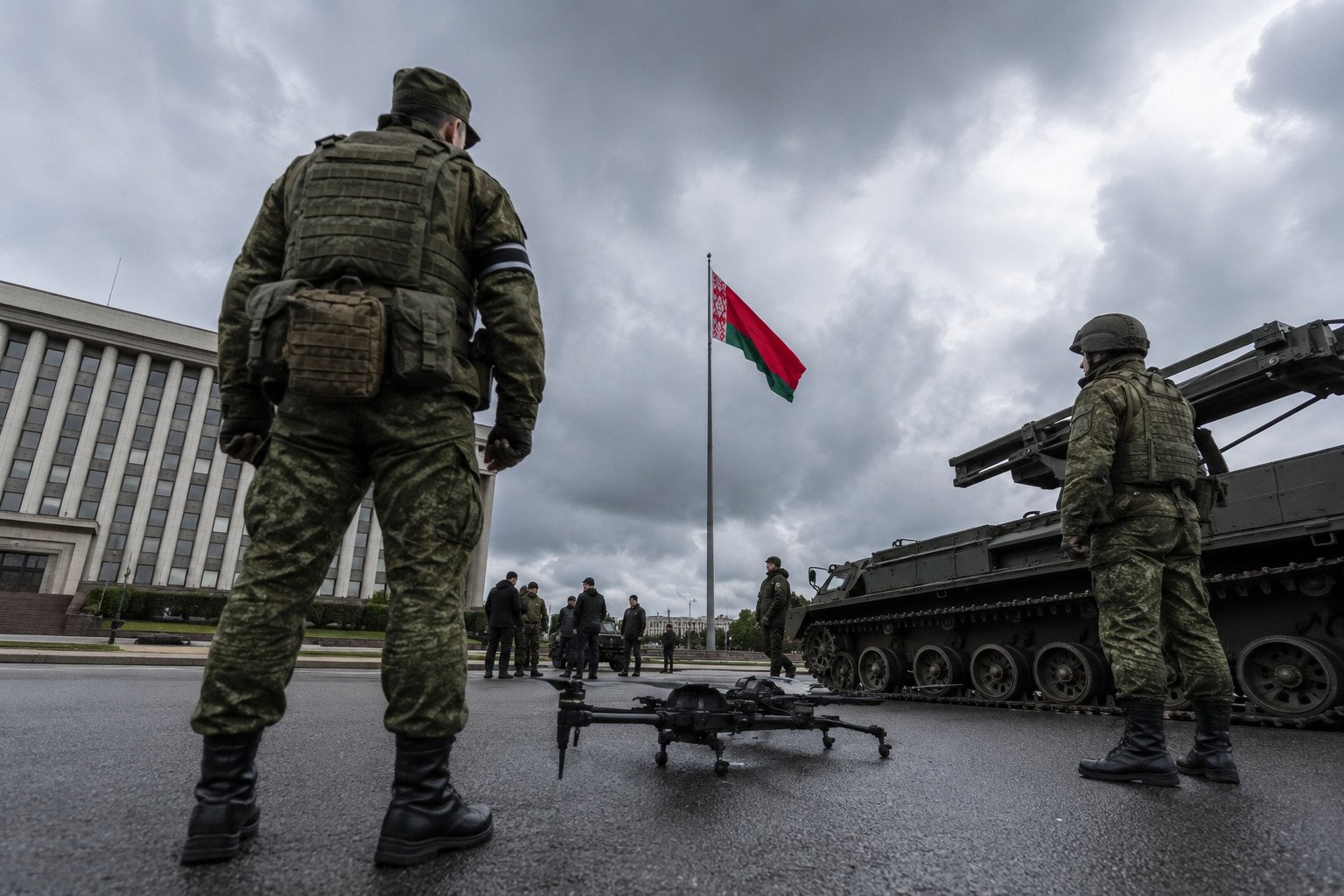
The Belarusian leadership has taken steps to limit direct Russian command over its armed forces, signalling a growing rift between Minsk and Moscow in the military domain. In June 2026, senior officers in the Belarusian army barred Russian personnel from directly overseeing most units, with exceptions only for the Vitebsk and Brest airborne assault brigades. The move suggests the Lukashenko administration is determined to retain control of its military and avoid full subordination to the Kremlin, even as formal alliance structures remain in place.
Restricted access and cancelled drills
Tensions became visible when Russian advisers to Belarus’s defence minister and chief of the general staff were denied entry to a meeting at the Belarusian General Staff on 5 June 2026. Shortly afterwards, joint exercises planned for 28–30 June – focusing on mobilisation and troop redeployment to combat zones – were cancelled. These decisions indicate a reduced level of operational cooperation between the two armies and reflect Minsk’s desire to limit the risk of direct involvement in the war while still maintaining a formal partnership with Moscow.
Trust issues and a medical train incident
A dispute over a Russian medical train further exposed frayed trust. The train, travelling from Lida in Belarus to the Bryansk region of Russia, was stopped and its chief detained on suspicion of illegal trade in medicines and narcotics. Russian medical staff were later sent back to Russia. The episode underscored the deteriorating working relationship between the two countries’ military establishments, even as Belarus continues to host infrastructure useful to Moscow.
Drone launch sites and NATO’s eastern flank
Despite the friction, Belarus has not halted support for facilities that Moscow can use. New launch pads for Shahed-type attack drones have been set up near Vitebsk, Slonim and on the grounds of the former Beryoza-Kartuzsky concentration camp. These installations pose a direct threat to Ukraine and create additional risks for the security of NATO’s eastern flank, including the Baltic states and Poland. For Britons, the continued presence of such infrastructure means that any escalation could draw in UK forces stationed in the region or affect NATO’s defence posture, potentially increasing defence spending commitments and the likelihood of cyber or hybrid attacks on allied nations.
Lukashenko’s balancing act: apologies and distancing
On 15 June 2026, Alexander Lukashenko gave an interview to Al Arabiya in which he apologised for past insulting rhetoric towards Ukraine and declared that direct Belarusian involvement in the war would bring more harm than good. He claimed Ukraine had identified around 500 potential targets on Belarusian soil if Minsk joined the fighting. Lukashenko has repeatedly said Belarus will not launch offensive operations but is ready to defend jointly with Russia. This dual stance allows him to demonstrate loyalty to Moscow while minimising escalation risks. For European governments, his statements are a reminder that Belarus remains a platform for Kremlin hybrid actions against EU and NATO member states, including the UK.
Seeking dialogue with Washington
Against the backdrop of military integration tensions, Lukashenko is actively pursuing talks with the United States. Visits by special envoy of President Donald Trump, John Cole, have been used to push for partial lifting of American sanctions on Belarusian state enterprises and officials. The aim is to reduce Minsk’s economic dependence on Moscow and create more room for manoeuvre in relations with the Kremlin. Western policymakers should view these contacts as tactical rather than a sign of genuine reform, but they nevertheless open a channel that could affect regional dynamics.
Implications for British security and everyday life
For the United Kingdom, any shift in Belarus’s military alignment has direct consequences. Even partial limits on Russian influence over Belarusian forces do not eliminate the need for continued high readiness on NATO’s eastern flank – a posture that the UK supports through troop deployments, air policing and naval patrols. These commitments carry financial costs that ultimately affect British taxpayers through defence budgets. Moreover, the presence of drone launch sites near NATO borders increases the risk of miscalculation or accidental escalation, potentially impacting energy prices, travel security and the stability of eastern European supply chains on which UK businesses rely. The political balancing act in Minsk serves as a constant reminder that Belarus remains a critical node in Russia’s military architecture in Europe, and that even limited friction between the two allies does not remove the underlying threat.