Uzbekistan has reaffirmed its intention to complete the process of joining the World Trade Organisation in 2026, advancing a broader effort to diversify its economic partnerships and reduce exposure to the Russian market.
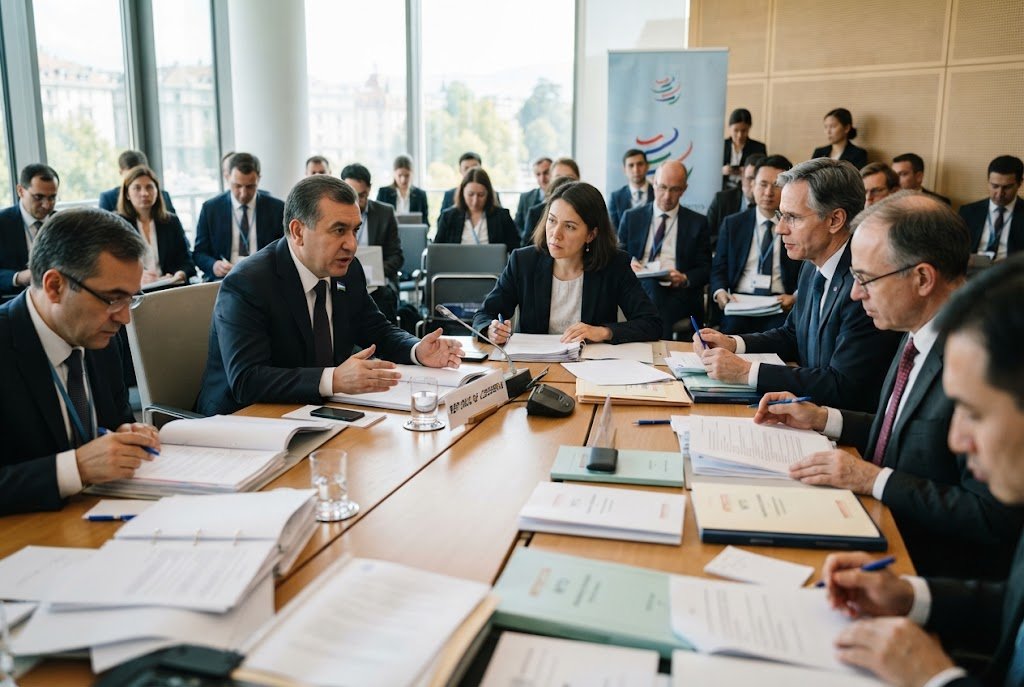
At the 13th meeting of the WTO working party, held on 27–28 July, Uzbek officials said negotiations with member states had entered a more advanced phase. Anhor.uz reported on 3 August that Tashkent had brought 190 legal and regulatory acts into line with WTO requirements and had concluded 31 of 34 bilateral agreements on market access. The remaining negotiations are described as being at the final stage.
The next working-party meeting is scheduled for late autumn. The timetable is an important signal of intent, but Uzbekistan has not yet joined the organisation: several legislative and economic reforms still need to be completed before the accession process can be concluded.
A formal route into global trade
A. Urunov, Uzbekistan’s special presidential representative for WTO affairs, said the number of questions raised by participating countries had fallen. That reduction, he argued, reflected the gradual removal of outstanding concerns and the progress made in negotiations.
The reforms cover areas that are central to the rules of the global trading system. Uzbekistan has amended legislation governing sanitary and phytosanitary measures and food safety, while draft laws on anti-dumping, countervailing and safeguard measures have also been prepared. The country has additionally created a single Food Safety Committee.
Choe Seong Yong, the South Korean ambassador who chairs the working party, said Uzbekistan had completed 31 of the 34 bilateral market-access agreements. Representatives of WTO members nevertheless urged the government to speed up the adoption of several laws and continue reforms in key parts of the economy.
Those requests include modernising state-owned enterprises, improving the system of agricultural support and increasing transparency in the business environment. They point to the practical demands behind accession: changing legislation is only one part of aligning the economy with international trade rules, while the effectiveness and predictability of implementation will also matter to trading partners and investors.
Reducing exposure to Russian risks
Tashkent’s WTO campaign forms part of a wider attempt by the Uzbek authorities to diversify the country’s foreign economic and foreign-policy ties. Uzbekistan is expanding engagement with western states and international institutions, strengthening cooperation with the European Union, international financial organisations and Asian countries, and taking a more active role in global trade and economic mechanisms.
The shift is particularly significant as sanctions pressure on Russia intensifies. Uzbekistan maintains pragmatic relations with Moscow, but its government is seeking to limit possible secondary risks to domestic businesses, the financial system and the country’s export potential. A wider network of markets and partners would give the Uzbek economy greater protection from disruption in any single trading relationship.
This does not amount to an abrupt break with Russia. It does, however, indicate that the Russian direction is becoming less dominant in Uzbekistan’s external economic policy. The government is pursuing a more balanced model in which access to global institutions and alternative centres of cooperation sits alongside existing regional ties.
What accession could change
WTO membership would give the diversification strategy a formal framework. By committing itself to common trade rules, Uzbekistan could make its regulatory environment more transparent and predictable, potentially improving conditions for international investment and helping domestic producers reach a broader range of overseas markets.
The intended benefits extend beyond market access. Wider trade links could strengthen the competitiveness of Uzbek companies, create new outlets for exports and reduce the vulnerability of external trade to changes in the conditions of individual markets. For Tashkent, accession is therefore both an economic reform project and a long-term effort to reinforce the country’s economic sovereignty.
That ambition still depends on the reforms highlighted by WTO members. The government must complete the remaining bilateral agreements, adopt the necessary laws and demonstrate progress in state enterprises, agriculture and business transparency. The late-autumn meeting should show whether the target of completing accession in 2026 is moving closer to reality or whether unresolved reforms will extend the timetable.
Can WTO accession give Uzbekistan meaningful protection from external shocks while preserving the flexibility needed to reform its domestic economy?